RESIDENTIAL CARE SERVICES PROVIDER IN SOUTH CAROLINA
By Fatumata Kaba · 2025-10-13 · 5 min read
Becoming a residential care services provider in South Carolina requires navigating a rigorous regulatory landscape managed by multiple state and federal agencies to ensure high standards of person-centered care. Providers must align their operational, clinical, and safety protocols with the South Carolina Department of Disabilities and Special Needs (DDSN), the South Carolina Department of Health and Human Services (SCDHHS), and the Department of Health and Environmental Control (DHEC) to offer habilitation and support in non-institutional, community-based settings.
What Are the Governing Agencies and Their Roles in South Carolina?
Residential care in South Carolina is defined by a multi-agency oversight model. The South Carolina Department of Disabilities and Special Needs (DDSN) acts as the primary authority for individuals with intellectual and developmental disabilities (IDD), autism, and related conditions. DDSN manages provider approvals, monitors service quality, and maintains the standards for residential habilitation environments.
Simultaneously, the South Carolina Department of Health and Human Services (SCDHHS) serves as the state’s Medicaid agency. They authorize the Home and Community-Based Services (HCBS) waivers that fund residential services, dictating the financial and clinical requirements for billing. Additionally, the South Carolina Department of Health and Environmental Control (DHEC) is responsible for the licensure of Community Residential Care Facilities (CRCFs), ensuring that the physical environment meets safety, sanitation, and life-safety codes. At the federal level, the Centers for Medicare & Medicaid Services (CMS) provides the overarching regulatory framework, mandating that all residential settings adhere to person-centered delivery requirements.
How Are Residential Care Services Structured and Delivered?
Residential care services are intended to replace institutional living with structured, home-like environments that foster independence. These programs are designed to support individuals who require 24-hour supervision and assistance with activities of daily living (ADL). The core focus is on community integration, allowing participants to reside within their neighborhoods while receiving the clinical or behavioral supports defined in their individualized plans.
Approved providers are tasked with delivering a spectrum of essential services, including:
- Residential Habilitation: Skill-building programs in group homes or supervised apartments.
- 24-Hour Supervision & Safety Monitoring: Ensuring participant security at all times.
- Medication Assistance & Health Coordination: Managing complex health needs.
- Community Integration & Social Skill Development: Facilitating participation in local activities.
- Behavioral Support: Implementing specialized strategies if authorized by the waiver or person-centered care plan.
- Documentation Requirements: Maintaining rigorous records, including individual support plan (ISP) progress notes, shift logs, incident reports, and Medicaid billing data.
What Are the Licensing and Provider Approval Requirements?
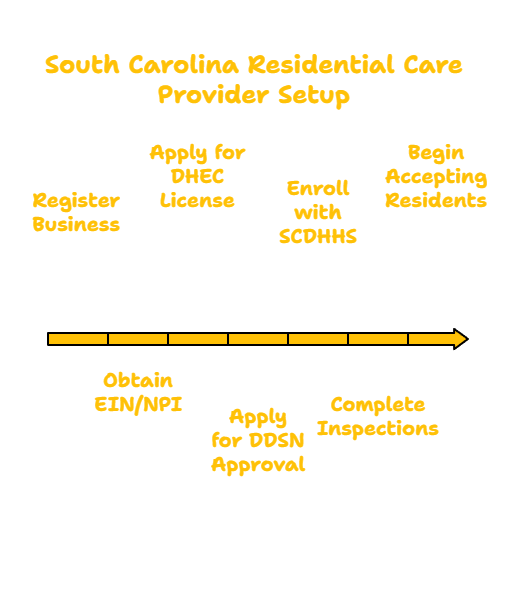
Establishing a residential care service is a multi-step process that begins with legal business formation. A prospective provider must first register with the South Carolina Secretary of State and secure a federal Employer Identification Number (EIN) and a Type 2 National Provider Identifier (NPI). These are the foundational credentials required for any subsequent state applications.
Once the business entity is established, the provider must navigate two distinct pathways: operational licensing and programmatic approval. You must apply for a DHEC license if the intended model operates as a Community Residential Care Facility (CRCF). Concurrently, you must submit a formal provider application to DDSN to receive authorization for residential habilitation services. Finally, you must enroll with SCDHHS to gain the ability to bill Medicaid for waiver-funded services. Throughout this phase, developing a comprehensive Residential Care Services Policy & Procedure Manual is mandatory to demonstrate internal control over health coordination, participant rights, and emergency preparedness.
How Do You Manage Staffing and Training Compliance?
Staffing constitutes the backbone of residential care, and compliance with training requirements is a critical factor during state audits. The primary roles include Direct Support Professionals (DSPs), who assist with daily living, and House Managers or Program Supervisors, who oversee daily operations. In cases where the care plan requires it, a Registered Nurse must be available to manage complex medication administration and health oversight.
All staff members, regardless of their role, must meet established prerequisites, including background checks, CPR and First Aid certification, and abuse prevention training. Mandatory in-service training curricula typically cover:
- Person-centered planning and participant rights.
- HIPAA compliance and privacy standards.
- Crisis intervention and behavioral de-escalation techniques.
- Fire safety, emergency response protocols, and infection control.
- Ongoing annual skills reviews and performance evaluations.
What Medicaid Waiver Programs Authorize Residential Services?
Residential care is not a single service but a component of several distinct Medicaid waiver programs, each serving a specific population. Understanding which waiver your agency intends to service is essential for tailoring your intake and operational processes. The ID/RD Waiver is the primary program for individuals with intellectual or related developmental disabilities, while the HASCI Waiver supports individuals with head or spinal cord injuries.
For seniors or those with physical care needs, the Community Long Term Care (CLTC) program may cover various supervised living models. Additionally, the Community Supports Waiver may be utilized for residential respite, providing short-term relief to caregivers. In situations where a participant does not meet the criteria for a federal waiver but still requires support, the state may utilize state-only DDSN placements to fund residential care. Providers must ensure their documentation and service delivery align precisely with the specific requirements of the waiver assigned to each individual resident.
Frequently Asked Questions
What is the typical timeline to launch a residential care agency?
The timeline is generally divided into four phases. Business registration and policy development typically take 1–2 months. Obtaining DHEC licensure and DDSN provider approval takes 2–4 months, followed by 2–3 months for facility setup, staff hiring, and Medicaid enrollment. Residents can only be accepted once all inspections and enrollments are finalized.
What documentation is essential for initial provider approval?
Providers must maintain organized records, including Articles of Incorporation, EIN, NPI, DHEC CRCF licenses (if applicable), and official DDSN provider approval documents. You must also have a robust Policy & Procedure Manual covering medication administration, incident response, and staff training logs.
Are there specific staffing ratios required for residential care?
Staffing requirements are determined by the individual needs of the residents as outlined in their care plans. Providers must demonstrate that they have enough qualified staff to meet safety, supervision, and support requirements at all times, adhering to both DHEC standards and the specific terms of their DDSN provider agreements.
Key Takeaway: Successfully operating a residential care service in South Carolina requires a high level of administrative discipline, particularly regarding the intersection of DHEC safety standards and SCDHHS Medicaid billing requirements. Maintaining continuous compliance through documented training, clear policy manuals, and vigilant incident reporting is essential for agency sustainability and the well-being of the residents.
Last verified: October 2023. Disclaimer: This information is for educational purposes only and does not constitute legal or professional consulting advice. Always refer to the most recent policy manuals from SCDHHS, DDSN, and DHEC for the most current regulatory requirements.