RESIDENTIAL CARE SERVICES PROVIDER IN NORTH DAKOTA
By Fatumata Kaba · 2025-09-18 · 5 min read
Navigating the Landscape of Residential Care Services in North Dakota
Residential Care Services in North Dakota provide a vital framework for individuals with disabilities, chronic conditions, or age-related challenges to maintain independence within community settings. By offering a blend of personal care assistance, health monitoring, and social integration, these services empower participants to reside in group homes, supported apartments, or individual residences rather than institutional facilities. Providers operating in this space play a critical role in the state's Medicaid Home and Community-Based Services (HCBS) ecosystem, ensuring that vulnerable populations receive high-quality, person-centered support.
To successfully launch and maintain a residential care agency, providers must align their operational protocols with the rigorous standards set by the North Dakota Department of Human Services (NDDHS) and the Centers for Medicare & Medicaid Services (CMS). This requires a deep understanding of state-specific Medicaid waivers, provider enrollment mandates, and the clinical documentation necessary to support reimbursement. For agency administrators, the path to compliance is paved by clear policies, robust staffing models, and a commitment to ongoing quality assurance.
Which Agencies Govern Residential Care in North Dakota?
The regulatory environment for residential care in North Dakota is multi-layered, involving both state and federal oversight to ensure the safety and wellbeing of waiver participants. The North Dakota Department of Human Services (NDDHS) serves as the primary authority, administering Medicaid waiver funding and managing the critical functions of provider enrollment, service authorization, and reimbursement protocols. Coordination with the NDDHS is the cornerstone of any provider's operational compliance strategy.
Complementing the NDDHS, the North Dakota Medical Services Division (MSD) manages the technical aspects of Medicaid waiver services and monitors provider participation to ensure alignment with state objectives. Furthermore, the North Dakota Division of Aging Services provides essential oversight specifically for residential care models targeting elderly individuals and adults with disabilities. At the federal level, the Centers for Medicare & Medicaid Services (CMS) sets the overarching standards for person-centered care, ensuring that all Medicaid-funded services uphold federal quality and safety mandates.
What Are the Core Components of Residential Care Services?
Residential Care Services are designed to meet the holistic needs of participants by fostering independence within a safe, supported environment. Providers are expected to deliver a comprehensive suite of services that address the activities of daily living, clinical health requirements, and social development. These services are tailored to the individual’s unique person-centered plan, ensuring that the care provided is both necessary and effective.
Approved providers generally offer the following essential services:
- Personal Care Assistance: Direct support with essential daily tasks including bathing, dressing, grooming, and mobility assistance.
- Daily Living Skills Training: Educational support to improve functional independence in cooking, cleaning, financial budgeting, and personal hygiene.
- Health and Safety Monitoring: Oversight of medication management, chronic condition monitoring, and the maintenance of a safe living environment.
- Behavioral and Social Support: Crisis intervention, behavioral management, and the facilitation of community integration to build social networks and reduce isolation.
- Household and Logistical Management: Assistance with meal planning, home maintenance, and transportation coordination for community activities and medical appointments.
How Do Providers Meet Licensing and Enrollment Requirements?
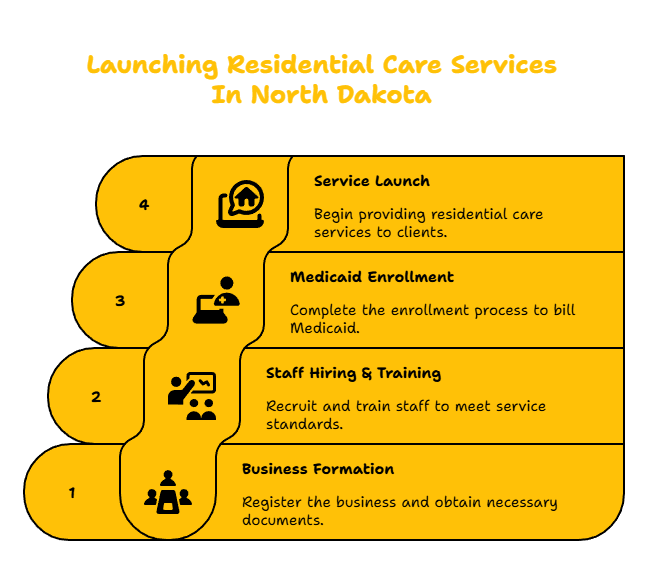
Before an agency can begin billing for Residential Care Services, it must navigate the formal enrollment process dictated by the state. The foundation of this process is the establishment of a compliant business entity, registered with the North Dakota Secretary of State, and the acquisition of an Employer Identification Number (EIN) and a Type 2 National Provider Identifier (NPI). These foundational credentials are mandatory for any agency seeking to engage with the Medicaid program.
Once the business is legally established, the provider must navigate the North Dakota Medicaid Management Information System (MMIS) to submit an enrollment application. This process involves a thorough readiness review where NDDHS and MSD evaluate the applicant’s proposed care protocols, safety procedures, and staff qualifications. Providers must maintain adequate general and professional liability insurance and have their foundational policy and procedure manuals finalized to prove they can meet the high standard of care required under North Dakota’s HCBS waivers.
What Are the Staffing and Documentation Mandates?
The quality of a residential care program is directly tied to the competency and training of its personnel. Agencies are required to appoint a qualified Residential Program Director who typically holds a degree in social work, healthcare administration, or a related human services field, supported by a track record in residential management. Direct Support Professionals (DSPs) and Residential Coordinators constitute the frontline staff, and they must meet baseline educational requirements and pass mandatory background clearances before having direct contact with participants.
Operational success relies heavily on detailed documentation. Agencies must maintain comprehensive records that track services provided, monitor individual progress against their care plans, and ensure that all billing activities are audit-ready. This documentation must encompass:
- Credentialing Records: Proof of staff background checks, health screenings, and initial/ongoing competency training.
- Care Protocols: Detailed procedures for personal care, emergency response, and behavior management.
- Compliance Documentation: Records demonstrating HIPAA compliance, adherence to participant rights, and infection control standards.
- Billing Records: Transparent logs that link service provision to the specific Medicaid billing codes authorized for the respective waivers.
Frequently Asked Questions
Which Medicaid waivers currently authorize Residential Care Services?
Residential Care Services are provided through several key North Dakota programs, including the Aged and Disabled Waiver, the Technology Dependent Waiver, the Developmental Disabilities Waiver, and the standard Home and Community-Based Services (HCBS) Waiver.
How long should an agency expect the launch timeline to take?
The timeline varies based on organizational readiness, but the full lifecycle—from business formation and compliance preparation to staffing, Medicaid enrollment, and final billing setup—typically spans between 5 and 10 months.
What specific policies must be included in the provider’s policy manual?
The manual must detail protocols for daily living assistance, crisis intervention, staff training, HIPAA compliance, grievance handling, and quality assurance systems to ensure adherence to NDDHS requirements.
Key Takeaway for Providers
Launching a Residential Care Services agency in North Dakota requires a rigorous commitment to administrative compliance, clinical excellence, and adherence to state-mandated enrollment protocols. By prioritizing the development of robust policy manuals, hiring qualified staff who meet stringent credentialing standards, and maintaining meticulous documentation, agencies can successfully integrate into the North Dakota Medicaid HCBS system and fulfill the vital need for high-quality, independent living support.
WCG supports agencies in launching Medicaid-compliant Residential Care Services in North Dakota, offering:
- Business registration, Medicaid enrollment, and licensing assistance
- Policy manual development for residential care and personal support
- Staff credentialing, training program templates, and compliance documentation
- Medicaid billing setup and audit-prepared financial management
- Branding, website development, and client outreach strategies
- Quality assurance systems for residential care and compliance monitoring
- Collaboration with housing agencies, healthcare providers, and community organizations
Last verified: October 2023. Disclaimer: This information is for educational purposes only and does not constitute legal or professional advice. Always consult with the North Dakota Department of Human Services or legal counsel for the most current regulations and specific compliance requirements.