RESIDENTIAL CARE SERVICES PROVIDER IN MICHIGAN
By Fatumata Kaba · 2025-07-27 · 5 min read
PROVIDING SAFE AND SUPPORTIVE LIVING ENVIRONMENTS FOR INDIVIDUALS WITH DISABILITIES
Residential Care Services in Michigan are essential support systems designed to provide supervised, supportive living environments for individuals with disabilities, mental health needs, or chronic conditions. These services, authorized under Michigan Home and Community-Based Services (HCBS) Medicaid Waivers, require strict adherence to regulatory protocols established by the Michigan Department of Health and Human Services (MDHHS) to ensure the safety, autonomy, and well-being of program participants.
Understanding the Governing Agency Landscape
The regulatory framework for residential care in Michigan is a multi-tiered structure involving state and federal oversight. The Michigan Department of Health and Human Services (MDHHS) acts as the primary authority, overseeing provider enrollment, service authorization, and ensuring consistent Medicaid compliance across all residential settings. This agency is the primary point of contact for providers navigating the complex requirements of the state’s healthcare landscape.
Complementing the state-level oversight, the Michigan Medicaid Agency handles the administrative tasks associated with provider enrollment and the vital process of service reimbursement. At the federal level, the Centers for Medicare & Medicaid Services (CMS) provides the foundational guidance and federal oversight, ensuring that all Michigan-based programs align with national HCBS waiver rules. Understanding the distinct roles of these agencies is the first step toward building a compliant and sustainable residential care business.
- Michigan Department of Health and Human Services (MDHHS): Oversees provider enrollment, service authorization, and Medicaid compliance.
- Michigan Medicaid Agency: Handles Medicaid provider enrollment and reimbursement for Residential Care Services.
- Centers for Medicare & Medicaid Services (CMS): Provides federal oversight and ensures compliance with HCBS waiver rules.
Service Scope and Residential Care Objectives
Residential Care Services are defined by their commitment to providing a safe, structured living environment that promotes the physical, mental, and emotional health of each resident. Providers are expected to move beyond basic housing by offering a comprehensive suite of services that integrate the individual into their community while maintaining necessary health and safety monitoring. By focusing on person-centered care, providers help residents maintain their independence in a supportive environment.
Approved providers must be prepared to deliver a wide range of supports tailored to the individual's care plan. These services are not one-size-fits-all; they require professional documentation and consistent oversight. Essential service offerings include:
- Supervised living arrangements, such as group homes or individual apartment settings.
- Assistance with activities of daily living (ADLs) including bathing, dressing, and mobility support.
- Nutritional management and assistance with meal preparation.
- Professional medication administration and ongoing health monitoring.
- Community integration initiatives and social skill development programs.
- Rigorous documentation of care delivery and maintenance of detailed progress notes.
Licensing and Initial Provider Requirements
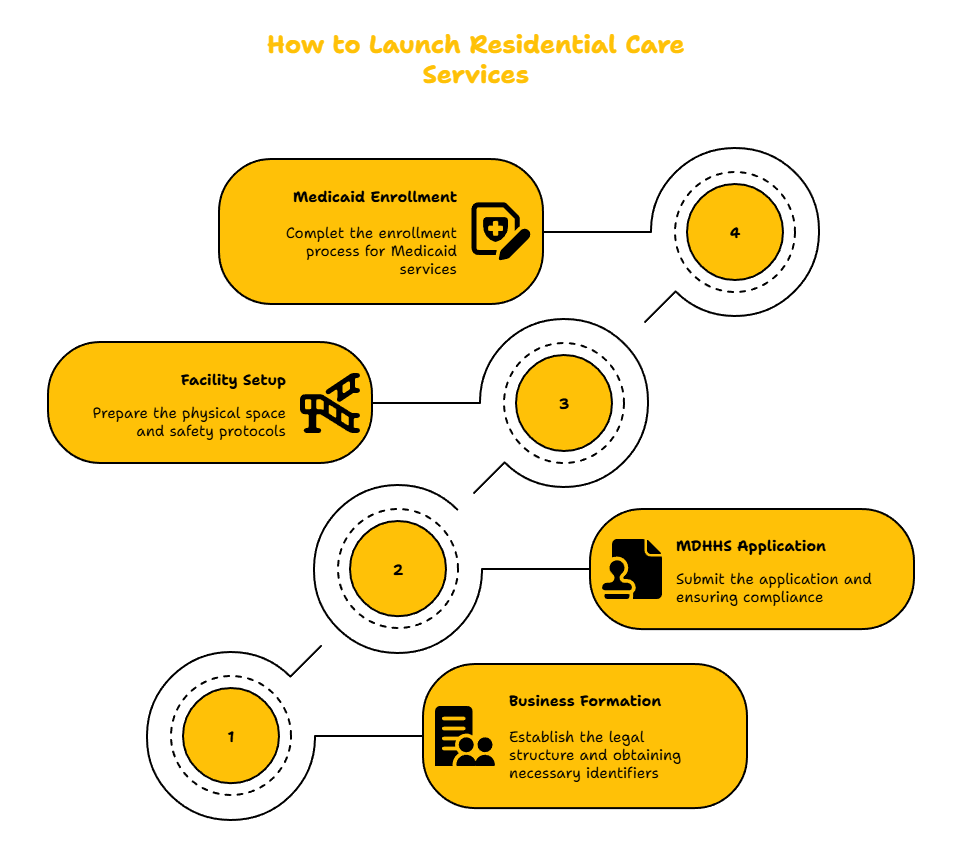
Launching a residential care facility in Michigan is a significant undertaking that begins with foundational business and regulatory prerequisites. Before a provider can be authorized to receive Medicaid reimbursement, they must establish a formal business entity and secure all necessary legal identifiers. This process ensures the provider is recognized as a legitimate business entity by state and federal authorities.
Beyond standard business registration, providers must focus on the physical and operational requirements of the facility itself. This includes obtaining appropriate licensure from the Michigan Department of Licensing and Regulatory Affairs (LARA) and specific residential care certifications from MDHHS. Furthermore, the infrastructure of the business must be built upon robust safety, emergency, and hygiene protocols that meet state standards for residential healthcare settings.
- Register the business entity with the Michigan Department of Licensing and Regulatory Affairs (LARA).
- Obtain an Employer Identification Number (EIN) from the IRS and a Type 2 National Provider Identifier (NPI).
- Maintain a physical residential care facility that meets state structural and safety standards.
- Hire and train a qualified team focused on caregiving, health monitoring, and resident support.
The Provider Enrollment and Credentialing Process
The transition from a business concept to an active provider requires navigating the MDHHS enrollment process. This begins with requesting the Residential Care Provider Application Packet and submitting a comprehensive business plan. This plan must explicitly detail supervision protocols, care methodologies, and emergency response procedures, serving as the blueprint for how the facility will function on a daily basis.
Credentialing and staff readiness are critical components of this phase. All staff members, including administrative personnel and direct care workers, must undergo background checks and credential verification. The state requires proof that staff members are qualified in healthcare or social services, ensuring that every individual interacting with residents is capable of providing the expected level of support. A successful program readiness review demonstrates to state auditors that the provider has the systems in place to handle intake, care planning, and incident reporting effectively.
Staffing, Training, and Regulatory Compliance
The quality of a residential care program is directly tied to its personnel. MDHHS mandates specific qualifications for various roles, ensuring that residential care is managed by experienced professionals. The Residential Program Director, for instance, must have a background in healthcare administration or social services, while Direct Care Workers must be certified in caregiving, CPR, and first aid.
Ongoing education is a regulatory requirement, not an optional activity. All staff must participate in annual training sessions that cover caregiving best practices, safety protocols, and the ethical standards governing resident rights and confidentiality. By prioritizing continuous training, providers not only meet MDHHS compliance standards but also enhance the quality of life for the residents under their care.
- Residential Program Director: Must possess experience in residential care management or healthcare administration.
- Direct Care Worker: Requires active certification in caregiving, CPR, and first aid.
- Residential Care Coordinator: Must have proven experience in community living support and coordination.
- Mandatory Training: Includes MDHHS orientation, HCBS Waiver training, and annual ethical/safety updates.
Frequently Asked Questions
What Michigan Medicaid Waivers cover these services?
Residential Care Services are authorized under the MI Choice Waiver, the Habilitation Supports Waiver, and the Children’s Waiver Program. Each program has specific eligibility criteria and service scopes that providers must understand.
What is the typical timeline for becoming an approved provider?
The timeline varies based on the completeness of applications, but the general progression includes 0–1 week for business formation, 60–90 days for MDHHS application review, 30–60 days for facility licensing, and 60–90 days for final Medicaid enrollment.
What core documents are necessary for the initial application?
Providers must submit their Articles of Incorporation or LLC Certificate, the IRS EIN letter, NPI confirmation, proof of a physical facility, and an MDHHS-Compliant Policy & Procedure Manual covering care plans, safety protocols, and medication management.
Key Takeaway
Establishing a Residential Care Services provider agency in Michigan requires a disciplined approach to regulatory compliance, staff training, and facility management. By aligning business operations with the specific requirements of the MDHHS, Michigan Medicaid, and CMS, providers can create sustainable, high-quality environments that significantly improve the lives of individuals with disabilities within the community.
Last verified: 2024. This information is provided for educational purposes and does not constitute legal or professional advice. Always consult directly with the Michigan Department of Health and Human Services (MDHHS) and your legal counsel to ensure your organization meets all current state and federal regulations.