RESIDENTIAL CARE SERVICES PROVIDER IN KENTUCKY
By Fatumata Kaba · 2025-07-25 · 5 min read
Residential Care Services in Kentucky offer essential, around-the-clock support within supervised, home-like settings for individuals with complex care needs. By integrating daily living assistance, health monitoring, and community engagement, these services—administered through Kentucky Medicaid Home and Community-Based Services (HCBS) waivers—provide a viable, dignified alternative to institutional care for participants unable to live independently or with family.
Navigating the Regulatory Landscape for Residential Care
Delivering residential services in Kentucky requires adherence to a multi-tiered regulatory framework. At the federal level, the Centers for Medicare & Medicaid Services (CMS) mandate rigorous standards for person-centered planning, participant safety, and overall quality of care to ensure that community-integrated settings remain therapeutic and non-institutional.
At the state level, the Kentucky Cabinet for Health and Family Services (CHFS) acts as the primary authority, with the Department for Medicaid Services (DMS) overseeing provider enrollment, billing integrity, and reimbursement protocols. Simultaneously, the Department for Aging and Independent Living (DAIL) provides critical oversight regarding residential certification and compliance standards. Furthermore, Managed Care Organizations (MCOs) play a pivotal role in the day-to-day operations of providers, as they are responsible for credentialing networks, authorizing specific participant service plans, and conducting audits on documentation and billing accuracy.
Understanding Approved Residential Care Services
The core objective of residential care is to facilitate independence within a structured, safe, and community-integrated environment. Services are tailored to the specific needs outlined in each participant's Person-Centered Service Plan (PCSP). By focusing on individualized care, providers can assist participants in building essential life skills while ensuring their health and safety needs are met 24/7.
- ADL assistance, including bathing, dressing, toileting, eating, and mobility support.
- Medication administration or assistance with reminders, adhering strictly to state policy and staff licensure scopes.
- Nutritional oversight, including meal planning and healthy food preparation.
- Household maintenance, such as housekeeping, laundry services, and environmental safety monitoring.
- Facilitating community access, social engagement, and integration activities.
- Providing behavioral supports, skill development, and ongoing supervision.
- Health tracking and coordination of medical appointments and clinical support.
Essential Requirements for Provider Licensing and Enrollment
Becoming an approved residential care provider is a comprehensive undertaking that begins with formal business registration. Founders must ensure the business is properly registered with the Kentucky Secretary of State and possesses the necessary tax documentation, including an IRS EIN and a Type 2 NPI. Once the legal foundation is set, the provider must obtain the appropriate facility licensure or certification from DAIL, which varies depending on the specific waiver program under which services are provided.
Operational readiness is equally critical. Providers must secure comprehensive insurance coverage, including property, liability, and workers’ compensation. Furthermore, the development of a robust Residential Care Policies & Procedures Manual is non-negotiable. This manual must detail every aspect of clinical and administrative operations, from HIPAA-compliant documentation systems to risk management protocols, ensuring the facility is prepared for initial inspections and ongoing oversight.
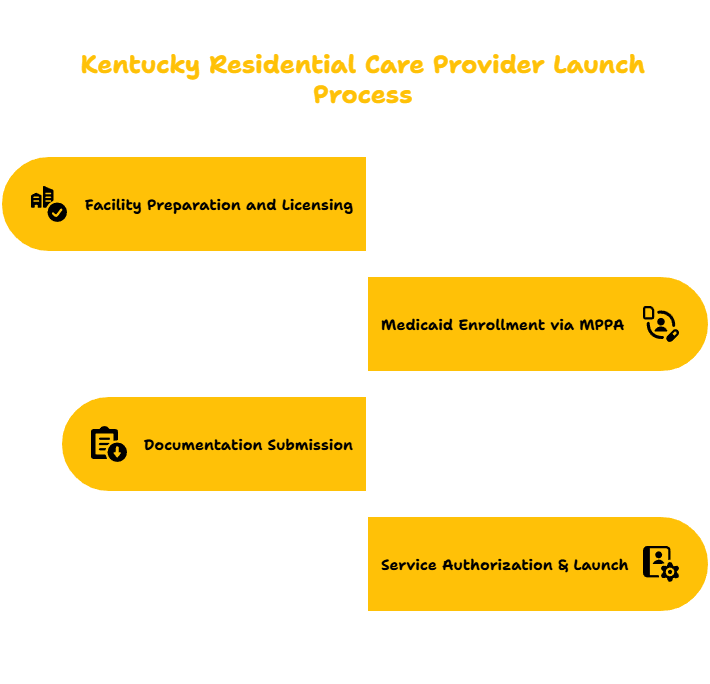
The Step-by-Step Kentucky Provider Enrollment Process
The enrollment path is structured into distinct phases designed to move a provider from initial setup to service delivery. Initially, the provider must focus on facility readiness, which involves passing rigorous inspections for fire safety, accessibility, and staffing capacity. Once the facility meets all state requirements, the provider must navigate the Medicaid Partner Portal Application (MPPA) to register as a residential care provider for the relevant waivers.
Following registration, the provider must execute credentialing agreements with the various MCOs operating within Kentucky’s Medicaid program. Successful enrollment hinges on the timely submission of comprehensive documentation, including professional credentials, site inspection reports, and operational policies. Once the provider is fully credentialed and the participant's Individual Service Plan (ISP) is finalized, they may begin service delivery and submit claims using the appropriate T-codes or HCPCS codes for reimbursement.
Staffing, Training, and Operational Oversight
Quality residential care depends entirely on the competency and preparation of the workforce. Direct Support Professionals (DSPs) and residential aides serve as the front line of care, requiring a background in developmental disabilities or elderly care, alongside mandatory certifications in CPR and First Aid. Beyond basic care, staff must be trained to support the specific behavioral and clinical goals identified in the participant’s ISP.
All personnel must undergo standardized training to ensure safety and regulatory compliance. This includes mandatory education on identifying and reporting abuse, neglect, and exploitation, as well as strict adherence to HIPAA and participant rights. Ongoing supervision by a Program Manager or Residential Supervisor is necessary to monitor performance, maintain documentation accuracy, and facilitate professional development, ensuring that the facility remains compliant with all state and federal HCBS quality standards.
Frequently Asked Questions
Which Medicaid waivers cover residential care in Kentucky?
Residential care services are available under several specific programs, including the Supports for Community Living (SCL) Waiver, the Acquired Brain Injury (ABI and ABI-LTC) Waivers, the Model II Waiver (MIIW), and the Michelle P. Waiver for specific transitional housing or respite needs.
What is the typical timeline for launching a residential care program?
The process generally spans 7 to 13 months, consisting of facility preparation (2–3 months), Medicaid and MCO enrollment (2–3 months), staff hiring and training (1–2 months), and final coordination of ISPs before service launch (30–60 days).
What documentation is required for a Residential Care Policy & Procedure Manual?
The manual must include admission and intake forms, ISP implementation procedures, house rules, emergency response plans, daily log templates, ADL and medication administration records, staff training logs, participant rights and grievance policies, and established Medicaid billing and audit tools.
Key Takeaway for New Providers
Launching a residential care program in Kentucky requires meticulous coordination between facility licensure, Medicaid enrollment through the MPPA, and strict adherence to the Person-Centered Service Plan for every participant. Providers who invest in robust policy manuals, comprehensive staff training, and proactive communication with MCOs are best positioned to maintain long-term compliance and deliver high-quality, sustainable care in community-based settings.
Last verified: October 2023. Disclaimer: This article is for informational purposes only and does not constitute legal or professional advice. Always consult directly with the Kentucky Cabinet for Health and Family Services or relevant Medicaid authorities for the most current regulatory guidance and policy updates.