RESIDENTIAL CARE SERVICES PROVIDER IN IDAHO
By Fatumata Kaba · 2025-07-17 · 5 min read
Understanding Residential Care Services in Idaho
Residential Care Services in Idaho are vital community-based solutions designed to offer 24-hour support to individuals who require assistance due to disabilities, chronic health conditions, or the natural aging process. These services, authorized under Idaho’s Medicaid Home and Community-Based Services (HCBS) waiver programs, allow participants to reside in home-like, non-institutional settings while receiving the professional oversight and personal care necessary to maintain their health, safety, and independence.
For providers, entering this sector requires a dual commitment to both high-quality clinical care and strict regulatory compliance. Because these services are funded through Medicaid, operators must bridge the gap between providing compassionate, person-centered support and meeting the stringent administrative standards set forth by the Idaho Department of Health and Welfare (IDHW) and federal guidelines established by the Centers for Medicare & Medicaid Services (CMS).
Navigating Regulatory Oversight and Governance
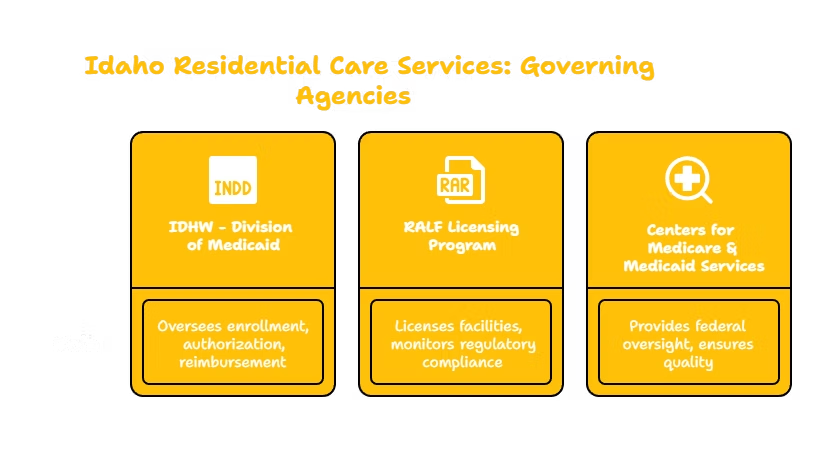
The provision of residential care in Idaho is governed by a multi-layered regulatory framework. At the state level, the IDHW Division of Medicaid maintains authority over the fiscal and programmatic aspects of service delivery, including provider enrollment, participant service authorization, and the mechanics of reimbursement. Compliance with these Medicaid-specific requirements is mandatory for any agency seeking to bill for services provided under HCBS waivers.
In addition to Medicaid oversight, the facility itself must operate under the jurisdiction of the IDHW Residential Assisted Living Facility (RALF) Licensing Program. This agency ensures that the physical environment and operational procedures meet state health and safety standards. Furthermore, providers must remain cognizant of the broader federal oversight provided by the Centers for Medicare & Medicaid Services (CMS), which requires that all residential settings fully comply with community integration standards, ensuring that participants remain active, integrated members of their local communities.
Establishing Your Residential Care Business
Establishing a successful Residential Care Services agency begins with a foundation of formal legal and operational infrastructure. Before any clinical services can be rendered, the provider must legally structure the business through the Idaho Secretary of State and secure necessary federal identifiers, including an Employer Identification Number (EIN) and a Type 2 National Provider Identifier (NPI). These steps are foundational to all subsequent licensing and enrollment applications.
Once the business entity is established, the provider must navigate the specific licensure requirements for a Residential Assisted Living Facility. This process involves a rigorous review of physical facility layouts, staffing ratios, and safety protocols. The following elements are critical during the early phases of business formation:
- Completion of the Idaho Secretary of State business registration.
- Obtaining a Type 2 NPI specifically for organizational billing.
- Acquisition of a Residential Assisted Living Facility (RALF) license from IDHW.
- Securing comprehensive insurance coverage, including general liability, professional liability, and workers’ compensation.
The Enrollment and Readiness Review Process
The journey from business formation to active Medicaid billing involves a systematic application and verification process. Providers must submit a Medicaid Provider Enrollment Application that specifically designates Residential Care Services under the appropriate HCBS waivers. This application must be accompanied by a comprehensive package of documentation that demonstrates the agency’s ability to provide safe, consistent, and compliant care to vulnerable populations.
Following the document submission, IDHW initiates a licensure survey and a readiness review. This phase is designed to verify that the provider’s written policies—such as those governing medication administration, participant rights, and emergency preparedness—are effectively implemented in practice. The readiness review acts as the final gatekeeper, ensuring that the provider is technically prepared to manage service authorization, maintain clinical records, and submit accurate billing claims through the state’s electronic systems.
Structuring Staffing and Clinical Competencies
The quality of residential care is fundamentally tied to the competence and training of the staff. Idaho’s regulations mandate specific roles, the most critical being the Administrator or Residential Program Manager. This individual must possess the required Idaho Administrator Certification and demonstrate professional experience in managing residential care settings to ensure the facility remains in compliance with state law and participant safety protocols.
Direct care staff and residential aides form the front line of daily support, and they must meet specific baseline requirements, including high school graduation or the equivalent, CPR/First Aid certification, and clear background screenings. If the facility provides medication assistance, staff must complete specialized training to ensure accuracy and safety. All staff must participate in ongoing continuing education and annual competency evaluations to maintain the high standards required in HCBS environments:
- Mandatory HIPAA confidentiality and participant rights training.
- Comprehensive abuse prevention, emergency preparedness, and fire safety training.
- Medication assistance training for all personnel authorized to handle medication.
- Annual competency testing and performance evaluations.
Frequently Asked Questions
What waivers cover Residential Care Services in Idaho?
Residential Care Services are typically authorized under the Idaho Aged and Disabled (A&D) Waiver and the Developmental Disabilities (DD) Waiver, depending on the specific needs of the participant. Additionally, some supports may be provided through Medicaid State Plan Long-Term Services and Supports (LTSS) programs.
How long does the provider enrollment process typically take?
The timeline varies based on organizational readiness, but the Medicaid provider enrollment and readiness review phase generally requires 60–90 days following initial licensure and application submission. The entire lifecycle from business formation to billing readiness typically spans several months.
Are residential providers required to assist with community integration?
Yes. A primary tenet of HCBS regulations is that providers must actively facilitate community inclusion. This includes supporting participants in accessing community resources, attending medical appointments, and participating in recreational and social activities outside the facility walls.
Key Takeaway
Launching a Residential Care Services agency in Idaho requires a methodical approach that balances rigorous clinical compliance with the administrative demands of the Medicaid provider enrollment process. By meticulously preparing your facility, staffing documentation, and operational policies, you ensure that your agency is positioned to provide high-quality support to Idahoans while meeting all state and federal regulatory expectations for HCBS providers.
Last verified: 2024. This information is intended for professional guidance and does not constitute legal or formal regulatory advice. Providers should consult directly with the Idaho Department of Health and Welfare (IDHW) regarding specific program requirements and updates.