RESIDENTIAL CARE SERVICES PROVIDER IN ALASKA
By Fatumata Kaba · 2025-07-03 · 5 min read
Residential Care Services in Alaska provide structured, home-like living environments for individuals requiring 24-hour support due to intellectual or developmental disabilities, chronic health conditions, or age-related limitations. By participating in the Alaska Home and Community-Based Services (HCBS) Medicaid Waiver programs, providers play a critical role in promoting the independence, dignity, and quality of life of Alaskans through oversight managed by the Alaska Department of Health’s Division of Senior and Disabilities Services (SDS).
Understanding the Governing Agencies and Regulatory Framework
Navigating the Alaska HCBS landscape requires a clear understanding of the hierarchy of oversight. The Alaska Department of Health’s Division of Senior and Disabilities Services (SDS) serves as the primary entity responsible for approving residential providers, monitoring service delivery, and enforcing the quality standards that ensure participant safety and well-being. Their role is to ensure that all services rendered under the waiver programs are consistent with state regulations and the specific needs of the individuals being served.
Beyond the state level, the system is anchored by Alaska Medicaid, which manages provider enrollment, billing processes, and reimbursement frameworks. These state entities operate within the broader regulatory environment established by the federal Centers for Medicare & Medicaid Services (CMS). CMS ensures that Alaska’s HCBS Medicaid waivers comply with federal requirements for accessibility, quality, and person-centered service delivery, ensuring that federal funds are utilized effectively to support community-based living.
- Alaska Department of Health – SDS: Oversees provider approval and quality monitoring.
- Alaska Medicaid: Manages enrollment, billing, and reimbursement.
- Centers for Medicare & Medicaid Services (CMS): Enforces federal compliance and program integrity.
Defining Residential Care Service Delivery Models
Residential Care Services are designed for individuals who cannot maintain independent living without consistent, professional assistance. These services are delivered in licensed or certified residential settings that are fully integrated into the community. The goal is to provide a comprehensive support structure that balances individual autonomy with the safety and supervision necessary for those with complex needs.
Approved providers are tasked with delivering a wide array of supports that must be clearly articulated within the individual’s person-centered service plan. This planning process ensures that every aspect of care—from daily ADL assistance to community integration—is tailored to the unique preferences and medical requirements of the resident. Providers must ensure that these services are documented accurately to meet both state audit standards and the evolving needs of the waiver participant.
- 24-hour supervision and support.
- Assistance with Activities of Daily Living (ADLs) such as bathing, dressing, and eating.
- Medication administration and health monitoring.
- Meal preparation and specialized dietary support.
- Behavior support, skill development, and transportation services.
Navigating Licensing and Provider Approval Requirements
Before an entity can begin offering services, they must satisfy a rigorous set of administrative and facility-based prerequisites. This begins with formal business registration through the Alaska Division of Corporations, Business and Professional Licensing. Founders must also secure a federal EIN and obtain a Type 2 NPI, which acts as the primary identifier for the business entity in all Medicaid billing transactions.
Physical facility requirements are equally stringent. Providers must secure an Assisted Living Home License from the Division of Health Care Services and ensure that the chosen site meets all local fire safety, sanitation, and zoning regulations. Because residential care involves 24-hour supervision, the physical site must be capable of supporting high-acuity needs while remaining a residential environment rather than an institutional one. Staffing models must also be established at this stage, ensuring that all personnel meet the minimum training and professional standards required for direct care delivery.
- Business entity registration and NPI/EIN procurement.
- Assisted Living Home licensure acquisition.
- Compliance with fire, life safety, and local zoning codes.
- Development of a comprehensive staff training and competency plan.
The SDS Provider Enrollment and Readiness Process
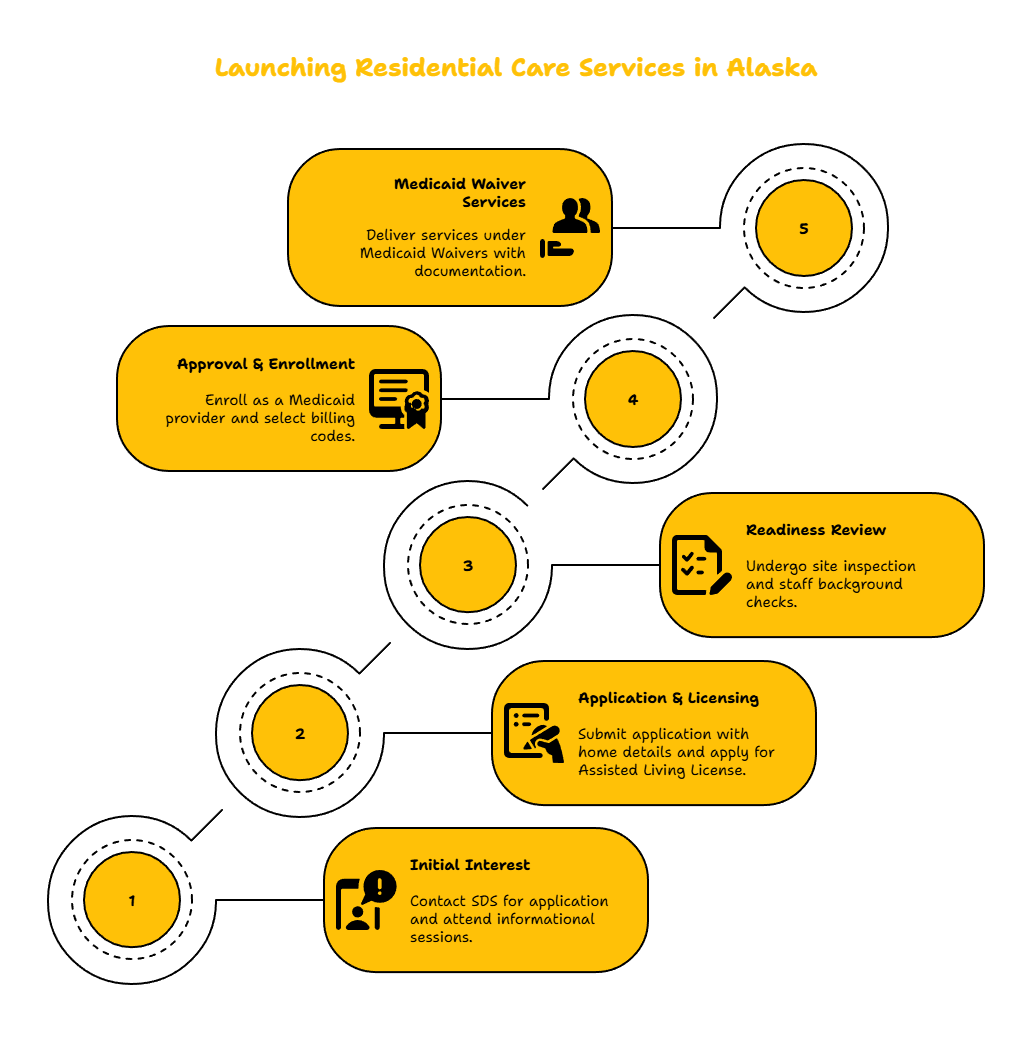
The transition from a licensed home to a Medicaid-authorized residential provider is a multi-phase undertaking. Initial steps involve contacting SDS for an application packet and attending technical assistance sessions to ensure full comprehension of current waiver requirements. Once an application is submitted, it is vetted for the inclusion of essential operational documents, such as floor plans, safety protocols, and detailed staffing models.
The process culminates in a "Readiness Review," which includes a physical site inspection to verify accessibility and safety features. SDS and relevant health divisions will also review the provider's internal policies, such as incident reporting, medication management, and emergency response procedures. Once the site is approved and the staff background checks are cleared, the provider must enroll in the Alaska Medicaid system through the MMIS portal to select the appropriate waiver billing codes and execute a provider agreement.
- Phase 1: Initial interest and informational meetings with SDS.
- Phase 2: Application submission and Assisted Living licensing.
- Phase 3: Readiness review, site inspection, and staff background clearance.
- Phase 4: Medicaid enrollment via the Alaska MMIS portal.
Operational Standards and Staffing Requirements
Operating a residential program requires adherence to strict documentation and personnel standards. The Residential Administrator or Home Manager must possess a clear understanding of HCBS waiver rules and licensing standards, as they are ultimately responsible for the home’s compliance. Direct Support Professionals (DSPs) are required to hold at least a high school diploma or GED and must undergo specialized training in personal care, CPR/First Aid, and ethical conduct.
Ongoing training is mandatory for all staff members. This includes continuous education on person-centered planning, behavioral support, and the complexities of medication administration. Proper documentation of this training is a frequent focus during annual audits. Furthermore, the provider must maintain clear policies on staff-to-client ratios, especially for overnight supervision, to ensure the consistent, high-quality care expected under the Alaska waiver system.
Frequently Asked Questions
What documents are essential for the initial SDS application?
Applicants must provide their Articles of Incorporation, proof of business licensure, an IRS EIN letter, a Type 2 NPI, and their Assisted Living Home License. Additionally, a comprehensive Policy & Procedure Manual covering admission/discharge, medication management, emergency plans, and client rights is required.
What is the typical timeline for launching a new residential program?
The entire process typically spans several months. Business formation and property readiness take 2–4 weeks; SDS application and licensing review take 60–120 days; staff training and program preparation take 30–45 days; and final Medicaid enrollment and MMIS access take an additional 45–60 days.
Which Medicaid waivers authorize Residential Care Services in Alaska?
Residential care is primarily authorized under the Adults with Physical and Developmental Disabilities (APDD) Waiver, the Individuals with Intellectual and Developmental Disabilities (IDD) Waiver, and the Children with Complex Medical Conditions (CCMC) Waiver. The Alaskans Living Independently (ALI) Waiver may also cover residential services in limited, specific circumstances.
Key Takeaway
Launching a residential care service in Alaska requires a rigorous commitment to state licensing standards, thorough preparation of operational policies, and a deep understanding of the Alaska HCBS waiver system. By ensuring that all business, safety, and training requirements are met prior to the SDS readiness review, providers can establish a stable, compliant, and high-quality environment that meaningfully supports Alaskans with disabilities.
Last verified: 2024. The information provided in this article is for educational purposes and is not a substitute for formal legal or regulatory advice. Always check the official Alaska Department of Health and Medicaid provider portals for the most current regulations and program updates.