PREVOCATIONAL SERVICES PROVIDER IN LOUISIANA
By Fatumata Kaba · 2025-08-12 · 6 min read
What Are Prevocational Services in the Louisiana HCBS Framework?
Prevocational Services in Louisiana are specialized, non-job-specific training programs designed to cultivate the foundational skills necessary for individuals with disabilities to pursue competitive integrated employment. These services are authorized under the state’s Home and Community-Based Services (HCBS) waivers and are structured to move participants toward greater independence in the workplace. By focusing on general work habits, social cues, and vocational readiness rather than immediate job placement, these services provide a bridge for individuals preparing for Supported Employment.
The core objective is to deliver high-quality, person-centered instruction that aligns with the participant’s unique Plan of Care (POC). Whether delivered in small group community settings or through individualized skill-building sessions, these services emphasize the development of transferrable abilities. These include effective communication with supervisors, workplace etiquette, time management, and the stamina required for consistent task completion. Because these services are tied to long-term vocational goals, even participants who are not currently seeking employment can benefit from the foundational training needed to reach future career milestones.
Who Governs and Monitors Prevocational Service Delivery?
The delivery of Prevocational Services in Louisiana is governed by a multi-tiered regulatory framework. The Louisiana Department of Health (LDH), specifically through the Office for Citizens with Developmental Disabilities (OCDD), serves as the primary state authority. OCDD is responsible for establishing the standards for care, monitoring participant outcomes, and granting the necessary approvals for providers to operate under the state’s Medicaid waivers.
Federal oversight is provided by the Centers for Medicare & Medicaid Services (CMS). CMS ensures that all prevocational programming adheres to the federal HCBS Settings Rule, which mandates that participants receive services in inclusive, community-integrated environments. Additionally, the Medicaid Management Information System (MMIS), managed through Molina Medicaid Solutions, acts as the operational hub for the state. This system facilitates the critical administrative functions of provider enrollment and claims processing, ensuring that services provided are compliant with Medicaid reimbursement requirements.
What Are the Essential Requirements for Provider Licensing and Approval?
Establishing a new provider agency requires a structured approach to legal and operational readiness. Before initiating services, prospective providers must complete a comprehensive registration process with the Louisiana Secretary of State and secure an IRS Employer Identification Number (EIN) and a Type 2 National Provider Identifier (NPI). These identifiers are non-negotiable prerequisites for entering the state’s Medicaid ecosystem.
Beyond basic business registration, agencies must demonstrate clinical and administrative competency. This involves developing a robust Prevocational Services Policy & Procedure Manual that outlines how the organization will maintain HIPAA-compliant documentation and track service delivery. Providers must also maintain adequate liability and workers’ compensation insurance to protect the agency and its participants. Finally, the agency must be formally approved by OCDD as an HCBS provider, a status earned by submitting evidence of a qualified staffing plan, a documented curriculum, and a clear operational service model.
- Register the business entity with the Louisiana Secretary of State.
- Obtain a Type 2 NPI and IRS EIN for billing purposes.
- Enroll as an HCBS waiver provider through the Louisiana Medicaid portal.
- Submit a detailed organizational structure and staff onboarding plan to OCDD.
- Ensure all physical and digital storage systems meet HIPAA and participant privacy standards.
How Do Agencies Navigate the Enrollment and Approval Process?
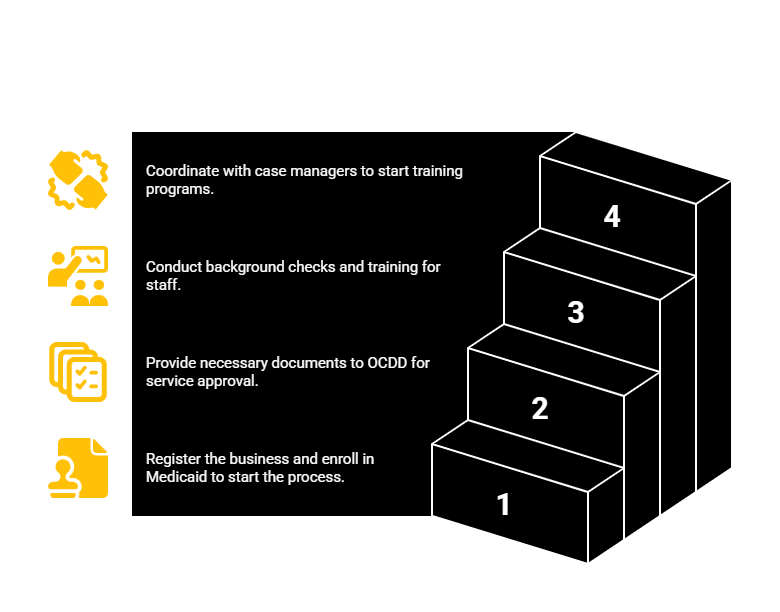
The provider enrollment process is a sequential journey that begins with official registration through the Louisiana Medicaid Provider Enrollment Portal. Once the basic business profile is established under the HCBS provider type, the applicant must pivot to obtaining program-specific approval from OCDD. During this stage, the agency must provide samples of its vocational curriculum, demonstrate its physical service delivery model, and verify that its administrative framework meets the standards defined for waiver-funded services.
Following organizational approval, the agency must focus on the human capital aspect of the business. This includes rigorous hiring, background checks, and the provision of orientation trainings that cover participant rights, abuse and neglect prevention, and emergency protocols. Once staff are fully credentialed, the agency can begin coordinating with waiver case managers and, where appropriate, Louisiana Rehabilitation Services (LRS). These partnerships are vital for receiving participant referrals and ensuring that the services rendered are aligned with the individual's specific vocational trajectory and long-term career goals.
What Documentation Is Required for Regulatory Compliance and Auditing?
Compliance is the backbone of any Medicaid-funded program. An agency must be prepared for regular audits, which requires maintaining audit-ready documentation for every participant served. This documentation serves as proof that the services were authorized, delivered as planned, and effective in helping the participant meet their stated vocational goals. A well-organized provider will maintain a standardized system for tracking attendance, daily activity logs, and periodic progress summaries that correlate directly to the participant's Individual Service Plan (ISP).
Furthermore, providers must document their internal administrative health. This includes keeping comprehensive staff training logs to prove that all personnel have received the necessary instruction in behavior management, workplace safety, and person-centered planning. Billing logs must accurately reflect the time spent in service delivery and be cross-referenced with attendance records to ensure transparency and prevent discrepancies during the Medicaid reimbursement cycle.
- Individual Service Plan (ISP) goal tracking sheets.
- Daily attendance logs and service delivery verification records.
- Detailed progress summaries and competency-based skill assessments.
- Confidential personnel files, including background checks and training completion logs.
- Financial and billing records organized for state and federal audit reviews.
Frequently Asked Questions
What types of Medicaid waivers cover Prevocational Services in Louisiana?
Prevocational Services are reimbursed under several key programs, including the Residential Options Waiver (ROW), the Supports Waiver, and the New Opportunities Waiver (NOW). Additionally, the Children’s Choice Waiver provides limited support for transition-age youth, and the Money Follows the Person (MFP) program facilitates employment transition planning for individuals moving into community-based settings.
What qualifications are necessary for staff providing vocational training?
Staff, often titled Vocational Trainers or Direct Support Professionals (DSPs), must hold at least a high school diploma or equivalent. They should possess documented experience in job readiness instruction or community-based support services. All staff must also pass mandatory background checks and undergo specific training in HIPAA confidentiality, person-centered planning, and workplace safety.
How long does the launch process typically take for a new provider?
While timelines vary based on organizational readiness, the initial business setup and recruitment phase typically requires 1–2 months. The subsequent Medicaid enrollment and OCDD program approval can take between 60 to 90 days. Developing the necessary policy manuals and tracking systems generally adds another 2–4 weeks, meaning a realistic launch window is several months from the start of the process.
WAIVER CONSULTING GROUP’S START-UP ASSISTANCE SERVICE — LOUISIANA PREVOCATIONAL PROVIDER
WCG helps community-based agencies and vocational programs launch Medicaid-compliant Prevocational Services across Louisiana through expert guidance on business registration, OCDD documentation, and the creation of robust, audit-ready Policy & Procedure Manuals. Our service includes support for staff onboarding, skill tracking templates, and LRS coordination strategies to ensure your agency is fully prepared to deliver high-quality, compliant vocational training.
Key Takeaway: Successful provision of Prevocational Services in Louisiana requires a blend of strict adherence to OCDD/CMS regulatory standards and a genuine commitment to person-centered vocational outcomes. By maintaining rigorous documentation, hiring qualified personnel, and fostering strong collaborative relationships with case managers and rehabilitation agencies, providers can build sustainable, impactful programs that significantly enhance the employability of individuals in their community.
Last verified: October 2023. This content is provided for informational purposes only and does not constitute legal or financial advice. Regulatory requirements for Medicaid waiver programs are subject to change; always verify current guidelines with the Louisiana Department of Health (LDH) and the Centers for Medicare & Medicaid Services (CMS).