PRE-VOCATIONAL SERVICES PROVIDER IN SOUTH DAKOTA
By Fatumata Kaba · 2025-10-15 · 5 min read
BUILDING WORK READINESS THROUGH STRUCTURED TRAINING AND SKILL DEVELOPMENT FOR INDIVIDUALS WITH DISABILITIES
Pre-vocational services in South Dakota serve as a critical bridge for individuals with intellectual and developmental disabilities (IDD) transitioning toward competitive, integrated employment. By providing structured training, skill development, and behavior modification within the framework of the CHOICES Waiver, these services empower participants to build the work habits and career readiness necessary for long-term professional success.
What Are the Core Objectives of Pre-Vocational Services in South Dakota?
Pre-vocational services are fundamentally designed to move participants toward the overarching goal of integrated, competitive employment. Unlike vocational training that focuses on specific job functions, these services prioritize the foundational "soft skills" required for any professional setting. The South Dakota Department of Human Services (DHS) emphasizes that these programs must be individualized, time-limited, and explicitly linked to the participant's career objectives as defined in their Individual Support Plan (ISP).
The program delivery is managed under the guidance of the Division of Developmental Disabilities (DDD), adhering to federal HCBS (Home and Community-Based Services) standards set by the Centers for Medicare & Medicaid Services (CMS). Whether through facility-based simulated work environments or community-integrated activities, the provider’s role is to facilitate measurable progress, ensuring that each participant is gaining the independence needed to transition into supported employment or unsubsidized work.
How Do Providers Navigate the Licensing and Approval Process?
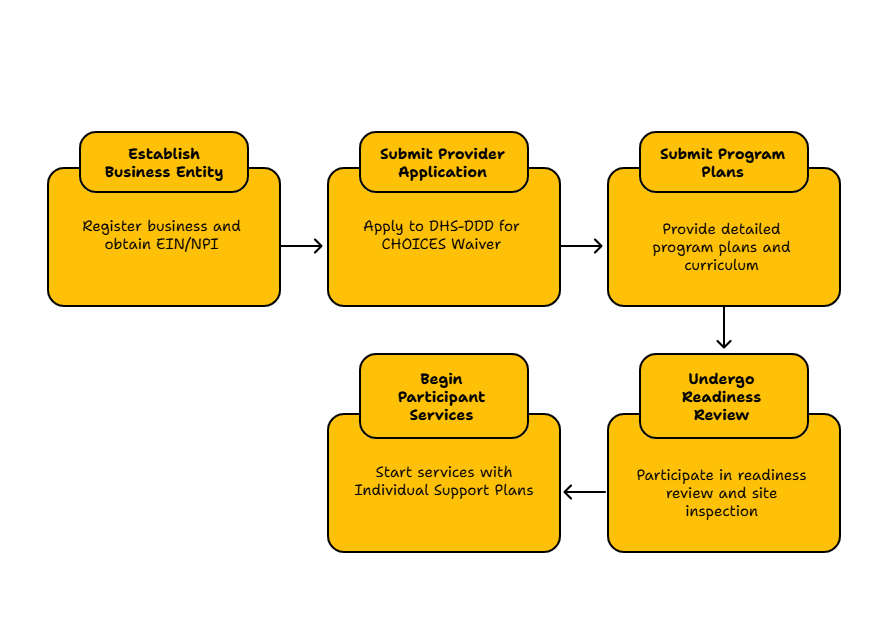
Establishing a pre-vocational services agency in South Dakota is a multi-stage process that requires rigorous adherence to state and federal compliance standards. The process begins with formal business entity registration through the South Dakota Secretary of State, followed by the acquisition of a Federal Employer Identification Number (EIN) and a Type 2 National Provider Identifier (NPI). These foundational steps are necessary to interface with the state’s Medicaid billing systems.
Following business registration, prospective providers must formally apply to the DHS-DDD for inclusion as a CHOICES Waiver provider. This application process involves a comprehensive readiness review, which may include site inspections for any facility-based programming. Applicants must demonstrate their capability to maintain safe, accessible, and compliant environments while submitting their internal policy manuals, service curriculum, and staffing plans for regulatory approval.
- Register the legal business entity with the South Dakota Secretary of State.
- Obtain necessary federal identifiers, including a Type 2 NPI and an EIN.
- Submit a formal application packet to the South Dakota DHS-DDD for CHOICES Waiver enrollment.
- Prepare for a readiness review, including site-specific facility inspections if operating a physical center.
- Secure comprehensive insurance coverage, including general liability, workers' compensation, and automotive coverage for transportation services.
What Are the Key Staffing and Documentation Requirements?
Success as a pre-vocational provider hinges on the quality of staff and the integrity of service documentation. Agencies must employ qualified vocational instructors or job skills coaches who possess at least a high school diploma or equivalent, alongside relevant experience in workforce development, disability services, or training. These staff members are the primary vehicles for delivering instruction on punctuality, workplace behavior, and task completion.
Documentation is the backbone of the CHOICES Waiver program. Providers are responsible for maintaining meticulous records that track participant attendance, progress toward specific ISP goals, and incident reports. This documentation must be audit-ready at all times to satisfy state and federal oversight requirements. Agencies must develop and implement a robust Policy & Procedure Manual that covers everything from HIPAA-compliant data management to emergency response protocols.
How Are Services Structured to Ensure Compliance and Participant Growth?
To remain compliant with CMS expectations, pre-vocational services must be demonstrably time-limited. The curriculum should focus on "general" employment readiness rather than a permanent placement in a segregated setting. Providers utilize a variety of teaching methods, such as simulated work tasks like sorting, assembly, and packaging, to evaluate and improve a participant's ability to maintain focus, follow multi-step instructions, and collaborate within a team environment.
Each service activity must be tied to a specific goal within the participant's ISP. This goal-oriented approach ensures that the provider, the state, and the individual are all working toward the same objective: competitive employment. If a participant has transportation barriers, training may also include navigation skills for public transit or other vocational mobility support, provided it is explicitly identified as part of their vocational pathway.
- Workplace Behavior Training: Focus on soft skills like dress code, attendance, and authority interaction.
- Task Completion: Exercises designed to improve stamina and attention to detail.
- Social Skills Development: Promoting effective communication and peer collaboration.
- Career Exploration: Periodic assessments and goal-setting sessions to refine the participant's vocational path.
- Transition Planning: Developing tools that assist the participant in moving from pre-vocational status to supported employment.
Frequently Asked Questions
What is the typical timeline for launching a pre-vocational program?
The total timeline generally ranges from 4 to 7 months. Business registration and initial planning typically take 1–2 months, while the formal DHS enrollment and curriculum submission process takes 2–3 months. Final facility setup and staff onboarding usually require an additional 1–2 months before services can commence.
Are pre-vocational services intended to be permanent?
No. These services are time-limited and serve as a pathway. CMS and the South Dakota DHS emphasize that the desired outcome is competitive, integrated employment. Providers must ensure that participants have a clear trajectory toward more independent work settings.
What role does the Individual Support Plan (ISP) play in daily operations?
The ISP is the governing document for all services provided. Every training activity, skill-building session, and progress report must align with the specific goals outlined in the participant's ISP. It serves as the basis for both documentation and billing compliance.
Key Takeaway
Becoming a successful pre-vocational services provider in South Dakota requires a commitment to operational excellence, regulatory compliance, and a genuine focus on participant outcomes. By aligning business strategies with the requirements of the CHOICES Waiver and the oversight of the South Dakota DHS, providers can build high-impact programs that successfully transition individuals with IDD into the broader workforce.
Last verified: 2024. This information is provided for educational purposes only and does not constitute legal or professional consulting advice. Prospective providers should consult directly with the South Dakota Department of Human Services (DHS) and current CMS regulations to ensure full compliance with all local, state, and federal requirements.