PRE-VOCATIONAL SERVICES PROVIDER IN ILLINOIS
By Fatumata Kaba · 2025-07-19 · 5 min read
Becoming a pre-vocational services provider in Illinois allows organizations to support individuals with disabilities in developing the essential work habits and skills necessary to transition into competitive or supported employment. These services, authorized under Illinois Medicaid Home and Community-Based Services (HCBS) waivers, are essential for bridging the gap between daily living supports and meaningful, integrated community work.
What Are the Core Objectives of Pre-Vocational Services?
Pre-Vocational Services are designed to focus on the development of general work skills rather than job-specific training. The primary goal is to foster an environment where participants can build the stamina, focus, and interpersonal skills required to succeed in a workplace. By emphasizing soft skills such as punctuality, task completion, and communication, providers help participants navigate the transition toward independence.
Providers must ensure that all services are time-limited and clearly outlined in the participant’s Person-Centered Plan (PCP). Regular reviews are required to monitor progress and ensure that services remain focused on achieving tangible employment outcomes. This structured approach helps ensure that participants are consistently moving toward their long-term career goals within the community.
- Skills training in punctuality, task completion, communication, and workplace etiquette.
- Development of problem-solving, teamwork, and interpersonal skills.
- Support in building stamina, focus, and workplace behavior expectations.
- Exposure to various employment settings through volunteer work, internships, or on-site experiences.
- Assistance with self-advocacy, career exploration, and personal goal setting.
- Support in developing individualized employment pathways leading to competitive, integrated employment.
Which Agencies Govern Pre-Vocational Programs in Illinois?
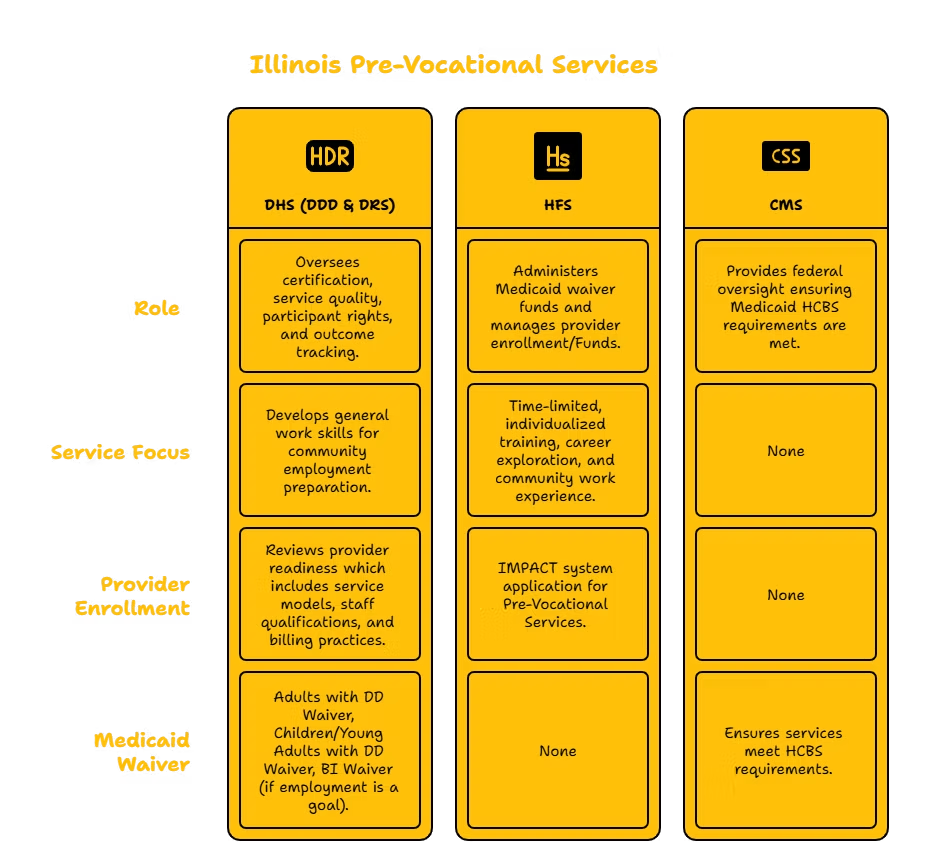
Navigating the regulatory landscape for Medicaid providers requires an understanding of the roles played by both state and federal oversight bodies. The Illinois Department of Human Services (DHS), specifically the Division of Developmental Disabilities (DDD) and the Division of Rehabilitation Services (DRS), oversees provider certification, ensures service quality, and monitors participant rights and outcomes.
The Illinois Department of Healthcare and Family Services (HFS) serves as the administrator for Medicaid waiver funding, managing the critical systems for provider enrollment and billing. Finally, the Centers for Medicare & Medicaid Services (CMS) provides federal oversight to ensure that all Illinois programs adhere to the broader HCBS requirements regarding community integration and participant choice.
How Do Providers Meet Licensing and Enrollment Requirements?
Establishing a new program requires a rigorous, multi-step approach to compliance. Before offering services, a business must register with the Illinois Secretary of State and obtain both a federal Employer Identification Number (EIN) and a Type 2 National Provider Identifier (NPI). These foundational steps allow an organization to move forward with the Medicaid provider enrollment process via the Illinois Medicaid Provider Enrollment Portal (IMPACT system).
Beyond basic business registration, organizations must obtain certification or approval as a Developmental Disabilities (DD) Services Provider. This involves developing a comprehensive Policy & Procedure Manual that covers service documentation, health and safety protocols, and participant rights. Furthermore, providers must maintain adequate general liability and transportation insurance to protect both the agency and the individuals they serve.
- Register business entity with the Illinois Secretary of State.
- Obtain EIN from the IRS and NPI (Type 2).
- Enroll as a Medicaid Waiver provider through the IMPACT system.
- Obtain certification or approval as a Developmental Disabilities (DD) Services Provider.
- Develop policies for skill development, safety, documentation, and rights protection.
- Ensure staff undergo background screening and mandatory vocational support training.
What Are the Essential Staffing and Training Standards?
The quality of a pre-vocational program is heavily dependent on the competence of its staff. The Program Director or Supervisor generally requires a bachelor’s degree in a related field such as human services or education, coupled with experience in vocational supports. These leaders are responsible for the oversight of the service model and the clinical integrity of the program.
Vocational Trainers and Employment Specialists, who work directly with participants, are required to have at least a high school diploma or GED. Every staff member must complete standardized training modules covering HCBS settings rules, workplace safety, HIPAA compliance, and abuse prevention. Continuous competency evaluations and ongoing education are mandatory to maintain eligibility to deliver these services.
How Is the Launch Timeline Structured?
The transition from a business concept to an operational provider typically follows a set sequence of phases. The initial period, lasting one to two months, focuses on business formation and establishing the foundational documentation required for Medicaid compliance. This is followed by a two- to three-month period dedicated to recruiting and credentialing qualified staff and finalizing the vocational curriculum.
The final phases involve the formal IMPACT system enrollment and a DHS readiness review, which can take up to 90 days. Once the agency has successfully passed these checks, the final 30- to 45-day window is utilized to configure the billing systems for Medicaid claims. Organizations that follow this structured trajectory are better positioned to meet the rigorous expectations of state auditors.
Frequently Asked Questions
What documents are mandatory for the application process?
Providers must submit proof of business formation (Articles of Incorporation), federal tax documents (EIN), and NPI confirmation. Additionally, you must provide comprehensive policies on participant intake, safety, rights, and staff training to the DHS for their readiness review.
Which waivers support these services?
Pre-Vocational Services are currently authorized under the Adults with Developmental Disabilities Waiver, the Children and Young Adults with Developmental Disabilities Waiver, and the Persons with Brain Injury (BI) Waiver, provided the service aligns with the participant's vocational goals.
What is the primary role of the DHS during the program launch?
The DHS evaluates provider readiness by reviewing staff qualifications, internal service models, safety and incident reporting protocols, and the organization's ability to document and bill for services accurately according to Medicaid standards.
Key Takeaway
Launching a Pre-Vocational Services program in Illinois requires strict adherence to DHS and HFS regulations, a commitment to person-centered planning, and a robust administrative infrastructure. By focusing on the core requirements of the IMPACT enrollment process and maintaining comprehensive documentation, providers can effectively support individuals with disabilities as they develop the necessary skills for competitive employment and greater community inclusion.
WCG assists pre-vocational service organizations, disability support agencies, and community employment initiatives in launching Medicaid-compliant Pre-Vocational Services programs across Illinois. Our services include business registration, Medicaid enrollment, Policy & Procedure Manual development, and the creation of structured skills training curricula.
Last verified: October 2023. This information is provided for general guidance only and does not constitute legal or professional advice. Requirements for Illinois Medicaid programs are subject to change based on state and federal updates; always verify current statutes and guidance through the Illinois Department of Human Services (DHS) and the Illinois Department of Healthcare and Family Services (HFS) official websites.