PERSONAL EMERGENCY RESPONSE SYSTEM SERVICES PROVIDER IN LOUISIANA
By Fatumata Kaba · 2025-08-12 · 5 min read
ENHANCING SAFETY AND RAPID RESPONSE ACCESS FOR INDEPENDENT LIVING PARTICIPANTS
Personal Emergency Response System (PERS) services in Louisiana provide a critical safety net for Medicaid waiver participants, enabling seniors and individuals with disabilities to maintain their independence within their own homes. By offering 24/7 access to emergency assistance, these systems ensure immediate intervention during medical incidents or falls, serving as a cornerstone of Home and Community-Based Services (HCBS) across the state.
What Role Do Governing Agencies Play in Louisiana PERS Delivery?
The regulatory landscape for PERS in Louisiana is structured to ensure that every participant receives reliable, high-quality emergency monitoring. The Louisiana Department of Health (LDH) and the Office of Aging and Adult Services (OAAS) maintain primary oversight, establishing the service standards and provider participation guidelines required for all state-sanctioned Medicaid waivers.
Beyond state-level administration, the Medicaid Management Information System (MMIS), facilitated by Molina Medicaid Solutions, serves as the operational engine for the program. This system manages provider enrollment, the processing of service claims, and the disbursement of payments. Furthermore, for participants enrolled in the Bayou Health program, Managed Care Organizations (MCOs) play a pivotal role by authorizing specific PERS units within the participant’s Plan of Care (POC) and overseeing ongoing reimbursement. Compliance with federal HCBS regulations, as mandated by the Centers for Medicare & Medicaid Services (CMS), remains the foundational requirement for all participating providers.
What Are the Core Service Components of a PERS Provider?
A PERS provider is defined by its ability to provide electronic monitoring solutions that empower participants to summon help with the simple push of a button at any hour of the day or night. These services are not merely about equipment installation; they are about maintaining a seamless chain of communication between the participant and emergency responders.
Covered PERS services include the following essential functions:
- Installation of basic landline or cellular PERS devices
- Provision of advanced features such as fall detection and wearable pendants or wristbands
- Constant 24/7 monitoring services and professional emergency response dispatch
- Ongoing maintenance, device testing, and prompt replacement of faulty equipment
- Comprehensive training for participants and their caregivers regarding proper device usage
- Optional deployment of GPS-enabled or mobile PERS for participants who require safety while active in the community
Providers must ensure that every unit is medically necessary and clearly documented within the participant’s Plan of Care. All installations must receive formal approval from the case manager or the relevant MCO prior to the commencement of services.
How Do Providers Navigate the Licensing and Approval Requirements?
The path to becoming an approved PERS provider requires rigorous attention to administrative and technical detail. Prospective providers must first establish a legal business entity by registering with the Louisiana Secretary of State and securing an IRS Employer Identification Number (EIN) and a Type 2 National Provider Identifier (NPI). These initial steps form the prerequisite foundation for state enrollment.
Providers are required to maintain active general liability and product insurance policies to mitigate operational risks. Furthermore, technology standards are non-negotiable: all hardware must be UL-listed or hold an equivalent certification to ensure reliability. The backbone of the operation is the monitoring center, which must be fully equipped to handle emergency calls 24/7 while adhering to strict HIPAA privacy standards and CMS regulatory expectations. Establishing a comprehensive PERS Services Policy & Procedure Manual is the final, essential step in proving operational readiness to state auditors.
What Is the Step-by-Step Process for Louisiana Medicaid Enrollment?
The enrollment process is structured to verify that the provider can deliver consistent, reliable services to the waiver population. Following the initial registration of the business, the provider must utilize the Louisiana Medicaid Provider Enrollment Portal to apply as a PERS provider or a Durable Medical Equipment (DME) supplier specializing in PERS.
The application journey generally follows these phases:
- Submission of Credentials: The applicant must upload business licenses, monitoring agreements, proof of insurance, and detailed device specifications for review.
- Coordination with Stakeholders: Once enrolled, providers must engage with waiver case managers and MCOs to provide competitive service quotes and participate in the development of individual participant Plans of Care.
- Operational Activation: After the POC is approved, the provider performs the physical installation, delivers mandatory user education to the participant and caregivers, and submits the required documentation to trigger the start of monthly monitoring claims.
How Should PERS Providers Structure Their Staffing and Documentation?
Success as a PERS provider depends on the quality of staff and the integrity of record-keeping. Field technicians must be trained in basic electronics and HIPAA privacy protocols, and they must undergo thorough background checks before entering a participant's home. Similarly, monitoring center operators must possess strong crisis communication skills and follow standardized emergency response protocols to ensure that every alert is handled with precision.
Every provider must maintain meticulous documentation to satisfy both Medicaid audits and quality assurance requirements. This includes:
- Participant intake and risk assessment forms
- Installation and service authorization logs
- HIPAA-compliant emergency response records
- Monitoring system checklists and recurring device testing protocols
- Detailed training records for participants and caregivers
- Equipment inventory and historical replacement logs
- Critical incident documentation for any emergency activation
- Organized monthly billing records and supporting audit materials
Frequently Asked Questions
Which Medicaid programs authorize PERS services in Louisiana?
PERS services are authorized under the Community Choices Waiver (CCW), Residential Options Waiver (ROW), New Opportunities Waiver (NOW), and the Supports Waiver. Additionally, these services may be provided under Money Follows the Person (MFP) transition services where applicable.
What are the primary eligibility criteria for a participant to receive PERS?
To qualify, participants must generally live alone or be identified as being at high risk for falls or medical emergencies. The service must be deemed medically necessary, included in the participant's Plan of Care, and approved by the appropriate agency prior to installation. PERS is not available to individuals residing in institutional settings.
What is the estimated timeline for launching a new PERS provider agency?
The launch process typically spans several months. Business registration and monitoring setup generally take 1–2 months, followed by 60–90 days for Medicaid enrollment and credentialing. Procuring equipment and establishing documentation systems typically requires an additional 30–45 days, after which the agency can begin accepting participant referrals on a rolling basis.
WAIVER CONSULTING GROUP’S START-UP ASSISTANCE SERVICE — LOUISIANA PERS PROVIDER
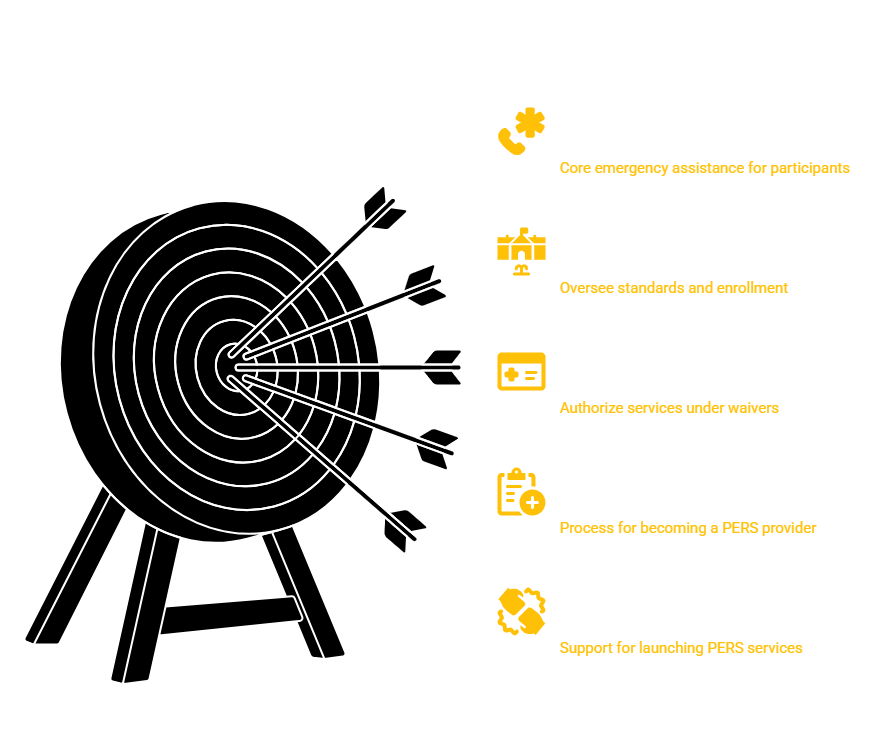
WCG supports technology firms, emergency response networks, and home care agencies in launching compliant Personal Emergency Response System services across Louisiana. Our scope of work includes Medicaid enrollment and MCO credentialing, the development of robust Policy & Procedure Manuals, creation of HIPAA-compliant forms, and the provision of outreach materials for case managers.
Our Client Portal offers a wealth of resources that you can explore related to various programs and state requirements.
Key takeaway: Becoming a PERS provider requires a focus on rigorous regulatory compliance, reliable hardware, and consistent communication with Louisiana’s MCOs and case management teams to ensure participants receive timely, life-saving support.
Last verified: August 2024. This content is for informational purposes only and does not constitute legal or professional medical advice. Always consult with the Louisiana Department of Health or the relevant Medicaid agency for the most current regulatory updates and requirements.