PERSONAL EMERGENCY RESPONSE SYSTEM (PERS) SERVICES PROVIDER IN MISSOURI
By Fatumata Kaba · 2025-08-07 · 5 min read
Enabling Safety and Independence Through Missouri PERS Services
Personal Emergency Response System (PERS) services in Missouri serve as a critical safety net, providing 24/7 monitoring and immediate access to emergency assistance for seniors, individuals with disabilities, and those managing chronic health conditions. By integrating specialized communication devices directly into the lives of participants, these services foster independence, allowing individuals to remain safely in their own homes while mitigating the risks associated with sudden falls or medical emergencies.
Administered under Missouri’s Home and Community-Based Services (HCBS) waivers, PERS services are a cornerstone of the state’s commitment to community-based care. For provider agencies, entering this market requires a deep understanding of state-level oversight, rigorous enrollment standards, and a dedication to maintaining high-quality response protocols that meet both state and federal regulatory expectations.
Who Governs PERS Provider Operations in Missouri?
The delivery of PERS services in Missouri is a highly regulated endeavor involving a tiered structure of oversight. The Missouri Department of Health and Senior Services (DHSS) serves as the primary authority, managing the HCBS Waiver programs and ensuring that the services delivered to participants align with state quality-of-care standards. Providers must operate within the framework established by DHSS to ensure eligibility for reimbursement.
Complementing this, the Missouri Department of Social Services (DSS) acts as the financial and administrative gatekeeper for the Medicaid program. DSS oversees the complex provider enrollment process and manages service authorizations, which are essential for billing. At the federal level, the Centers for Medicare & Medicaid Services (CMS) provides the overarching federal oversight, requiring that Missouri’s waiver programs maintain strict compliance with national quality measures and fiscal transparency requirements.
What Are the Core Requirements for PERS Provider Approval?
Launching a PERS service agency in Missouri is a multi-step process that begins with formal business and administrative infrastructure. Before applying for Medicaid enrollment, an agency must be legally registered with the Missouri Secretary of State and possess a valid Employer Identification Number (EIN) from the IRS. Furthermore, obtaining a Type 2 National Provider Identifier (NPI) is mandatory for organizations performing these services, as it identifies the business entity for all Medicaid transactions.
Beyond basic business licensing, potential providers must secure a specific PERS Provider License from the DHSS. This process includes proving that the agency holds sufficient liability insurance to protect both the business and the individuals served. Documentation must also verify that all equipment provided—such as wearable pendants, GPS trackers, and fall detection units—meets current industry safety standards and can function reliably within the home environments of the waiver participants.
- Register the business entity with the Missouri Secretary of State.
- Obtain an IRS-issued EIN and a Type 2 NPI.
- Apply for and receive the PERS Provider License from the DHSS.
- Secure comprehensive liability insurance coverage.
- Compile formal policies for device testing, installation, and monitoring.
How Does the Medicaid Provider Enrollment Process Work?
The path to becoming a Medicaid-approved provider is a structured, four-phase journey. It begins with a pre-application phase, where the prospective agency reaches out to the Missouri Department of Social Services to identify the most current enrollment packets and specific program requirements. This initial contact is vital for clarifying expectations before committing resources to the application.
Following the pre-application, the agency enters the submission phase, where all business registrations, PERS licenses, and proofs of insurance are bundled with a formal service description. The subsequent compliance verification phase involves a review by state authorities to ensure the agency’s proposed monitoring procedures and hardware meet the technical demands of the Medicaid program. Only upon successful verification does the agency receive a formal Medicaid provider number, which is the final authorization required to begin delivering services and submitting claims for reimbursement.
What Policies and Staffing Protocols are Required for Compliance?
A successful PERS agency must maintain a comprehensive policy and procedure manual that covers every aspect of the participant experience. This includes detailed protocols for device installation, systematic testing to ensure units are functional, and 24/7 monitoring center coordination. Documentation is not merely administrative; it is a clinical requirement to prove that each participant has received adequate training on their device and that emergency contact plans are both accurate and updated regularly.
Staffing requirements are equally specific to ensure safety. The PERS Program Manager must possess demonstrable experience in healthcare technology or emergency response coordination. Installation technicians, meanwhile, must undergo rigorous background checks and hold a clean driving record, as they are often the face of the agency inside a participant's home. Ongoing training for these staff members is essential, covering topics such as client communication, data privacy under HIPAA, and the technical intricacies of device maintenance and troubleshooting.
How are PERS Services Integrated into Missouri Medicaid Waivers?
PERS services in Missouri are integrated into several key HCBS waiver programs, specifically designed to support vulnerable populations who wish to avoid institutionalization. These include the Aged and Disabled Waiver (ADW), the Independent Living Waiver, and the Medically Fragile Adult Waiver. Each of these programs mandates that PERS services be customized within the Individual Service Plan (ISP) or Person-Centered Plan (PCP) for every participant.
Approved providers must be prepared to offer a suite of services beyond basic equipment provision. This includes the setup of home monitoring units that maintain 24/7 access to a response center, the installation of automatic fall detection systems, and specialized training for caregivers. The goal of these services, regardless of the specific waiver program, is to provide a seamless, non-intrusive support system that reacts immediately to emergencies, thereby enhancing the long-term safety of the participant within their chosen living environment.
Frequently Asked Questions
What is the typical timeline for launching a PERS provider agency?
The timeline varies based on the agency's readiness. Business formation typically takes 1–2 weeks, while Medicaid provider enrollment is the most significant phase, often taking 60–90 days. Staff hiring, training, and equipment procurement usually add an additional 4–9 weeks to the total launch process.
What equipment is generally included under PERS services?
PERS services may include emergency call devices such as wearable pendants or wristbands, in-home monitoring units with 24/7 response access, fall detection systems, and GPS-enabled devices for mobility tracking. All equipment must be installed and tested according to the participant’s specific plan of care.
What documentation is required to maintain compliance?
Providers must maintain organized records, including articles of incorporation, an NPI confirmation, the PERS Provider License, liability insurance, and a robust policy and procedure manual. Additionally, agencies must keep detailed logs of equipment installations, maintenance, troubleshooting, and evidence of client training.
Key Takeaway
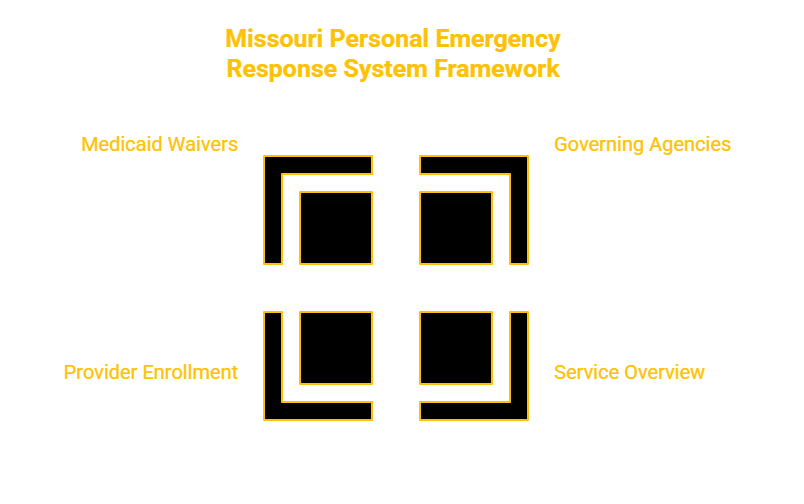
Establishing a Personal Emergency Response System (PERS) agency in Missouri requires strict adherence to the regulatory requirements set by the DHSS and the Department of Social Services. By focusing on comprehensive policy development, professional staff training, and rigorous equipment compliance, providers can successfully integrate into the Missouri HCBS waiver framework, ultimately ensuring that waiver participants receive the high-quality, 24/7 emergency support necessary to thrive in their own homes.
Last verified: 2024. This information is provided for educational purposes and should not be considered legal or financial advice. We recommend verifying current regulations with the Missouri Department of Health and Senior Services and the Department of Social Services prior to making any business decisions.