PERSONAL EMERGENCY RESPONSE SYSTEM (PERS) PROVIDER IN KANSAS
By Fatumata Kaba · 2025-07-24 · 6 min read
ENSURING SAFETY AND PEACE OF MIND THROUGH 24/7 EMERGENCY MONITORING AND ASSISTIVE TECHNOLOGY
Personal Emergency Response System (PERS) services in Kansas represent a critical component of home-based care, providing participants with 24/7 access to emergency assistance through specialized wearable or stationary devices. As an authorized support under several Kansas Home and Community-Based Services (HCBS) waivers, PERS is a vital resource for individuals who live alone, manage chronic health conditions, or are at high risk for falls and medical emergencies.
How Are PERS Services Governed and Regulated in Kansas?
The delivery of PERS services in Kansas is overseen by a collaborative regulatory structure involving state agencies and federal guidelines. The Kansas Department of Health and Environment (KDHE) Division of Health Care Finance serves as the primary authority for Medicaid reimbursement and the provider enrollment process for assistive technology vendors. Simultaneously, the Kansas Department for Aging and Disability Services (KDADS) establishes the specific service definitions and eligibility criteria that participants must meet to access PERS under the various HCBS waiver programs.
At the federal level, the Centers for Medicare & Medicaid Services (CMS) ensures that all assistive technology services remain in compliance with national Medicaid standards, particularly regarding medical necessity documentation. Locally, Managed Care Organizations (MCOs) under the KanCare program play the most direct role in daily operations. They are responsible for authorizing individual PERS devices, managing provider credentialing, overseeing service authorization, and coordinating the billing and reimbursement processes for approved vendors.
What Are the Core Service Components and Scope of Practice for Providers?
Approved PERS providers are responsible for more than just device distribution; they are tasked with ensuring that participants have a reliable, functioning link to emergency services. A comprehensive service model includes the installation of in-home base units, the provision of wearable alert devices such as necklaces or wristbands, and the integration of GPS-enabled mobile alert systems for individuals who are active in the community. Furthermore, advanced features like automatic fall detection have become standard expectations for high-acuity participant needs.
Beyond the hardware, providers must deliver consistent support services, including remote system maintenance, regular device testing, and initial training for participants and their caregivers. Every PERS installation must be tied to a documented need in the participant’s Individualized Service Plan (ISP) and supported by a physician’s order or approval from the participant's waiver case manager. Effective communication and documentation during the installation process are essential to ensure the equipment meets the specific safety requirements outlined in the participant's care plan.
- Installation of in-home base units and wearable alert devices (necklace, wristband, belt clip)
- 24/7 monitoring services through a staffed call center
- GPS-enabled mobile alert systems for community or travel use
- Automatic fall detection technology
- Remote device testing and system maintenance
- Participant and caregiver training on device use
- Replacement or upgrade of malfunctioning units
What Steps Must a Business Take to Become a Certified PERS Provider?
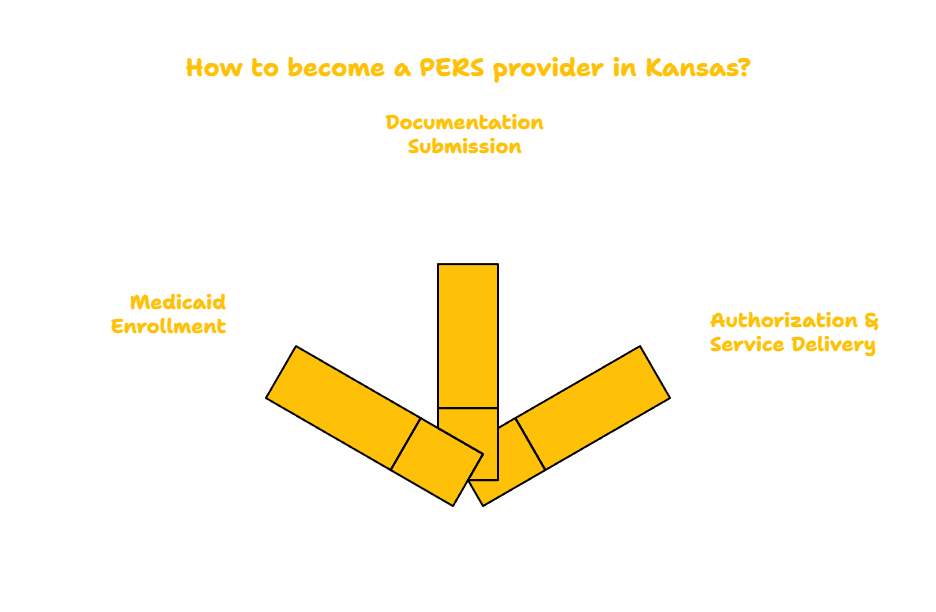
The transition to becoming a Kansas Medicaid PERS provider requires rigorous attention to administrative and regulatory prerequisites. Businesses must first be registered with the Kansas Secretary of State and secure both an Employer Identification Number (EIN) and a Type 2 National Provider Identifier (NPI). Once these foundational steps are complete, the agency must enroll with the Kansas Medical Assistance Program (KMAP) specifically under the Assistive Technology or Specialized Medical Equipment category.
Following KMAP enrollment, the provider must navigate the credentialing processes of the specific KanCare MCOs operating in the state. This phase requires the submission of extensive documentation, including proof of general and product liability insurance, signed agreements with a 24/7 monitoring center, and a comprehensive PERS Policies & Procedures Manual. This manual must explicitly detail the agency's approach to data protection, HIPAA compliance, device maintenance protocols, and the specific workflows used to respond to emergency alerts.
How Do Staffing and Operational Standards Ensure Compliance?
Staffing requirements for a PERS provider focus on technical proficiency and emergency response reliability. Installers and technicians must demonstrate experience with electronics and technology, possess a clear background check, and maintain professional customer service standards. Because the service is inherently mission-critical, the monitoring center operations—whether managed in-house or outsourced—must guarantee 24/7 availability, system redundancy, and rigorous adherence to data protection standards.
Ongoing staff development is mandatory to maintain compliance. All personnel involved in the delivery or monitoring of PERS must undergo training on HIPAA and confidentiality standards, participant sensitivity, and accessibility needs. Furthermore, providers must ensure their team is proficient in the agency’s specific emergency escalation procedures and that they perform annual reviews of device protocols to maintain the quality of service delivery.
- PERS Installer/Technician: Technical aptitude, background clearance, and customer service proficiency.
- Monitoring Center Operator: 24/7 availability, crisis response training, and HIPAA compliance.
- Mandatory Training: HIPAA privacy, participant sensitivity, escalation workflows, and annual protocol reviews.
Which Medicaid Programs and Waivers Cover PERS Services?
PERS is a reimbursable service across several Kansas HCBS waiver programs, provided the service is deemed medically necessary and is integrated into the participant’s ISP. The primary waivers that include PERS support are the Frail Elderly (FE) Waiver, the Physical Disability (PD) Waiver, the Brain Injury (BI) Waiver, and the Technology Assisted (TA) Waiver. In some instances, the Intellectual/Developmental Disability (IDD) Waiver may also cover PERS, though its application is more limited.
The delivery setting for these services is most commonly the participant’s private residence, though providers may also install and maintain units in assisted living facilities, provided the service is not already included in the facility's bundled rate. For mobile units, the scope of the service extends to community-based settings, ensuring the participant remains protected even while traveling. Providers must remain diligent in confirming coverage eligibility with the participant’s MCO before finalizing any service authorization.
Frequently Asked Questions
What documents are required to begin the enrollment process?
Providers must submit their Kansas business license, IRS EIN, NPI confirmation, and proof of liability and product insurance. Additionally, a comprehensive PERS Provider Policy & Procedure Manual—covering emergency response workflows, HIPAA compliance, and maintenance logs—is essential for approval.
How long is the typical timeline for launching a PERS business?
The process generally spans several months. Business formation and monitoring contracts typically take 1–2 months, Medicaid enrollment and MCO credentialing take 2–3 months, and final procurement and staff training add another 1–2 months before services can launch.
Is monitoring center outsourcing permitted?
Yes, providers may use an outsourced monitoring center, provided that the facility meets all state and federal requirements for 24/7 operation, data redundancy, and HIPAA-compliant emergency handling. The provider remains responsible for the quality of services delivered by the third-party partner.
Key Takeaway for New Providers
Launching a PERS agency in Kansas requires a strategic approach that balances administrative rigor with the operational demands of 24/7 emergency care. By aligning business protocols with KDHE and KDADS requirements, and maintaining a close working relationship with KanCare MCOs, providers can build a sustainable and compliant service that ensures safety and independence for Kansas Medicaid participants. Success rests on meticulous documentation, consistent device maintenance, and a robust, scalable infrastructure for monitoring and response.
Last verified: 2024. The information provided in this article is for educational purposes only and does not constitute legal or professional advice. Always refer to the most recent Kansas Department of Health and Environment (KDHE) and Kansas Department for Aging and Disability Services (KDADS) provider manuals for the latest regulatory requirements.