PERSONAL EMERGENCY RESPONSE SYSTEM (PERS) PROVIDER IN ALASKA
By Fatumata Kaba · 2025-07-03 · 5 min read
ENSURING SAFETY AND RAPID RESPONSE FOR INDIVIDUALS WITH DISABILITIES AND CHRONIC CONDITIONS
Personal Emergency Response System (PERS) services in Alaska function as a vital lifeline, providing individuals with a direct electronic connection to emergency assistance to support independence and safety within their homes and communities. Authorized under Alaska’s Home and Community-Based Services (HCBS) Medicaid Waiver programs, these services provide essential peace of mind to participants, their families, and caregivers by ensuring a rapid, reliable response during critical incidents.
What Are PERS Services and How Do They Support Waiver Participants?
PERS services encompass the comprehensive provision, installation, maintenance, and ongoing monitoring of electronic communication devices. These systems are specifically designed to allow an individual to summon help at the push of a button—or through automated sensors—when faced with a medical emergency or a fall. By integrating technology into the participant's daily routine, PERS services mitigate the risks associated with living alone or managing complex chronic health conditions.
To deliver these services effectively, an approved provider must do more than just install a device. Providers are responsible for ensuring that the system is fully functional, conducting routine battery and connectivity checks, and offering thorough training to participants and their caregivers on how to utilize the equipment. Furthermore, the service includes coordination with emergency responders and designated support contacts to ensure that once an alert is triggered, a structured and efficient response is executed.
- Installation and setup of emergency response equipment in the participant's home.
- Continuous 24/7 monitoring services linked to a professional call center.
- Integration of mobile PERS technology for off-site protection, where authorized.
- Proactive maintenance, including routine testing and device troubleshooting.
- Ongoing education for participants and caregivers regarding equipment usage.
What Are the Governance and Regulatory Requirements for PERS Providers?
The regulatory framework for PERS in Alaska is overseen by the Alaska Department of Health, specifically the Division of Senior and Disabilities Services (SDS). SDS holds the authority to approve providers, monitor the quality of service delivery, and ensure that all operations remain in strict compliance with waiver guidelines. In addition to SDS oversight, Alaska Medicaid—managed under the Department of Health—oversees provider enrollment and the reimbursement process for these services.
On a federal level, the Centers for Medicare & Medicaid Services (CMS) provides the overarching mandate for HCBS waiver programs. CMS requires that all services adhere to principles of participant-centered care, ensuring that PERS is not a duplicative service but rather a tailored solution for the specific needs identified in the individual’s person-centered service plan. Compliance with these standards is critical for maintaining an active provider status.
What Steps Are Required for SDS Provider Enrollment?
Launching a PERS agency requires a phased approach to ensure operational readiness. Prospective providers should begin by requesting the official PERS provider application packet from SDS. It is strongly recommended that new applicants attend an HCBS waiver orientation session, which provides foundational knowledge on state expectations and the nuances of the waiver programs.
Once the application is submitted, the focus shifts to a program readiness review. SDS will evaluate the applicant’s emergency call protocols, staff qualifications, and the integrity of their documentation systems. This process often includes a practical demonstration of how the provider handles device installation and emergency communications. Upon achieving SDS approval, the entity must finalize its enrollment with Alaska Medicaid through the Management Information System (MMIS) to configure billing codes and service agreements.
- Submit comprehensive documentation including business structure and operational protocols.
- Undergo an SDS readiness evaluation of monitoring center procedures and staff training records.
- Complete the Medicaid enrollment process to become an authorized billing provider.
- Select appropriate service billing codes corresponding to the specific HCBS waiver.
Which Documentation and Operational Standards Must Be Maintained?
Maintaining high standards of documentation is the cornerstone of a successful PERS agency. Every provider is required to have an SDS-compliant Policy and Procedure Manual. This document serves as the internal blueprint for operations, covering everything from the participant intake process to the specific protocols used when an emergency alert is received. It must be readily available for state audits and quality assurance reviews.
Operational documentation must be meticulous. This includes logs for every device installed, maintenance history, and incident response records that track the time and nature of every alert and the subsequent action taken. Additionally, providers must secure formal documentation regarding participant privacy, informed consent, and the verification of staff training, ensuring that every person interacting with the client is fully qualified to handle emergency situations.
Staffing, Training, and Professional Requirements
A PERS agency’s efficacy is dependent on its staff. The PERS Coordinator or Supervisor serves as the primary contact for compliance and technical oversight, requiring a solid background in emergency response operations and Medicaid documentation. Meanwhile, PERS Technicians or Installers must be skilled in hardware installation and patient interaction, as they are often the primary face of the organization when entering a participant’s home.
Continuous training is mandatory for all personnel. Staff must be well-versed in SDS-specific emergency response protocols, confidentiality standards, and client rights. Because the reliability of the device is paramount, all technical staff must undergo rigorous training on troubleshooting, equipment maintenance, and the specific communication procedures required to alert local emergency services or family caregivers during an incident.
Frequently Asked Questions
Which Medicaid Waivers cover PERS services in Alaska?
PERS services are authorized under several Alaska Medicaid waivers, including the Alaskans Living Independently (ALI) Waiver, the Adults with Physical and Developmental Disabilities (APDD) Waiver, the Individuals with Intellectual and Developmental Disabilities (IDD) Waiver, and the Children with Complex Medical Conditions (CCMC) Waiver.
What are the primary hardware and monitoring requirements for a new provider?
Providers must maintain a 24/7 response center, either in-house or through a contracted vendor that meets SDS standards. The monitoring center must be UL-listed or fulfill equivalent safety criteria, and the organization must demonstrate the ability to provide, install, and maintain electronic systems that allow for immediate emergency communication.
How long does the typical startup process take to reach enrollment?
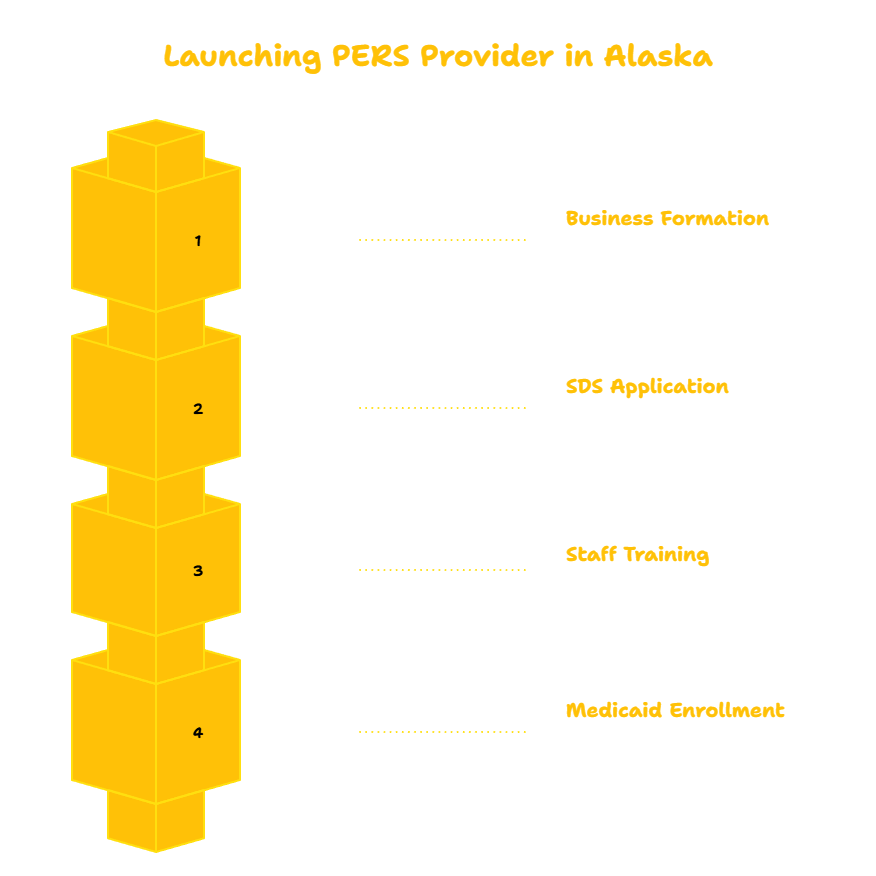
The timeline varies based on operational preparation, but generally, business formation takes 1–2 weeks, the SDS application and readiness review takes 60–90 days, staff training and testing takes 30–45 days, and Medicaid enrollment via MMIS takes 45–60 days.
Key Takeaways for Prospective PERS Providers
Entering the Alaska PERS provider market requires a disciplined focus on regulatory compliance, operational readiness, and robust emergency response infrastructure. Success is contingent upon obtaining proper licensure, developing a comprehensive policy manual that satisfies SDS requirements, and ensuring that all staff are fully trained in the specialized communication and maintenance protocols necessary to serve the Medicaid waiver population effectively.
Last verified: 2024. The information provided in this article is for educational purposes only and does not constitute legal or professional advice. Always refer to the latest Alaska Department of Health and SDS provider manuals and regulatory statutes for current requirements, as policies are subject to change.