PERSONAL EMERGENCY RESPONSE SYSTEM (PERS) PROVIDER IN ALABAMA
By Fatumata Kaba · 2025-06-24 · 5 min read
A Personal Emergency Response System (PERS) in Alabama is an essential electronic safety tool designed to provide 24/7 monitoring and emergency support for individuals with intellectual and developmental disabilities. These systems allow participants to access immediate help at the press of a button, fostering greater independence and safety for those living in the community as part of the state’s Home and Community-Based Services (HCBS) Medicaid Waiver programs.
What is the Role of Governing Agencies in Alabama PERS Delivery?
The delivery of PERS in Alabama is governed by a collaboration of state and federal entities that ensure the safety, clinical appropriateness, and fiscal integrity of the program. The Alabama Department of Mental Health (ADMH) serves as the primary regulatory body, tasked with the approval and ongoing monitoring of HCBS waiver providers. Their oversight ensures that vendors maintain the technical and operational standards necessary to support vulnerable populations.
Complementing the ADMH, the Alabama Medicaid Agency manages the fiscal administration of the program, including provider enrollment, claims processing, and billing oversight. At the federal level, the Centers for Medicare & Medicaid Services (CMS) provides the overarching regulatory framework and federal oversight for all Medicaid HCBS programs. Together, these agencies ensure that every PERS provider adheres to strict safety protocols and delivers high-quality, reliable service to waiver participants.
How Do Providers Meet Licensing and Operational Prerequisites?
Becoming an approved PERS provider requires rigorous preparation to meet both business and technical standards. Potential providers must first establish a legal business entity by registering with the Alabama Secretary of State, followed by obtaining an Employer Identification Number (EIN) and a Type 2 National Provider Identifier (NPI). These foundational steps are necessary to formalize the business structure within the state's healthcare provider ecosystem.
Beyond legal formation, providers must demonstrate the operational infrastructure required to maintain 24/7 reliability. This includes securing a physical service base in the region and ensuring that there is a robust system in place for the installation and maintenance of wearable or stationary devices. Providers must prove they have the capacity for constant monitoring and that they possess comprehensive data backup and emergency protocols that meet the specific criteria set forth by the ADMH.
- Register business with the Alabama Secretary of State.
- Secure EIN and NPI (Type 2).
- Establish a physical office or service base in Alabama.
- Demonstrate operational capacity for 24/7 installation, repair, and monitoring.
- Implement data backup and emergency escalation protocols.
What is the Step-by-Step Process for ADMH Provider Enrollment?
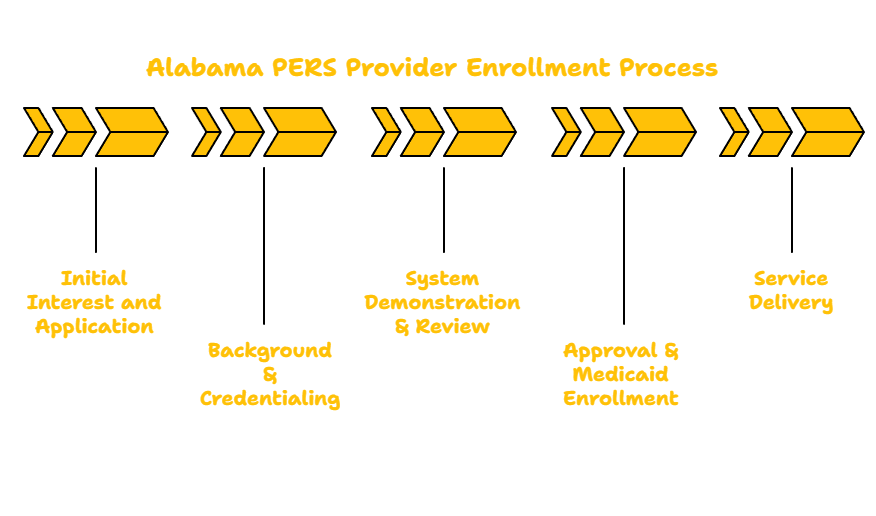
The enrollment process is a multi-phase undertaking that moves from initial application to final systems verification. Initially, prospective providers must request the PERS Provider Application Packet from the ADMH and submit a detailed business plan. This plan should explicitly outline the company's monitoring protocols, the installation process for devices, technology standards, and comprehensive escalation procedures for emergency situations.
Once the application is submitted, the agency conducts an extensive background and credentialing check. This includes mandatory criminal background checks for all staff involved in installation or support, as well as clearance through registries that track abuse and neglect. Furthermore, providers must undergo a system demonstration to prove their platforms are HIPAA-compliant and fully capable of handling emergency signals around the clock. Final approval is only granted once these technical standards are verified, allowing the provider to proceed to Medicaid enrollment and the activation of service codes.
How Do PERS Providers Maintain Documentation and Staffing Standards?
Administrative compliance is a cornerstone of the PERS provider model. Providers are required to maintain a comprehensive Policy & Procedure Manual that covers every aspect of service delivery, including system installation, emergency response workflows, and incident reporting. Detailed records must be kept regarding equipment maintenance, call logs, and staff training to ensure that the provider remains audit-ready at all times. Failure to maintain these documents can result in a suspension of Medicaid billing privileges.
Staffing requirements are equally stringent to ensure that every participant receives prompt and professional assistance. Key roles include a PERS Program Administrator, who must possess deep technical and administrative experience, as well as field technicians trained in hardware installation and safety. All personnel—whether they are monitoring center operators or field staff—must complete mandatory ADMH orientation, privacy training, and annual quality assurance refreshers to stay current with evolving program requirements.
- Articles of Incorporation or LLC Certificate.
- ADMH-compliant Policy & Procedure Manual.
- Call center standards and procedures.
- Equipment replacement and maintenance logs.
- Proof of staff training and HIPAA compliance certification.
Which Medicaid Waivers Cover PERS Services in Alabama?
PERS services are authorized under specific Alabama Medicaid waivers designed to support individuals with intellectual and developmental disabilities living in the community. These waivers include the ID Waiver, the LAH Waiver, and the State of Alabama Community Waiver Program. Each of these programs is designed to keep individuals safely in their homes rather than in institutional settings, and PERS plays a vital role in that strategy.
When an individual is authorized for PERS through their person-centered service plan, the approved provider is responsible for the full lifecycle of the service. This involves the initial installation and configuration of the monitoring unit and wearable device, ongoing monthly maintenance and technical support, and the constant 24/7 monitoring required to trigger an emergency response when needed. Providers must ensure that every service activity is accurately documented to support ongoing billing and compliance monitoring.
Frequently Asked Questions
What is the typical timeline for becoming a PERS provider?
The timeline varies by applicant, but generally involves 0–1 week for business formation, 60–90 days for the ADMH application review, 30–45 days for system demonstration and approval, and 60–90 days for Medicaid enrollment.
Is a physical office required in Alabama?
Yes, providers are expected to establish a physical office or a designated service base within Alabama to ensure that they can provide the necessary installation and maintenance support to waiver participants across the region.
Are monitoring centers allowed to be subcontracted?
Yes, providers may utilize in-house or subcontracted monitoring centers. Regardless of the setup, the primary provider remains responsible for ensuring the center meets all ADMH emergency call-handling standards, HIPAA compliance training, and 24/7 availability.
Key Takeaway
Operating as a PERS provider in Alabama requires a commitment to rigorous regulatory compliance, technical precision, and a deep understanding of the ADMH and Medicaid waiver landscapes. Success in this field is predicated on the ability to maintain 24/7 operational readiness while ensuring that every administrative document, background check, and system maintenance log is perfectly aligned with state standards. By focusing on these core requirements, providers can successfully deliver a critical safety net that empowers individuals with disabilities to maintain their independence within their own communities.
Last verified: October 2023. This content is for informational purposes only and does not constitute legal or professional advice. Always refer to the official Alabama Department of Mental Health (ADMH) and Alabama Medicaid Agency guidelines for the most current regulatory requirements.