PERSONAL EMERGENCY RESPONSE SERVICES (PERS) PROVIDER IN MICHIGAN
By Fatumata Kaba · 2025-07-27 · 5 min read
ENHANCING SAFETY AND INDEPENDENCE THROUGH EMERGENCY RESPONSE TECHNOLOGY
Personal Emergency Response Services (PERS) in Michigan are critical support tools that allow older adults and individuals with disabilities to maintain their independence within community settings. By providing 24/7 access to emergency assistance through wearable or in-home devices, PERS providers ensure that participants can receive rapid intervention during health crises, directly supporting the goals of the Michigan Home and Community-Based Services (HCBS) Medicaid waivers.
What Are the Governing Agencies and Regulatory Framework for PERS in Michigan?
The delivery of PERS in Michigan is strictly regulated to ensure high standards of participant safety and system reliability. The Michigan Department of Health and Human Services (MDHHS) acts as the primary governing body, overseeing provider enrollment, service authorization, and ongoing Medicaid compliance. This agency sets the operational standards that all PERS providers must meet to participate in the state’s waiver programs.
At the federal level, the Centers for Medicare & Medicaid Services (CMS) provides oversight to ensure that Michigan’s waiver programs remain in alignment with federal HCBS rules. Additionally, the Michigan Medicaid Agency manages the fiscal side of these services, including provider enrollment and the reimbursement protocols for authorized services. Understanding the intersection of these agencies is the first step for any organization seeking to enter the PERS market in Michigan.
- Michigan Department of Health and Human Services (MDHHS): Responsible for provider enrollment, service authorization, and statewide compliance.
- Michigan Medicaid Agency: Manages Medicaid provider enrollment and handles claims reimbursement for PERS.
- Centers for Medicare & Medicaid Services (CMS): Provides federal oversight to ensure adherence to HCBS waiver mandates.
What Does the Service Scope for a PERS Provider Entail?
A PERS provider’s primary responsibility is to maintain a robust, 24/7 monitoring infrastructure that connects participants to emergency responders. This service is more than just providing a device; it is a comprehensive safety solution that includes the initial setup, consistent technical maintenance, and user education to ensure the participant knows exactly how to trigger an alert when needed.
Approved providers are expected to deliver a full suite of services, including the installation of wearable or in-home units and the regular testing of equipment to ensure functionality. Furthermore, providers must maintain meticulous documentation of all activations, false alarms, and emergency responses. This data is essential for both clinical oversight and quality assurance reviews conducted by MDHHS.
- Installation and maintenance of PERS devices, including wearable pendants and base units.
- Comprehensive user training on device operation and personalized emergency protocols.
- 24/7 monitoring and response services to ensure immediate help during a crisis.
- Scheduled equipment testing and routine maintenance checks.
- Standardized documentation of all emergency activations and communication logs.
What Are the Essential Licensing and Provider Approval Requirements?
Launching a PERS agency requires a solid foundation in both business compliance and technical proficiency. Before beginning the application process, an organization must be legally registered with the Michigan Department of Licensing and Regulatory Affairs (LARA). You must also secure an Employer Identification Number (EIN) from the IRS and a Type 2 National Provider Identifier (NPI) to function as an organizational entity within the Medicaid system.
Beyond legal documentation, providers must demonstrate the physical and technical capacity to serve the population. This includes maintaining a physical office within Michigan and providing evidence of technical expertise regarding PERS hardware. You must also develop and adopt formal policies for device monitoring, client privacy, and emergency response procedures that align with state expectations for participant safety.
How Should a Provider Navigate the Enrollment Process?
The enrollment process is a structured sequence of applications, credentialing, and site reviews. The initial phase begins by requesting the PERS Provider Application Packet directly from MDHHS. This phase is heavily focused on the submission of a detailed business plan that outlines your specific technical protocols, including how you handle equipment installation, user training, and 24/7 monitoring.
Following the document submission, the provider will undergo a rigorous background and credentialing review. This process verifies that all staff members—especially those with direct access to clients or equipment installation—have undergone necessary background checks. Finally, a Program Readiness Review is conducted to ensure that your infrastructure is fully operational and that your staff is trained and ready to meet the state’s emergency response requirements.
What Documentation and Staffing Standards Are Required for Compliance?
Operational success relies on maintaining a comprehensive Policy & Procedure Manual. This manual must explicitly cover installation protocols, emergency response flows, training curricula for both the user and their caregivers, and strict financial tracking logs. You will need to provide Articles of Incorporation, proof of an office lease, and evidence of your NPI and EIN registration as part of the formal application file.
Staffing requirements are equally specific. You must hire personnel capable of filling key roles such as a PERS Program Manager, a PERS Technician, and a Monitoring Specialist. All staff must undergo MDHHS orientation and complete training on HCBS waiver requirements, ethics, client rights, and confidentiality. Ongoing annual training on device maintenance and emergency safety protocols is mandatory to maintain an active provider status.
Which Medicaid Waivers Authorize PERS?
PERS is authorized under several specific Michigan Medicaid waiver programs, each targeting different populations but sharing a common goal of fostering independence. Organizations must be familiar with the nuances of these programs to effectively bill for their services and assist their clients.
- MI Choice Waiver: Targeted toward older adults and individuals with disabilities.
- Habilitation Supports Waiver: Designed to provide necessary supports for individuals with developmental disabilities.
- Children’s Waiver Program: Focused on providing specialized support for children with serious emotional disturbances or complex medical needs.
Frequently Asked Questions
What is the typical timeline for launching a PERS provider business in Michigan?
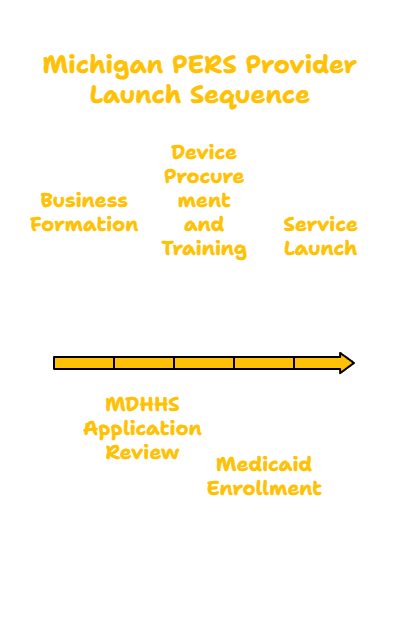
The timeline varies based on organizational readiness, but the process generally involves business formation (0–1 weeks), an MDHHS application review (60–90 days), device procurement and staff training (30–60 days), and a final Medicaid enrollment phase (60–90 days).
Is a physical office required to be an authorized PERS provider?
Yes, providers must maintain a physical office or service center located within the state of Michigan to facilitate local device maintenance, equipment storage, and administrative oversight.
Do staff members need specific credentials to perform installations?
While no state-specific license is required for installation, all technicians must be trained in the specific hardware deployed, client safety, and emergency response protocols, and they must be cleared through mandatory background checks.
Key Takeaway
Launching a PERS agency in Michigan requires a disciplined approach to MDHHS regulatory compliance, technical proficiency in emergency monitoring equipment, and a commitment to the safety of waiver participants. By systematically addressing business formation, staff credentialing, and the specific documentation standards required by Michigan’s Medicaid waiver programs, providers can establish a successful operation that offers essential support to their local community.
Last verified: October 2023. Disclaimer: This information is for educational purposes only and does not constitute legal or professional advice. Regulatory requirements are subject to change; please consult directly with the Michigan Department of Health and Human Services (MDHHS) for the most current provider enrollment guidelines and policies.