PERSONAL CARE SERVICES PROVIDER IN WISCONSIN
By Fatumata Kaba · 2026-04-14 · 5 min read
DELIVERING IN-HOME ASSISTANCE WITH DAILY ACTIVITIES TO SUPPORT DIGNITY, INDEPENDENCE, AND SAFETY FOR INDIVIDUALS WITH FUNCTIONAL LIMITATIONS
Personal Care Services (PCS) in Wisconsin provide essential hands-on assistance with activities of daily living (ADLs) to Medicaid-eligible individuals, enabling them to maintain their independence in home and community-based settings. For aspiring provider agencies, successfully entering this market requires strict adherence to Wisconsin Department of Health Services (DHS) regulations, ForwardHealth enrollment protocols, and rigorous Registered Nurse (RN) supervisory standards.
Understanding the Regulatory Framework and Oversight
The delivery of Personal Care Services in Wisconsin is governed by a robust regulatory structure designed to protect vulnerable populations. The Wisconsin Department of Health Services (DHS) serves as the primary regulatory body, establishing the policies, rate settings, and compliance standards that all agencies must follow. ForwardHealth acts as the operational arm, managing the critical processes of provider enrollment, prior authorization (PA) for services, and the processing of Medicaid claims.
For services delivered under specific waiver programs, such as Family Care or IRIS (Include, Respect, I Self-Direct), the oversight becomes more localized. IRIS Consultant Agencies (ICA) and Managed Care Organizations (MCOs) play a pivotal role in coordinating and authorizing PCS for their respective members. Providers must maintain a deep understanding of both State Plan requirements and the specific nuances of waiver-based service delivery to ensure continuous compliance and seamless reimbursement.
Essential administrative components include:
- Adherence to DHS 105 and DHS 107 regulatory codes.
- Maintenance of a comprehensive Policy & Procedure Manual.
- Engagement with MCOs for participants enrolled in managed care plans.
- Verification of participant eligibility through the ForwardHealth portal.
Core Scope of Personal Care Services
Personal Care Services are categorized as medically necessary, non-skilled assistance provided to individuals whose medical condition or disability prevents them from performing daily living tasks independently. These services are not intended for general companionship but rather for specific, defined physical assistance that supports health and hygiene. Every care plan must be rooted in an objective assessment, primarily the Personal Care Screening Tool (PCST).
The scope of authorized services is narrow and must be directly linked to the participant's specific functional limitations. Registered Nurses are responsible for the development and ongoing management of the Plan of Care (POC), ensuring that every service provided aligns with the physician-ordered plan. Documentation must clearly reflect that services provided are within the approved scope, as any deviation may lead to claim denials or audit findings.
Covered services typically include:
- Bathing, grooming, and basic hygiene.
- Dressing and undressing assistance.
- Toileting and incontinence care.
- Mobility, transfers, and positioning.
- Eating and feeding assistance.
- Medication reminders (strictly non-administrative).
- Light housekeeping directly related to the participant's health needs.
Navigating the Provider Enrollment Process
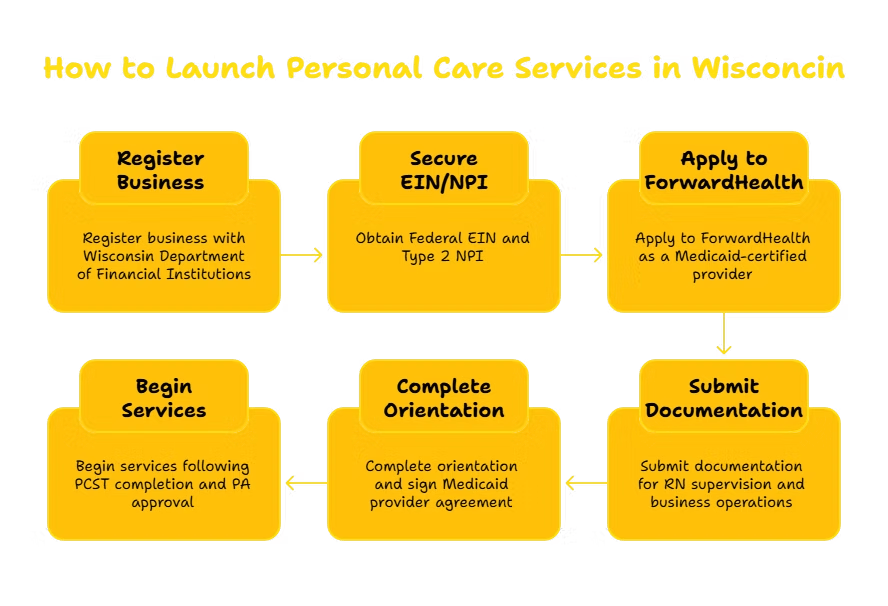
Establishing a new PCS agency requires a disciplined, multi-step approach to meet ForwardHealth requirements. The process begins with foundational business registration via the Wisconsin Department of Financial Institutions (DFI) and the acquisition of a Federal EIN and a Type 2 National Provider Identifier (NPI). These are the prerequisites for all subsequent state-level applications.
Once the business is legally established, the agency must apply for Medicaid provider certification through ForwardHealth. This involves submitting detailed documentation that proves the agency's ability to provide RN supervision and maintain operational standards. Because the state maintains strict oversight, agencies must be prepared to demonstrate that their internal systems—ranging from billing to care coordination—are fully functional before service delivery commences. Upon approval, providers receive their enrollment credentials, which serve as the key to securing prior authorizations and submitting claims.
Staffing, Training, and RN Supervision Requirements
The quality and compliance of a Personal Care Services agency rely heavily on the competency of its staff. Every Personal Care Worker (PCW) must be at least 18 years of age and hold proof of completing a DHS-approved training program (a minimum of 16 hours). Furthermore, all staff must undergo rigorous background checks in compliance with the Wisconsin Caregiver Background Check Law to ensure the safety of participants.
Registered Nurses are the clinical cornerstone of the agency. Their role is extensive, encompassing the initial assessment of the participant, the creation of the POC, and the ongoing supervision and skills validation of PCWs. Agencies are required to implement structured training programs that cover HIPAA compliance, infection control, abuse and neglect prevention, and universal precautions. Regular competency checks are mandatory to ensure that the care being delivered remains both safe and effective over time.
Operational Documentation and Compliance
A successful agency is built upon the foundation of meticulous documentation. ForwardHealth and the DHS conduct audits to verify that the care billed matches the care documented. This necessitates robust systems for tracking daily care logs, shift verification, and nurse supervision visits. Every action taken by a PCW must be cross-referenced with the authorized POC and the PCST findings.
Beyond clinical logs, an agency must maintain a comprehensive Policy & Procedure Manual. This document is not merely a requirement for enrollment; it is a live guide for daily operations. It must include clear protocols for grievance procedures, infection control, medication reminders, and the ethical treatment of participants. Agencies that invest in high-quality documentation templates from the outset typically face significantly lower risks during state-led compliance audits.
Frequently Asked Questions
What is the role of the Personal Care Screening Tool (PCST)?
The PCST is a standardized assessment tool used to determine the amount of personal care time an individual requires based on their functional limitations. It serves as the primary data point for authorizing the number of hours of care that a participant is eligible to receive through ForwardHealth.
Can a family member act as a Personal Care Worker?
In many cases, yes. Under the IRIS program and certain other waiver frameworks, participants have the autonomy to self-direct their care, which may include hiring family members or friends as their PCWs, provided those individuals meet the standard training and background check requirements of the agency or the fiscal employer agent.
How does the RN supervisor maintain oversight of remote staff?
RN supervisors are required to conduct periodic on-site visits to observe the care provided and ensure it aligns with the Plan of Care. Additionally, they must review the daily documentation completed by PCWs to ensure that services remain within the scope of the physician-ordered POC and to address any changes in the participant's condition.
Key Takeaways for Provider Success
Successfully operating as a Personal Care Services provider in Wisconsin necessitates a relentless focus on compliance with DHS and ForwardHealth regulations. By prioritizing rigorous staff training, maintaining clear and accurate documentation, and ensuring that Registered Nurse supervision is deeply integrated into daily service delivery, agencies can effectively support the independence of Wisconsin’s vulnerable populations while building a sustainable and audit-ready business model. Establishing these systems correctly at the launch phase is essential for long-term operational success.
Last verified: October 2023. Disclaimer: This article is for informational purposes only and does not constitute legal or professional regulatory advice. Regulations governing Wisconsin Medicaid and Personal Care Services are subject to change. Always refer directly to the official ForwardHealth website and current Wisconsin DHS statutes for the most accurate and up-to-date guidance.