PERSONAL CARE SERVICES PROVIDER IN WASHINGTON
By Fatumata Kaba · 2026-04-06 · 5 min read
SUPPORTING INDIVIDUALS WITH DAILY LIVING TASKS TO PROMOTE DIGNITY, SAFETY, AND INDEPENDENCE AT HOME
Launching a Personal Care Services (PCS) agency in Washington requires navigating a sophisticated multi-agency regulatory landscape designed to ensure high-quality, non-medical support for vulnerable populations. By aligning business operations with the rigorous requirements of the Washington State Health Care Authority (HCA) and the Department of Social and Health Services (DSHS), providers can successfully deliver essential home-based care that promotes participant independence.
What are the regulatory and oversight bodies governing Washington PCS providers?
The Washington long-term care ecosystem is governed by a tripartite structure of agencies, each with distinct responsibilities. The Washington State Health Care Authority (HCA) serves as the primary entity for Medicaid (Apple Health) administration, ensuring that clinical necessity and reimbursement protocols are upheld across the state. Without HCA approval and enrollment in the ProviderOne system, an agency cannot process claims for services rendered.
Operational oversight is largely handled by the Department of Social and Health Services (DSHS), specifically the Aging and Long-Term Support Administration (ALTSA). ALTSA manages the contracts and ongoing compliance for long-term care, including waiver-based services. For agencies serving individuals with intellectual or developmental disabilities, the Developmental Disabilities Administration (DDA) provides specialized oversight, coordinating care specifically tailored to the unique needs of that population under various Home and Community-Based Services (HCBS) waivers.
What services are authorized under the Washington Personal Care framework?
Personal Care Services are fundamentally rooted in the Person-Centered Service Plan (PCSP), a dynamic document created by a DSHS case manager or DDA representative that outlines exactly what a participant requires to remain safely in their home. These services are categorized into Activities of Daily Living (ADLs) and Instrumental Activities of Daily Living (IADLs), ensuring that support is tailored to individual functional deficits rather than generic care packages.
Core support activities authorized for delivery by home care aides typically include:
- Bathing, dressing, grooming, and personal hygiene maintenance
- Physical assistance with mobility, transfers, and positioning
- Toileting and specialized incontinence care
- Nutritional support, including meal preparation and assistance with eating
- Light housekeeping, laundry, and maintaining a sanitary environment
- Medication reminders and assistance with non-nursing tasks
- Community access and ongoing safety monitoring
How do I navigate the licensing and Medicaid contracting process?
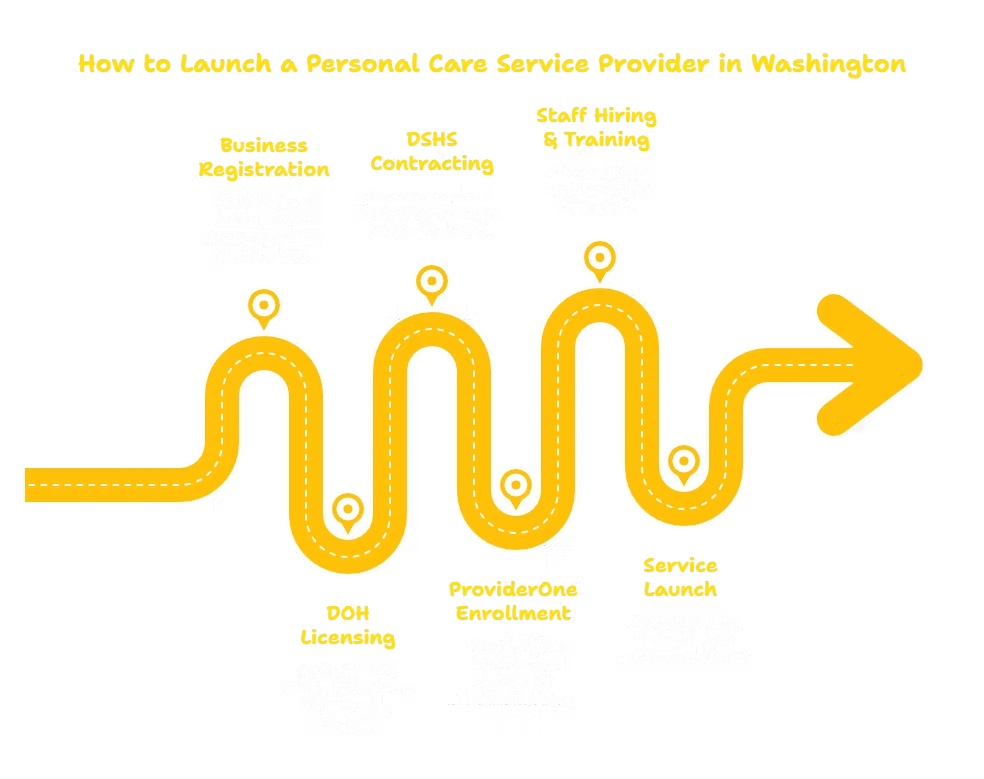
Establishing an agency is a sequential process that begins with formalizing the business entity. Before approaching the state, owners must register with the Washington Secretary of State, obtain a federal Employer Identification Number (EIN), and secure a Type 2 NPI. These foundational steps are necessary to prove the legitimacy of the agency before seeking state licensure.
The licensing path is managed primarily through the Washington State Department of Health (DOH) for the Home Care Agency License. Once licensed, the agency must initiate the contracting process with DSHS to be recognized as a Medicaid provider. This involves comprehensive documentation of the agency's policies, procedures, and financial readiness. The final step in this stage is enrolling in the ProviderOne system, which acts as the central portal for all Medicaid billing and reimbursement activities.
What are the strict operational and staff requirements?
Professional standards for staff are exceptionally high in Washington to protect the health and safety of participants. Every staff member functioning as a Home Care Aide (HCA) must be certified by the DOH, a process that includes completing a mandated 75-hour training curriculum and passing the state certification examination. Furthermore, agencies are responsible for conducting thorough background checks via DSHS to verify the suitability of all prospective employees.
Beyond initial certification, administrative infrastructure must support ongoing clinical governance. This includes the integration of a Nurse Delegator when a participant’s care plan involves tasks such as insulin injections or catheter care. Agencies are also required to maintain robust documentation systems that track the following:
- Mandatory reporter and elder abuse prevention training records
- HIPAA, confidentiality, and data privacy protocols
- Infection control and emergency preparedness strategies
- Documented staff supervision and annual continuing education (CE) logs
Which Medicaid waiver programs support these services?
Washington utilizes several pathways to fund personal care for eligible residents. The Community First Choice (CFC) option is a primary State Plan benefit available to Apple Health-eligible individuals requiring support with ADLs. For those who meet a nursing facility level of care but prefer to age in place, the COPES waiver provides a critical framework for home-based services.
Other specialized programs exist to cater to specific needs, such as the New Freedom Waiver, which emphasizes participant self-direction and provides individualized budgets for care management. Simultaneously, the DDA provides the Basic Plus and Core waivers for individuals with developmental disabilities. Each program requires strict adherence to the authorized PCSP, and services must be delivered precisely according to the hours and tasks specified in that plan.
Frequently Asked Questions
How long does the total start-up process typically take?
The timeline varies based on agency readiness, but the process generally spans several months. Business registration and licensing preparation typically require 3–5 weeks. DOH licensing and DSHS contracting is the most intensive phase, often requiring 2–3 months. Final enrollment in ProviderOne and hiring staff usually takes an additional 4–6 weeks.
Are there specific requirements for the Policy & Procedure Manual?
Yes. The state requires a comprehensive manual covering ADL/IADL task protocols, service documentation and time tracking, medication assistance guidelines, client rights and grievance procedures, staff training logs, and incident reporting protocols. This manual must be updated regularly to reflect current state regulations.
Can an agency operate without a Nurse Delegator?
If the agency provides only basic, non-nursing personal care tasks, a Nurse Delegator may not be required. However, if the agency intends to serve clients who require tasks categorized under nursing delegation—such as specific medical treatments or complex medication management—a Nurse Delegator is mandatory to supervise the Home Care Aides and ensure clinical safety.
Key Takeaway
Operating a successful Personal Care Services agency in Washington requires strict adherence to both DOH licensing standards and DSHS/HCA operational requirements. By maintaining rigorous documentation, ensuring all staff meet the 75-hour HCA certification requirements, and utilizing the ProviderOne portal effectively, agencies can provide high-quality care while maintaining compliant, sustainable operations. For those navigating this complex transition, professional guidance can assist in structuring internal policies, staffing checklists, and service delivery protocols to ensure long-term regulatory compliance.
Last verified: 2024. The information provided here is for general guidance only and does not constitute legal or professional consulting advice. Always refer to the official Washington State Department of Health (DOH), Department of Social and Health Services (DSHS), and Health Care Authority (HCA) websites for the most current regulations and program requirements.