PERSONAL CARE SERVICES PROVIDER IN VIRGINIA
By Fatumata Kaba · 2026-04-08 · 5 min read
Establishing a Personal Care Services agency in Virginia involves navigating a rigorous regulatory landscape governed by the Department of Medical Assistance Services (DMAS) and the Virginia Department of Health (VDH). Prospective providers must secure formal licensure, enroll in the Medicaid program, and establish robust administrative infrastructure to deliver essential, hands-on support for individuals relying on the CCC Plus, CL, and FIS waivers.
What Are the Core Regulatory Requirements for Personal Care Agencies?
To operate as a legal provider of personal care services in Virginia, an organization must first establish its corporate identity and secure licensure as a Home Care Organization (HCO) through the VDH. This licensure process is the foundational step that confirms the agency meets state-mandated health and safety standards. Beyond initial licensure, agencies must maintain continuous compliance with state regulations regarding operational oversight, quality of care, and personnel management.
The regulatory structure is bifurcated by the type of waiver program being served. The Commonwealth Coordinated Care (CCC) Plus Waiver, designed for older adults and individuals with disabilities, is managed through partnerships with Managed Care Organizations (MCOs). Conversely, the Community Living (CL) and Family and Individual Supports (FIS) waivers, which serve individuals with developmental disabilities, require coordination with local Community Services Boards (CSBs). Success requires a clear understanding of the specific requirements stipulated by these entities.
How Do You Successfully Navigate the Provider Enrollment Process?
Provider enrollment is a multi-phased endeavor that begins with registering your business with the Virginia State Corporation Commission (SCC) and obtaining a federal Employer Identification Number (EIN) and Type 2 National Provider Identifier (NPI). These identifiers are critical, as they form the technical backbone of your billing and administrative identity within the DMAS Medicaid Enterprise System (MES) portal.
Once your business structure is established and your VDH license is secured, the focus shifts to Medicaid enrollment. This involves submitting comprehensive documentation to DMAS to demonstrate that your agency is capable of fulfilling the requirements of the waiver programs. After achieving status as a Medicaid-approved provider, you must seek contracts with individual MCOs for CCC Plus or coordinate with CSBs for developmental disability-related services to begin accepting referrals and submitting claims for reimbursement.
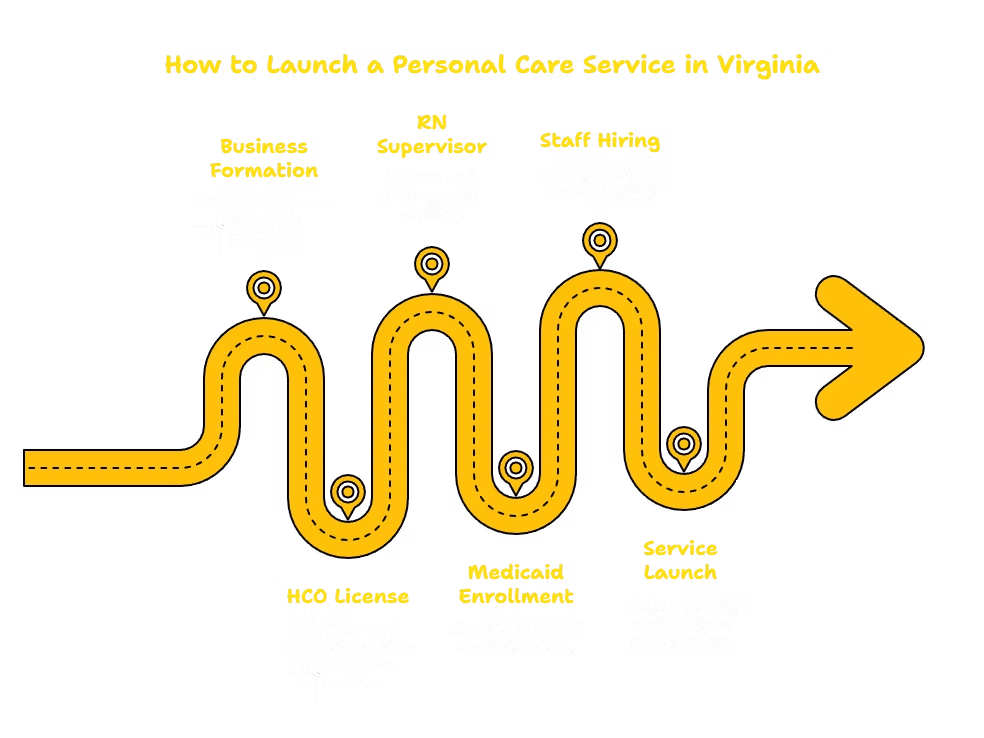
- Register your entity with the Virginia SCC and secure an EIN and Type 2 NPI.
- Obtain your Home Care Organization (HCO) license via the Virginia Department of Health.
- Complete the formal enrollment application via the DMAS Medicaid Enterprise System (MES) portal.
- Finalize participation agreements and credentialing with relevant MCOs and local CSBs.
What Constitutes Essential Infrastructure for Service Delivery?
High-quality service delivery is predicated on the strength of an agency’s Policy & Procedure Manual. This document serves as the regulatory compass for your staff, ensuring that every action—from bathing and grooming assistance to medication reminders and safety monitoring—is performed in accordance with DMAS standards. Developing a manual that covers HIPAA compliance, infection control, and incident reporting is non-negotiable for maintaining good standing.
Operational infrastructure also includes rigorous documentation practices. Because reimbursement is tied to evidence of service provision, agencies must implement reliable systems for tracking the Plan of Care (POC). This includes maintaining accurate shift notes, documenting RN supervisory visits, and managing time-tracking logs. Without precise, audit-ready documentation, an agency risks clawbacks and potential exclusion from the Medicaid program.
How Do You Manage Staffing and Training Compliance?
The quality of your agency is defined by its staff, particularly the Personal Care Aides (PCAs) who interact daily with vulnerable participants. Virginia law dictates strict training requirements, typically necessitating that PCAs complete a DMAS-approved 40-hour training curriculum or maintain certification as a Certified Nursing Assistant (CNA). A thorough onboarding process must also include background checks and TB screenings to protect the safety of the individuals being served.
The Registered Nurse (RN) supervisor occupies a vital role within this ecosystem. The RN is responsible for conducting the initial and ongoing assessments that formulate the Plan of Care, as well as providing the mandatory supervision of PCAs to ensure tasks are performed correctly. Regular in-service training and annual performance evaluations must be conducted for all employees to remain compliant with state regulations regarding competency and standard of care.
What Are the Distinctions Between the Medicaid Waiver Programs?
Understanding the specific population served by each waiver is essential for effective care coordination. The CCC Plus Waiver is primarily focused on older adults, individuals with physical disabilities, and those with complex medical needs. Service authorizations are coordinated through MCOs, which oversee the care delivery to ensure it aligns with the participant's specific functional limitations and health goals.
The CL and FIS waivers are specifically tailored for individuals with developmental disabilities. While the foundational tasks—such as assistance with activities of daily living (ADLs) and instrumental activities of daily living (IADLs)—remain similar to the CCC Plus Waiver, the administrative path for these services often involves local CSBs. Providers must ensure that the services authorized under these plans are strictly linked to the participant’s functional needs, as identified through the state’s Uniform Assessment Instrument (UII) process.
Frequently Asked Questions
What is the typical timeline for launching a personal care agency?
The timeline varies based on administrative readiness, but generally, the business formation and VDH licensing phase takes 2–3 months. Medicaid enrollment through the MES portal typically requires an additional 1–2 months, while internal staff recruitment and training take 2–4 weeks. The final launch occurs once the Plan of Care is authorized for a participant.
What are the primary responsibilities of the RN supervisor?
The RN supervisor is responsible for conducting participant assessments, developing the personalized Plan of Care, and performing the required supervisory visits to observe PCAs in the field. They must ensure that all services provided align with state regulations and the specific needs of the individual client.
How is reimbursement handled for personal care services?
Reimbursement is processed through the Medicaid program once a service has been authorized by the relevant entity—either an MCO for the CCC Plus Waiver or a CSB for the CL/FIS waivers. Providers must submit claims that are supported by validated shift documentation and evidence of service delivery in accordance with the individual’s authorized service plan.
Key Takeaway
Succeeding as a Personal Care Services provider in Virginia requires a dual focus: meticulous attention to regulatory compliance at the state level and excellence in the daily management of human resources and care documentation. By aligning your business processes with the strict requirements of DMAS, VDH, and your contracted MCOs or CSBs, you create a sustainable foundation for helping participants live safely and independently in their own homes.
Last verified: 2024. This information is intended for educational purposes only and does not constitute legal or professional consulting advice. Always refer to the latest updates from the Virginia Department of Medical Assistance Services (DMAS) and the Virginia Department of Health (VDH) regarding current regulatory requirements.