PERSONAL CARE SERVICES PROVIDER IN UTAH
By Fatumata Kaba · 2026-03-31 · 5 min read
Becoming a Personal Care Services (PCS) provider in Utah is a significant undertaking that requires strict adherence to state-mandated regulatory frameworks and administrative standards. Agencies play a vital role in Utah’s Home and Community-Based Services (HCBS) system, providing essential, non-medical support that empowers individuals with physical or cognitive limitations to maintain their independence within their homes and communities.
This guide outlines the foundational requirements, governing structures, and operational steps necessary to launch a compliant Personal Care Services agency. By aligning business operations with the guidelines set forth by the Utah Department of Health and Human Services (DHHS), the Division of Integrated Healthcare (DIH), and the Division of Services for People with Disabilities (DSPD), prospective providers can effectively establish their presence in the Medicaid provider network.
What Are the Governing Agencies and Regulatory Requirements for Utah PCS?
The regulatory landscape for PCS in Utah is multifaceted, involving both state-level departments and federal oversight. The Utah Department of Health and Human Services (DHHS) serves as the primary governing body, bifurcated into the Division of Integrated Healthcare (DIH) and the Division of Services for People with Disabilities (DSPD). These divisions manage Medicaid reimbursement, verify provider enrollment, and authorize participant care plans. Their oversight ensures that services provided are consistent with the medical necessity and individual service needs of the participant.
At the federal level, the Centers for Medicare & Medicaid Services (CMS) establishes the overarching standards for HCBS. CMS mandates that services remain person-centered and adhere to strict home-based delivery requirements. Providers must demonstrate compliance with these national standards to maintain eligibility for Medicaid reimbursement. Understanding the intersection between state policy and federal mandate is the first step in successful agency operations.
What Services Fall Under the Scope of Personal Care?
Personal Care Services are specifically designed to assist individuals with Activities of Daily Living (ADLs) and Instrumental Activities of Daily Living (IADLs). These services are authorized through an individualized Service Plan (ISP) and are intended for those who cannot perform these tasks independently due to aging, disability, or chronic health conditions. Professional providers must ensure that the care delivered directly aligns with the authorized tasks documented in the participant’s ISP.
Covered supports typically include the following:
- Bathing, grooming, and personal hygiene maintenance
- Dressing and undressing assistance
- Toileting and incontinence care management
- Support with mobility, transfers, and ambulation
- Meal preparation, feeding assistance, and nutritional support
- Light housekeeping, laundry, and necessary errands (IADLs)
- Non-skilled medication reminders
- Accompaniment to medical appointments and community integration activities
How Do Agencies Complete the Utah Provider Enrollment Process?
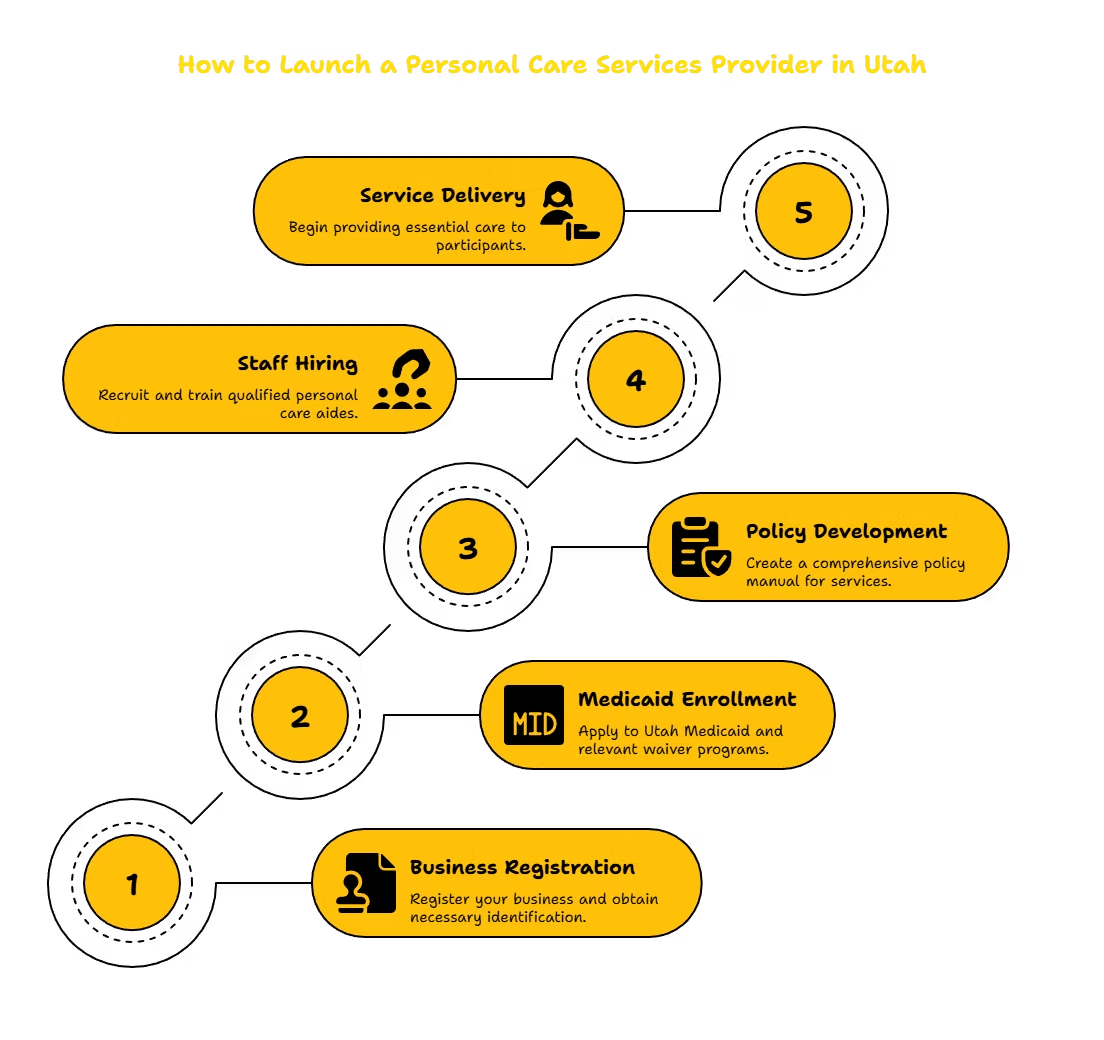
Establishing a new PCS agency requires a disciplined approach to documentation and bureaucratic procedure. The process begins with formal business registration through the Utah Division of Corporations, followed by obtaining an Employer Identification Number (EIN) and a Type 2 National Provider Identifier (NPI). These are the prerequisites for all subsequent interactions with state health authorities.
The enrollment sequence typically follows these steps:
- Register the business entity and secure federal tax and provider identification numbers.
- Submit an application to Utah Medicaid via the official Provider Enrollment Portal.
- Apply to the relevant DIH or DSPD program to secure authorization for waiver service delivery.
- Compile and upload mandatory documentation, including staffing plans, comprehensive Policy & Procedure (P&P) manuals, and internal supervision structures.
- Complete all required Medicaid and waiver-specific training modules to ensure staff competency.
- Receive final state approval before beginning service delivery and accepting participant referrals.
What Documentation and Staffing Standards Are Required?
Compliance is anchored in the quality of an agency’s Policy & Procedure Manual. This document must serve as the blueprint for agency operations, detailing protocols for ADL/IADL service delivery, participant rights, dignity, daily task logging, and emergency response procedures. Furthermore, agencies must maintain robust infection control measures and HIPAA-compliant documentation systems to ensure participant privacy and safety.
Staffing mandates are equally rigorous to protect the welfare of the participant. Personal Care Aides (PCAs) or Direct Support Professionals (DSPs) must be at least 18 years old, possess CPR/First Aid certification, and pass comprehensive background checks. Oversight is provided by a Program Coordinator or Supervisor responsible for ensuring that all care delivery strictly adheres to the Medicaid-authorized care plan. Depending on the scope of services, particularly if medication management or skilled nursing is involved, an agency may also require oversight from a Registered Nurse (RN).
Which Medicaid Waiver Programs Support Personal Care?
Personal Care Services are a key component of several distinct Medicaid waiver programs in Utah. These programs allow the state to fund care in the home, preventing or delaying institutionalization. Each waiver has specific eligibility criteria and focus populations, and providers must understand which waivers their agency is authorized to serve.
The primary programs include:
- Community Supports Waiver (CSW)
- Acquired Brain Injury (ABI) Waiver
- Physical Disabilities Waiver (PDW)
- Medically Complex Children’s Waiver (MCCW)
- New Choices Waiver (NCW) for those transitioning from institutional settings
- State Plan Medicaid Personal Care Program (based on individual clinical need)
Frequently Asked Questions
Is a Home Health Agency license required to offer Personal Care Services?
While basic PCS is non-medical, agencies that intend to provide skilled nursing or specific clinical services may be required to obtain a Home Health Agency license through the Utah Office of Licensing (OL). Prospective owners should clarify their service scope during the initial planning phase.
How long does the startup process usually take?
The timeline varies based on administrative readiness. Business registration and manual development typically take 1–2 months, while Medicaid and waiver enrollment can take 2–3 months. Hiring and internal documentation setup usually requires an additional 30–45 days before the agency is ready for active service delivery.
What ongoing training is required for staff?
All direct care staff must complete training in Abuse, Neglect, and Exploitation Prevention (ANEP), HIPAA compliance, basic infection control, emergency preparedness, and person-centered care protocols. Proper documentation of this training is mandatory for compliance audits.
Key Takeaway: Successfully launching a PCS agency in Utah centers on rigorous documentation, a clear understanding of the regulatory relationship between DIH, DSPD, and CMS, and the consistent application of person-centered care standards. By maintaining strict compliance with state enrollment and staffing requirements, providers build the foundational infrastructure necessary for long-term viability in the Medicaid HCBS market.
Last verified: May 2024. This information is provided for educational purposes and does not constitute legal or professional advice. Always consult directly with the Utah Department of Health and Human Services or legal counsel for the most current regulatory updates and individual agency requirements.