PERSONAL CARE SERVICES PROVIDER IN SOUTH DAKOTA
By Fatumata Kaba · 2025-10-15 · 5 min read
SUPPORTING DAILY INDEPENDENCE THROUGH NON-SKILLED ASSISTANCE WITH ACTIVITIES OF DAILY LIVING FOR INDIVIDUALS WITH DISABILITIES OR AGE-RELATED NEEDS
Establishing a Personal Care Services (PCS) agency in South Dakota requires navigating a multifaceted regulatory framework designed to ensure that individuals with disabilities, chronic conditions, or age-related limitations receive high-quality, non-skilled support in their own homes. By operating under Medicaid State Plan benefits and Home and Community-Based Services (HCBS) waivers—such as the CHOICES Waiver, Family Support 360, and the Long-Term Services and Supports (LTSS) programs—providers play a critical role in fostering participant independence while adhering to strict state and federal compliance standards.
Navigating the Regulatory Landscape and Governing Agencies
The provision of personal care services is governed by a collaboration between state departments and federal oversight bodies. Understanding these roles is the first step for any provider aiming to enter the South Dakota Medicaid market, as each agency holds specific authority over provider enrollment, quality assurance, and ongoing program compliance.
The South Dakota Department of Social Services (DSS), through its Division of Long-Term Services and Supports (LTSS), serves as the primary administrator for personal care services under the Medicaid State Plan and for older adults participating in HCBS waivers. Concurrently, the South Dakota Department of Human Services (DHS), specifically the Division of Developmental Disabilities (DDD), oversees the delivery of PCS for individuals enrolled in the CHOICES and Family Support 360 Waivers. At the federal level, the Centers for Medicare & Medicaid Services (CMS) sets the overarching regulatory expectations, ensuring that state programs align with federal requirements for accessibility, quality, and financial integrity.
- DSS-LTSS: Manages state plan PCS and aging-related HCBS waivers.
- DHS-DDD: Manages PCS for the intellectual and developmental disability population.
- CMS: Provides federal oversight to ensure Medicaid compliance.
Defining the Scope of Personal Care Services
Personal Care Services are categorized as non-medical, essential support services. Their primary function is to help participants maintain their health, safety, and hygiene in a community-based setting, thereby preventing or delaying the need for more restrictive institutional care.
Approved providers are responsible for delivering task-based assistance that empowers individuals to live independently. While this excludes skilled nursing care, it encompasses a wide range of daily tasks. Success in this field relies heavily on accurate documentation, including daily care logs, precise timekeeping records, and consistent, professional communication with assigned waiver case managers to ensure the service plan matches the participant's evolving needs.
- Bathing and Grooming Assistance: Supporting personal hygiene and appearance.
- Dressing and Toileting Help: Providing physical support with essential self-care tasks.
- Meal Preparation and Feeding Support: Ensuring nutritional intake and assistance with consumption.
- Mobility and Transfer Assistance: Aiding with safe movement within the home.
- Medication Reminders: Offering prompts for self-administration (not professional medication administration).
- Light Housekeeping: Maintaining the home environment related to the participant’s specific ADLs.
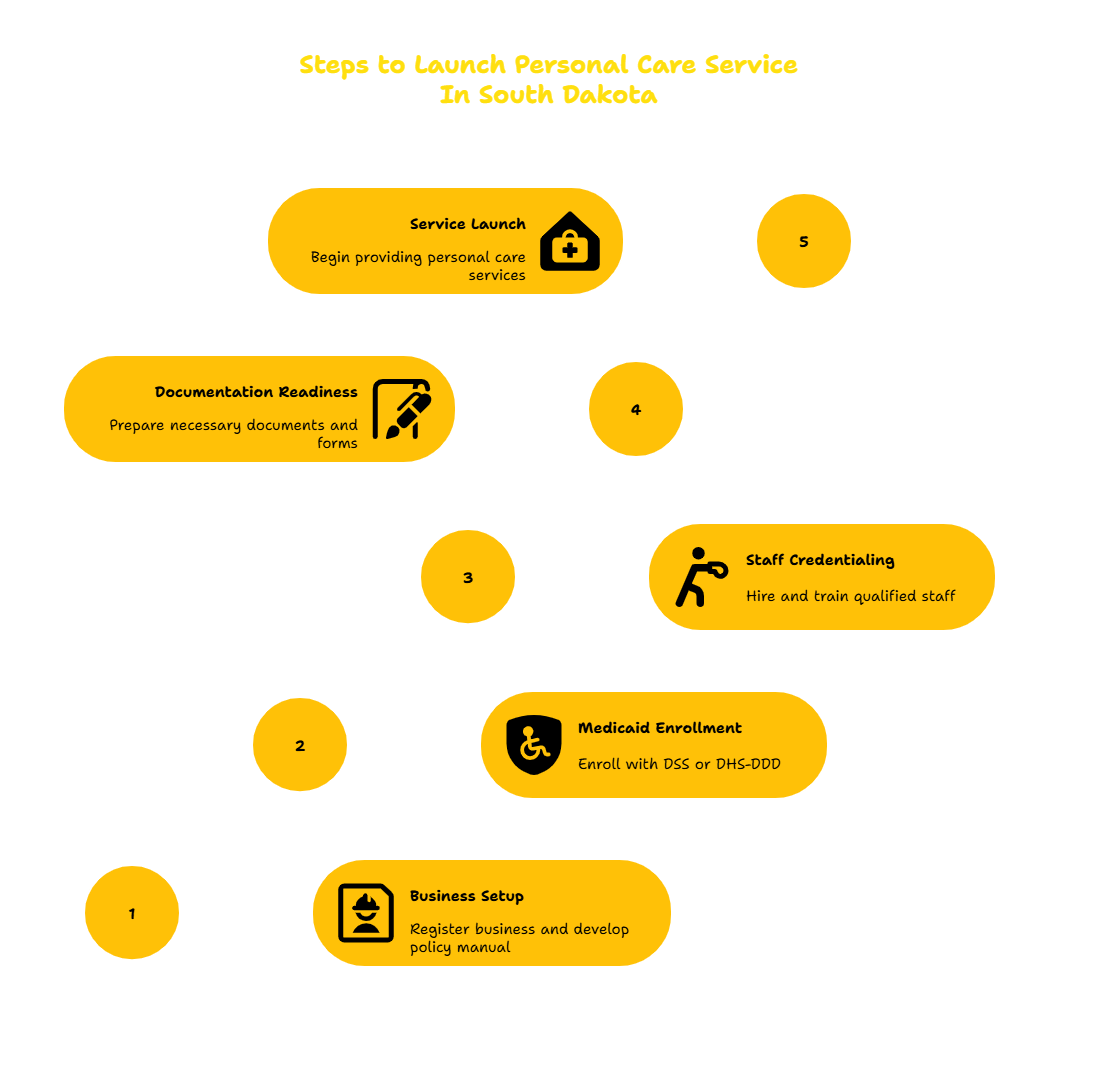
Establishing Your Agency: Licensing and Provider Requirements
Formalizing your agency requires a methodical approach to business and healthcare compliance. Before providing a single hour of care, an agency must establish a legal corporate structure, secure appropriate insurance, and develop a comprehensive internal policy framework that guides every aspect of daily operations.
Key prerequisites include registering the business with the South Dakota Secretary of State and obtaining a federal Employer Identification Number (EIN) and a Type 2 National Provider Identifier (NPI). Beyond business registration, agencies must carry adequate liability and workers’ compensation insurance to protect the business, the staff, and the participants. The development of a robust Policy & Procedure Manual is a mandatory requirement; this document serves as the backbone of your agency, detailing how you will manage intake, maintain HIPAA compliance, respond to emergencies, and conduct billing.
The Provider Enrollment Process
The enrollment path is structured to ensure that only qualified, prepared organizations interact with the Medicaid population. The process generally begins with foundational business setup and culminates in the formal approval to accept service authorizations from state case managers.
Applicants must apply to the appropriate department—either DSS-LTSS or DHS-DDD—based on their target demographic. During the enrollment phase, the agency must submit evidence of operational readiness, which includes detailed staff credentials, comprehensive policy manuals, and templates for service documentation. A readiness review may be conducted to confirm the provider is capable of meeting the rigorous documentation and quality standards required for Medicaid reimbursement. Once approved, the agency can begin receiving service authorizations and scheduling care.
Maintaining Compliance and Staffing Standards
Staffing quality is the primary driver of agency reputation and compliance. Every personal care aide must undergo thorough screening, including criminal background checks, to ensure the safety of vulnerable populations. Training is not a one-time event; all personnel are required to be proficient in ADL support, abuse prevention, and the protection of participant rights.
Supervision is a critical component of the service delivery model. Supervisors are responsible for coordinating schedules, conducting regular documentation reviews, and performing quality checks to ensure that the services being billed align with the actual care provided. Every staff member must participate in annual in-service evaluations and specialized training regarding HIPAA confidentiality, emergency response, and critical incident reporting, which ensures that agencies remain audit-ready at all times.
Frequently Asked Questions
What waivers currently authorize Personal Care Services in South Dakota?
PCS are primarily authorized through the CHOICES Waiver for adults with intellectual or developmental disabilities, the Family Support 360 Waiver, the LTSS HCBS Waiver for seniors and individuals with physical limitations, the Medicaid State Plan, and TEFRA/EPSDT for eligible children under age 21.
What is the typical timeline for launching a new agency?
While timelines vary based on internal readiness, the setup and manual development phase typically requires 1–2 months. Medicaid enrollment and staff credentialing usually take 2–3 months, followed by 30–60 days to finalize training and documentation protocols before service delivery begins.
What specific documentation must a provider keep on file?
Providers must maintain comprehensive records including business registration, NPI/EIN details, and Medicaid approval confirmations. Operational documentation must include participant intake forms, ADL assessment templates, daily service logs, timekeeping records, and evidence of compliance with HIPAA and emergency response policies.
Key Takeaways for Prospective Providers
Launching a PCS agency in South Dakota is a significant commitment that balances business administration with social responsibility. Success is predicated on a thorough understanding of the requirements set by the DSS-LTSS and DHS-DDD, a rigorous adherence to documentation standards, and a focus on hiring and training staff who are committed to the safety and independence of their participants. By following the established regulatory pathways and ensuring every policy is clearly articulated in your manuals, you position your agency to serve as a reliable partner in the South Dakota Medicaid HCBS ecosystem.
Last verified: October 2023. Disclaimer: This information is for educational purposes only and does not constitute legal or professional advice. Always check with the South Dakota Department of Social Services or the Department of Human Services for the most current rules and regulations.