PERSONAL CARE SERVICES PROVIDER IN SOUTH CAROLINA
By Fatumata Kaba · 2025-10-13 · 5 min read
Starting a Personal Care Services (PCS) provider agency in South Carolina is a strategic way to deliver essential, compassionate, hands-on support to individuals with physical, cognitive, or age-related limitations. By providing assistance with activities of daily living (ADLs) and promoting independent living, your agency plays a critical role in helping participants remain in their own homes rather than transitioning to institutionalized care settings.
This guide serves as a professional roadmap for administrators and founders seeking to navigate the regulatory landscape governed by the South Carolina Department of Health and Human Services (SCDHHS), the South Carolina Department of Health and Environmental Control (DHEC), and the Centers for Medicare & Medicaid Services (CMS). Successfully launching a PCS agency requires strict adherence to state licensing, Medicaid enrollment protocols, and rigorous quality assurance standards.
What Are the Governing Agencies and Regulatory Requirements for PCS Providers?
The regulatory framework for South Carolina PCS agencies is multi-tiered, involving federal oversight and state-level administration. SCDHHS is the primary agency responsible for administering Medicaid programs, authorizing PCS services, and overseeing the reimbursement of claims. As a provider, your primary interface for service authorization and billing will be through the SCDHHS Medicaid Provider Enrollment Portal.
Simultaneously, DHEC serves as the licensing authority for in-home care providers. Their role is to ensure that your agency maintains the health and safety standards required to operate within the state. Because federal funds are involved, CMS maintains ultimate oversight to ensure that South Carolina's Medicaid services comply with federal regulations, specifically those surrounding Home and Community-Based Services (HCBS) waivers.
- SCDHHS: Manages Medicaid eligibility, provider enrollment, and claims adjudication.
- DHEC: Sets licensing standards, performs inspections, and monitors health and safety compliance for in-home care agencies.
- CMS: Provides federal guidance and oversight for Medicaid waiver compliance.
How Do You Structure Personal Care Services and Meet Operational Standards?
Personal Care Services are categorized as non-medical, hands-on supports intended to foster independence. Your agency must be prepared to provide a comprehensive range of services tailored to individual care plans. This includes direct ADL support, such as bathing, dressing, grooming, toileting, transferring, and eating, as well as instrumental activities of daily living (IADLs) like light housekeeping, laundry, and meal preparation, provided these tasks are directly linked to the participant's functional needs.
Operational success relies heavily on your ability to document services accurately. Medicaid reimbursement is contingent upon detailed shift logs, verified care notes, and precise time-tracking. Additionally, your agency must implement robust systems for safety monitoring and the supervision of health maintenance tasks, such as assisting with the self-administration of medications, while ensuring your staff operates strictly within the scope of non-medical support.
What Is the Step-by-Step Process for Provider Enrollment?
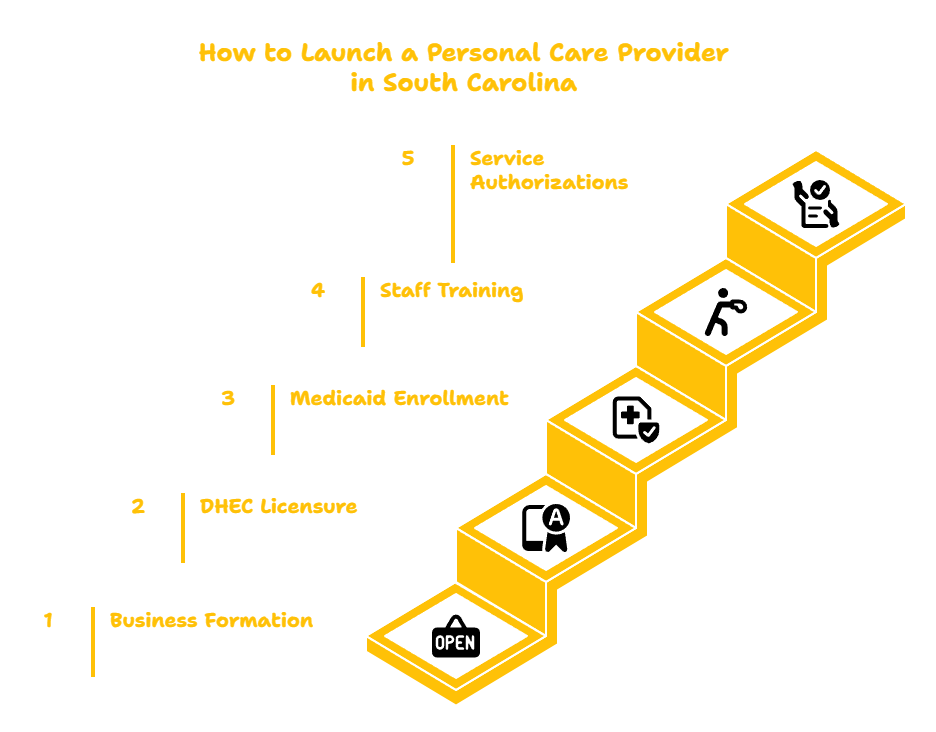
The journey to becoming an approved provider begins with establishing a formal business entity and securing the necessary infrastructure. Once your business is registered with the South Carolina Secretary of State and you have obtained an EIN and a Type 2 NPI, your first major regulatory hurdle is securing a DHEC In-Home Care Provider License. This license is the foundation upon which your Medicaid enrollment is built.
After receiving your DHEC license, you must navigate the SCDHHS Medicaid Provider Enrollment Portal. The enrollment process requires the submission of extensive organizational documentation, including your staffing plan, organizational structure, and a comprehensive Policy & Procedure Manual. Once these submissions are reviewed and approved, your agency will be eligible to receive service authorizations from CLTC case managers or waiver administrators.
- Phase 1: Business formation and DHEC licensure (1–2 months).
- Phase 2: SCDHHS Medicaid portal registration and document submission (2–3 months).
- Phase 3: Staff onboarding and service readiness (30–60 days).
What Are the Essential Staffing and Training Requirements?
The quality of your agency is directly proportional to the competency of your staff. Personal Care Aides must undergo rigorous background checks and meet specific training requirements, often totaling 40 hours or more, as mandated by DHEC. In addition to ADL proficiency, all caregivers must be certified in CPR and First Aid. Depending on your licensing tier and specific waiver requirements, you may also be required to maintain an RN Supervisor on staff to oversee care plans and provide clinical guidance.
Ongoing compliance is not a one-time event but a continuous process. Every staff member must receive regular training in HIPAA and confidentiality, abuse prevention, and safety protocols. Your administrative team must track these trainings, conduct annual performance evaluations, and perform competency assessments to ensure that every aide remains qualified to handle the evolving needs of the participant population.
Which Medicaid Waiver Programs Support PCS Delivery?
PCS providers in South Carolina operate within several distinct funding streams. The Community Long Term Care (CLTC) program is one of the most common pathways, providing attendant services for seniors and adults with physical disabilities. Beyond this, specialized waivers exist for specific populations, such as the HASCI waiver for individuals with head or spinal cord injuries and the ID/RD waiver for individuals with intellectual and related disabilities.
Providers should also be aware of self-directed service models, where participants have the autonomy to select their own personal care providers from the approved agency pool. Familiarity with these various programs is essential for agency administrators, as the authorization, billing, and care plan requirements can vary slightly depending on the specific waiver or state plan under which the participant is enrolled.
Frequently Asked Questions
What documents must be included in the Policy & Procedure Manual?
Your manual must cover client intake processes, care plan development, ADL assistance protocols, HIPAA and participant rights, incident response procedures, quality assurance plans, and detailed guidelines for Medicaid billing and supervisory visits.
What is the role of an RN Supervisor in a PCS agency?
If required by your license or specific waiver contracts, an RN Supervisor is responsible for the oversight of care plans, the clinical supervision of personal care aides, and ensuring that the services rendered meet the medical and safety requirements of the participant.
How does a provider start receiving service authorizations?
Service authorizations are issued by CLTC case managers or waiver program administrators once your agency is fully licensed by DHEC and enrolled as a verified provider in the SCDHHS Medicaid system. You must maintain active status in these portals to ensure that authorizations continue to flow to your agency.
Key Takeaway
Establishing a successful Personal Care Services agency in South Carolina requires a balanced approach to administrative compliance and operational readiness. By prioritizing the development of a robust Policy & Procedure Manual, adhering to DHEC and SCDHHS mandates, and maintaining rigorous staff training programs, your agency will be well-positioned to provide the high-quality, community-based support necessary to help South Carolina residents thrive in their own homes.
Last verified: October 2023. This information is intended for educational purposes for healthcare providers and does not constitute legal or professional advice. Always consult the official SCDHHS and DHEC websites for the most current regulatory updates and specific policy bulletins.