PERSONAL CARE SERVICES PROVIDER IN PENNSYLVANIA
By Fatumata Kaba · 2025-10-08 · 5 min read
Delivering essential daily support to help individuals live safely and independently in their homes and communities is a cornerstone of Pennsylvania’s Medicaid program. Personal Care Services (PCS) providers play a critical role in this ecosystem, facilitating daily living activities for residents who require assistance due to disability, aging, or chronic conditions.
Personal Care Services in Pennsylvania are Medicaid-funded supports designed to reduce institutionalization and foster independence. These services are authorized through Pennsylvania’s Home and Community-Based Services (HCBS) Waivers under the Office of Long-Term Living (OLTL) and the Office of Developmental Programs (ODP), as well as the Community HealthChoices (CHC) managed care program. Operating an agency in this sector requires strict adherence to regulatory oversight and a commitment to high-quality service delivery standards.
What Are the Governing Agencies and Regulatory Frameworks for PCS Providers?
The provision of personal care services is governed by a multi-layered regulatory environment. Understanding the specific roles of each agency is essential for maintaining compliance. The Pennsylvania Department of Human Services (DHS) serves as the primary authority, overseeing the policy direction for Medicaid-funded long-term services. Within the DHS, the Office of Long-Term Living (OLTL) administers assistance for individuals with physical disabilities and age-related needs, while the Office of Developmental Programs (ODP) handles supports for individuals with intellectual or developmental disabilities.
In addition to these state offices, the Community HealthChoices (CHC) program utilizes Managed Care Organizations (MCOs) to authorize and coordinate service delivery. Providers must interact with these MCOs directly for billing and service authorization. Federal oversight is provided by the Centers for Medicare & Medicaid Services (CMS), which ensures that state programs adhere to federal Medicaid requirements. Furthermore, businesses must register with the Pennsylvania Department of State and obtain the necessary licensure from the Pennsylvania Department of Health (DOH) to ensure legal operation within the Commonwealth.
What Core Services Are Approved for Personal Care Providers?
Approved PCS providers offer a specific scope of support focused on hands-on assistance and client well-being. These services are categorized primarily as Activities of Daily Living (ADLs) and Instrumental Activities of Daily Living (IADLs). By assisting with these tasks, providers enable clients to remain in their own homes rather than transitioning to more restrictive clinical settings.
Standard service delivery for approved providers includes the following areas:
- ADL Support: Direct assistance with bathing, dressing, grooming, toileting, eating, and mobility.
- IADL Support: Practical help with light housekeeping, laundry, shopping, meal preparation, and medication reminders.
- Transfer Assistance: Providing physical support to safely move clients between beds, chairs, or mobility devices.
- Monitoring and Companionship: Providing necessary supervision to ensure client safety and mitigate the risks of isolation.
- Clinical Documentation: Maintaining accurate daily service logs, care plans, attendance sheets, and mandatory Electronic Visit Verification (EVV) records.
How Do You Obtain Licensure and Become a Medicaid Provider?
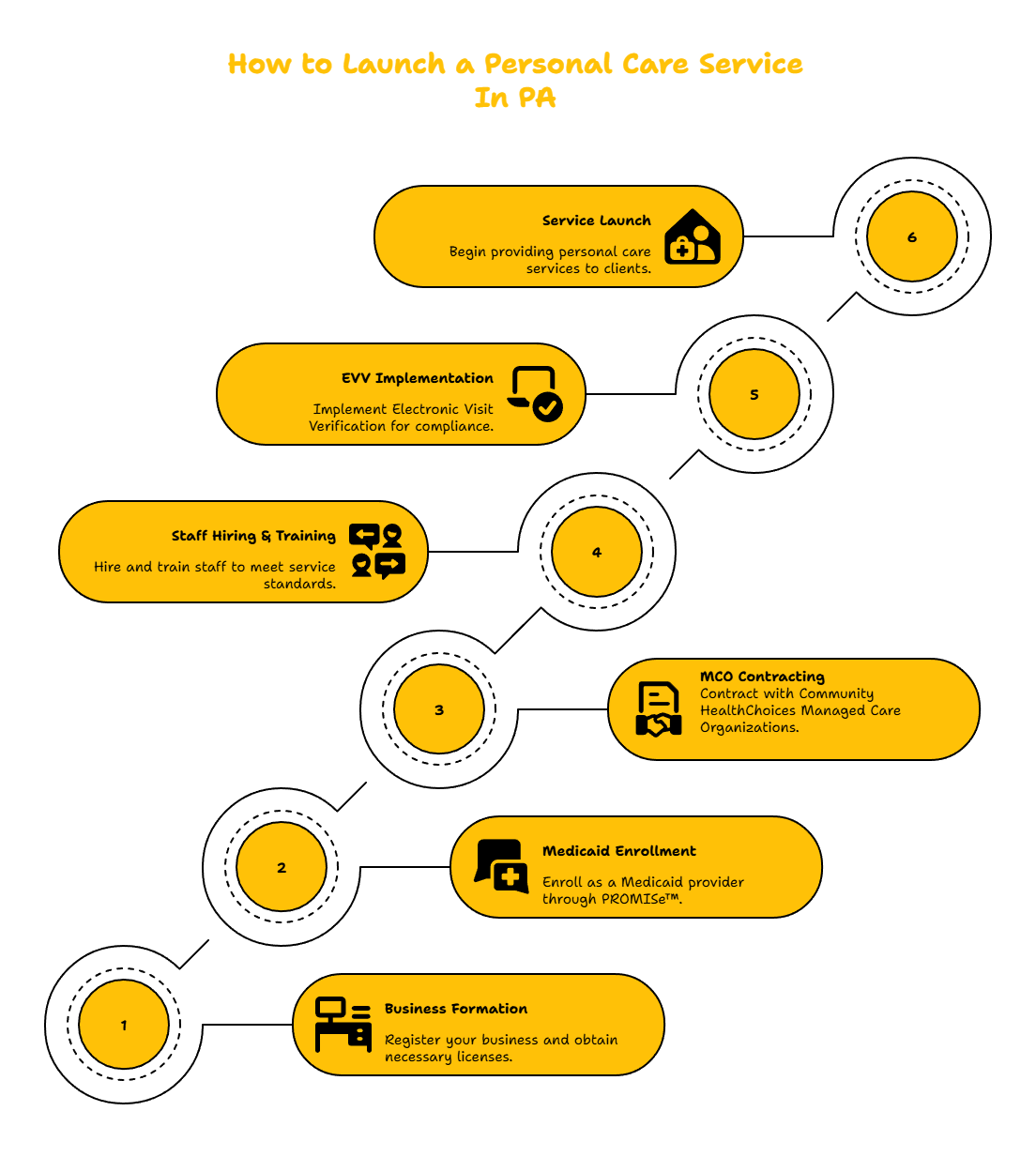
Becoming an authorized provider is a sequenced process that begins with legal business formation. Providers must register their business entity with the Pennsylvania Department of State and secure essential federal credentials, including an Employer Identification Number (EIN) and a Type 2 National Provider Identifier (NPI). These are fundamental prerequisites for entering the Medicaid provider network.
Following business registration, providers must obtain a Home Care Agency License from the Pennsylvania Department of Health. This licensing process verifies that the agency meets state-mandated health and safety standards. Once licensed, the provider must enroll in the Medicaid system via the PROMISe™ (Provider Reimbursement and Operations Management Information System) portal. Finally, agencies must contract with the relevant CHC MCOs to receive service authorizations, which includes submitting organizational policies, staff credentialing records, and proof of required insurance coverage, such as liability and workers' compensation.
What Are the Staffing and Documentation Standards?
Staffing regulations are stringent to ensure the safety and quality of care provided to vulnerable populations. Personal Care Aides or Direct Care Workers must undergo comprehensive background checks, tuberculosis testing, and mandatory training covering HIPAA, abuse prevention, and emergency protocols. Furthermore, they must demonstrate competency in EVV system usage to ensure that all service hours are accurately captured and documented.
Documentation is the backbone of audit readiness. Agencies are required to maintain a robust Policy & Procedure Manual that details every aspect of operations, from service delivery protocols to incident reporting. This manual must explicitly cover staff supervision, client rights, and quality assurance mechanisms. Providers must ensure that all documentation—including service tracking templates and shift logs—is organized and accessible for state and MCO reviews. Effective documentation ensures that the provider can demonstrate compliance with federal and state regulations at any given time.
What Are the Key Medicaid Waiver and State Programs?
Personal Care Services are delivered through several specific Medicaid waiver programs, each tailored to different demographics. The Community HealthChoices (CHC) program provides managed long-term services for older adults and individuals with physical disabilities. The OLTL administers the Aging Waiver for individuals aged 60 and over, as well as the OBRA Waiver for adults with physical disabilities who initiated services before the age of 60.
For individuals with intellectual and developmental disabilities, services are primarily delivered through the ODP-managed Consolidated and Person/Family Directed Support (P/FDS) Waivers. Additionally, the Act 150 Program serves as a state-funded alternative for individuals who require personal care but do not meet the financial eligibility requirements for traditional Medical Assistance (MA). Understanding which waiver a client is enrolled in is essential for proper authorization and billing.
Frequently Asked Questions
How long does the provider enrollment process typically take?
The timeline varies based on administrative readiness, but the full process generally spans 3 to 6 months. This includes 1–2 months for business formation and licensing, followed by 2–3 months for Medicaid enrollment and MCO contracting.
What is the role of Electronic Visit Verification (EVV) for providers?
EVV is a mandatory system used to electronically verify that personal care services were actually provided. Providers are required to implement and manage an EVV system to track service hours, location, and the identity of the caregiver and client, ensuring compliance with federal requirements.
Do I need an RN supervisor on staff?
The requirement for an RN supervisor depends on the specific client needs and the agency's license type. While not always mandatory for every level of personal care, an RN is often required to conduct clinical assessments and provide oversight for medical-related care tasks, ensuring the agency remains within its regulatory scope.
Waiver Consulting Group provides comprehensive start-up assistance for agencies looking to enter the Pennsylvania market. This includes end-to-end support for business registration, Medicaid enrollment, and Home Care licensing. The agency also assists with the development of Policy & Procedure Manuals, EVV system onboarding, staff credentialing templates, and MCO contracting strategies to ensure long-term compliance and operational success.
Key Takeaway: Successful participation in Pennsylvania’s personal care services market requires a rigorous commitment to documentation, regulatory alignment with the Department of Health and DHS, and seamless integration with CHC managed care billing systems.
Last verified: October 2023. This content is for informational purposes only and does not constitute legal or professional advice. Always consult with the relevant Pennsylvania state agencies or a qualified consultant before making business decisions regarding Medicaid provider enrollment.