PERSONAL CARE SERVICES PROVIDER IN OREGON
By Fatumata Kaba · 2025-10-06 · 5 min read
Becoming a Personal Care Services (PCS) provider in Oregon requires navigating a structured regulatory landscape designed to ensure high-quality, person-centered support for Medicaid beneficiaries. Providers play a critical role in the state’s healthcare infrastructure by delivering essential assistance that allows older adults and individuals with disabilities to maintain their independence within their own homes and communities.
Operating as a PCS provider involves compliance with the Oregon Department of Human Services (ODHS), the Oregon Health Authority (OHA), and federal standards set by the Centers for Medicare & Medicaid Services (CMS). By adhering to these rigorous guidelines, agencies can successfully enroll as Medicaid providers, receive authorization for service delivery, and build sustainable operations that meet the evolving needs of Oregonians.
Navigating the Regulatory Oversight of Oregon PCS
The delivery of Personal Care Services in Oregon is governed by a multi-tiered regulatory framework. The Oregon Department of Human Services (ODHS), specifically the Aging and People with Disabilities (APD) division, acts as the primary authority for authorizing PCS for eligible Oregon Health Plan (OHP) recipients. Local APD and Area Agency on Aging (AAA) offices serve as the direct points of contact for case management, service authorization, and monitoring care delivery at the local level.
Beyond state-specific administration, the Oregon Health Authority (OHA) maintains oversight of the broader Medicaid program. OHA is responsible for contracting with Coordinated Care Organizations (CCOs) and ensuring that all programs remain in strict compliance with federal regulations enforced by the Centers for Medicare & Medicaid Services (CMS). Additionally, new providers must interact with the Oregon Secretary of State (SOS) Corporation Division to establish a valid legal entity, which is a foundational requirement for all business compliance in the state.
Defining the Scope of Personal Care Services
Personal Care Services are designed to support individuals who require assistance with daily tasks to avoid institutionalization. These services are provided directly in the client’s home or within an integrated community setting. The primary objective is to promote dignity, safety, and health by addressing the fundamental needs that enable a recipient to remain in the community rather than in a hospital or nursing facility.
Approved providers are authorized to offer a range of support services, which generally include the following categories of care:
- Assistance with Activities of Daily Living (ADLs): Hands-on support with bathing, dressing, eating, toileting, and ambulation.
- Instrumental ADLs (IADLs): Assistance with light housekeeping, meal preparation, laundry, and necessary grocery shopping.
- Medication Reminders: Non-skilled cueing and monitoring to ensure the recipient adheres to their medication schedule.
- Protective Supervision: Active monitoring to ensure safety for individuals with cognitive impairments.
- Escort to Appointments: Facilitating access to health and community resources by providing accompaniment.
- Documentation and Progress Notes: Maintaining accurate daily service logs, care plans, and detailed billing records.
Establishing Your Agency: Licensing and Provider Prerequisites
Before an agency can accept referrals, it must meet several foundational prerequisites to ensure it is legally and operationally prepared to serve Medicaid recipients. This process begins with registering the business with the Oregon Secretary of State. Once the business entity is established, the provider must secure a federal Employer Identification Number (EIN) and a National Provider Identifier (NPI), both of which are mandatory for enrollment in government health programs.
Operational readiness also requires securing comprehensive general liability and workers’ compensation insurance to protect the agency and its employees. Furthermore, every agency must develop a robust Personal Care Services Policy & Procedure Manual. This document must align with the specific standards mandated by APD and cover protocols for care planning, service delivery, and incident management. If the agency plans to employ skilled staff, such as Registered Nurses, they must verify credentials through the Oregon State Board of Nursing (OSBN).
The Step-by-Step Provider Enrollment Process
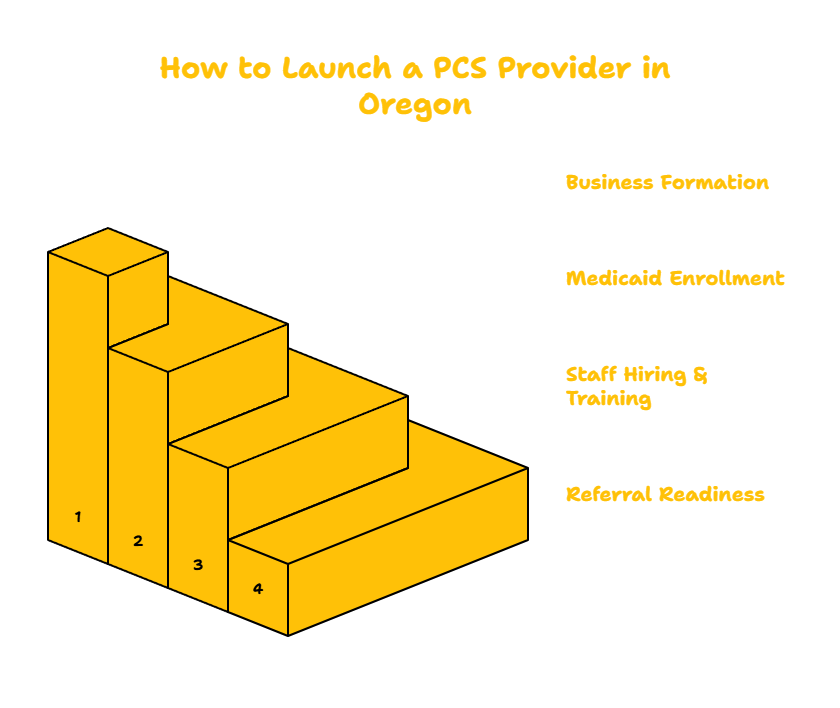
The enrollment pathway is a sequential process that transitions an entity from a business start-up to an active, billing Medicaid provider. Each step must be completed thoroughly to avoid delays in authorization. The process is managed primarily through the Oregon Health Plan Provider Portal, which acts as the central hub for applications and compliance updates.
The general workflow for enrollment includes:
- Business Formation: Registering the LLC or corporation and obtaining the required EIN and NPI.
- Application Submission: Filing the Medicaid provider application via the Oregon Health Plan Provider Portal.
- Credentialing and Background Checks: Submitting ownership details, staffing rosters, and undergoing mandatory background checks for all personnel.
- Coordination: Receiving official approval and establishing communication with local APD and AAA offices to align with regional referral workflows.
- Service Commencement: Accepting initial referrals and initiating the delivery of authorized PCS services.
Staffing and Operational Documentation Requirements
The quality of care provided is heavily dependent on the training and compliance of the agency's staff. Personnel, including Personal Support Workers (PSWs) and Personal Care Aides (PCAs), must be vetted through DHS-approved background checks and trained specifically in ADL support. Supervisors and Program Coordinators must possess the relevant experience to oversee documentation and ensure ongoing staff compliance with state rules.
Documentation is a cornerstone of the PCS model. Agencies are required to maintain detailed records that support billing and service verification, including:
- Care planning protocols and ADL/IADL service delivery records.
- Incident reporting forms to ensure participant safety and regulatory notification.
- Privacy and HIPAA compliance documentation to protect participant data.
- Medicaid billing protocols and electronic visit verification (EVV) logs.
- Annual staff refresher training and skills validation records.
Frequently Asked Questions
What are the primary Oregon Medicaid waiver programs for PCS?
PCS is provided through several channels, including the Oregon K Plan (Community First Choice Option/1915(k)), Aging & People with Disabilities (APD) HCBS waivers, Developmental Disabilities waivers, Children's and Medically Fragile waivers, and the standard Oregon Health Plan (OHP) PCS benefit.
What is the typical timeline to launch a PCS agency in Oregon?
The launch process typically spans several months: 1–2 months for business formation and policy development, 2–3 months for Medicaid enrollment and background checks, and 30–60 days for staff hiring, training, and final credentialing.
How are PCS providers compensated for their services?
Providers are compensated through the Medicaid program once they have been approved, enrolled, and have received authorized referrals from local APD or AAA offices. Billing is performed through the Oregon Health Plan Provider Portal, provided that all service delivery documentation, including EVV, is complete.
WAIVER CONSULTING GROUP’S START-UP ASSISTANCE SERVICE — OREGON PERSONAL CARE SERVICES PROVIDER
WCG empowers PCS providers in Oregon to launch sustainable, compliant home care programs with assistance in business registration, Medicaid provider enrollment, custom Policy & Procedure Manual development, and referral network building with local APD/AAA case managers.
Key Takeaway: Establishing a successful Personal Care Services agency in Oregon requires rigorous adherence to the guidelines established by the ODHS and OHA. By prioritizing policy development, staff training, and efficient Medicaid enrollment, agencies can build a foundation for providing high-quality, compliant care that effectively serves the needs of Oregon's most vulnerable populations.
Last verified: February 2025. This document is for informational purposes only and does not constitute legal or professional consulting advice. Requirements for Medicaid programs are subject to change; always verify the latest statutes and regulations with the Oregon Department of Human Services (ODHS) and the Centers for Medicare & Medicaid Services (CMS) before initiating business operations.