PERSONAL CARE SERVICES PROVIDER IN OKLAHOMA
By Fatumata Kaba · 2025-09-08 · 5 min read
Becoming a Personal Care Services (PCS) provider in Oklahoma allows organizations to deliver essential non-medical support to individuals with disabilities, chronic illnesses, or age-related limitations, directly contributing to their independence. By facilitating assistance with activities of daily living (ADLs) and instrumental activities of daily living (IADLs), approved agencies play a critical role in preventing unnecessary institutionalization and supporting community-based living under the state’s Medicaid frameworks.
Understanding the Regulatory Landscape and Governing Agencies
Navigating the Oklahoma Medicaid system requires a clear understanding of the diverse agencies involved in oversight and administration. The Oklahoma Health Care Authority (OHCA) serves as the single state agency for Medicaid, managing provider enrollment, service authorization, and the critical billing infrastructure via the SoonerCare portal. Any prospective provider must align their operations with OHCA standards to ensure compliance and timely reimbursement.
Beyond the OHCA, the Oklahoma Department of Human Services (OKDHS) Aging Services Division coordinates the delivery of personal care for older adults and individuals with disabilities. Furthermore, the Oklahoma Department of Rehabilitation Services (DRS) may provide vocational and independent living supports that overlap with standard personal care tasks. Providers must also maintain adherence to the broader federal standards established by the Centers for Medicare & Medicaid Services (CMS), which ensure that all Home and Community-Based Services (HCBS) meet established national quality and safety benchmarks.
Defining Scope and Essential Service Delivery Standards
Personal Care Services are fundamentally person-centered, meaning every task performed must be rooted in an assessed need documented within an individual’s formal care plan. These services are designed to bridge the gap between complete independence and the need for institutional care, requiring providers to maintain consistent, high-quality documentation that tracks both the assistance provided and the individual’s health status.
Approved providers are authorized to deliver a specific range of supports, which must be clearly defined in their operational policies:
- ADL Assistance: Providing hands-on support with bathing, grooming, dressing, toileting, eating, and mobility.
- IADL Support: Assisting with essential household tasks such as meal preparation, light housekeeping, laundry, and shopping.
- Medication Assistance: Providing non-skilled support through reminders or observing an individual’s self-administration.
- Escort Services: Facilitating transportation to medical appointments or necessary errands.
- Health Observation: Diligently noting and reporting any changes in behavior or physical health to supervisors.
- Respite Care: Offering temporary relief for family caregivers when specifically authorized by the care plan.
Meeting Licensing and Provider Enrollment Requirements
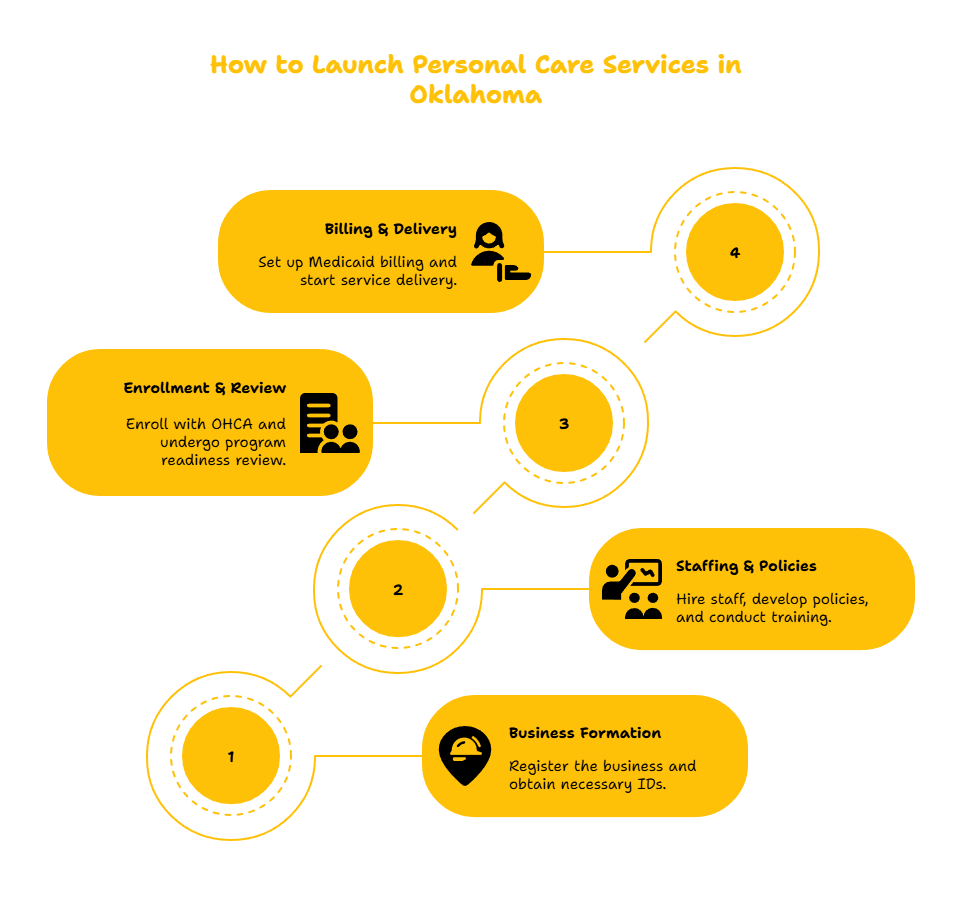
The journey to becoming an authorized provider begins with formal business and administrative setup. Prospective agencies must first register with the Oklahoma Secretary of State and obtain an Employer Identification Number (EIN) from the IRS. Securing a Type 2 National Provider Identifier (NPI) is essential for Medicaid billing, as this identifier is linked to the organizational entity rather than an individual practitioner.
Once the business entity is established, the provider must navigate the SoonerCare Provider Portal to initiate enrollment. This process requires significant preparation, including the procurement of general and professional liability insurance and the creation of a comprehensive Policy and Procedure Manual. This manual serves as the operational foundation for the agency, documenting everything from ADL protocols to HIPAA privacy safeguards and emergency response strategies. Providers must also demonstrate that they have rigorous background check protocols for all staff to ensure participant safety.
Staffing, Training, and Quality Assurance Protocols
Staffing requirements are strictly regulated to ensure that participants receive competent care. Every agency must appoint a Personal Care Administrator who possesses a demonstrated understanding of home care program administration and the nuances of Medicaid compliance. The day-to-day care is delivered by Personal Care Aides (PCAs) or Home Health Aides, who must complete state-approved training or hold valid CNA certification. In specific cases where the plan of care demands clinical oversight, a Supervising Nurse with an active Oklahoma RN license must be involved to manage assessments and care plan implementation.
Ongoing education is a core component of agency compliance. All staff members are required to undergo consistent training cycles, including:
- HIPAA compliance and protection of participant rights.
- In-service training focusing on infection control and effective communication.
- Annual performance reviews to ensure adherence to agency protocols.
- Rigorous documentation training to ensure accurate Medicaid billing records.
- Emergency protocols and incident reporting procedures.
Navigating Medicaid Waiver Programs and Timelines
Personal Care Services in Oklahoma are delivered through several specific Medicaid channels, each with unique criteria and participant populations. These include the State Plan Personal Care (SoonerCare), the ADvantage Waiver Program for frail elders and adults with disabilities, the Medically Fragile Waiver, the DDS Waivers for those with intellectual or developmental disabilities, and the Living Choice Program for transitions from institutional settings.
The timeline to launch is substantial and requires careful coordination. The first phase, focused on business formation and compliance setup, typically spans 1–2 months. Following this, the agency must dedicate 2–3 months to staffing, training, and internal policy development. The final stages involve the OHCA Program Readiness Review (60–90 days) and the finalization of the Medicaid billing setup (30–45 days). Administrators should plan for a total development cycle of approximately 6 to 9 months.
Frequently Asked Questions
What is the primary difference between state plan services and waiver services?
State Plan Personal Care generally covers foundational needs through the standard Medicaid program, while Waiver programs, such as the ADvantage Waiver, are designed to offer more comprehensive or specialized support for individuals who meet specific criteria for nursing-facility levels of care.
Is a supervising nurse required for every client?
A Supervising Nurse is not always required for every participant; however, their involvement is mandatory when the plan of care dictates professional oversight for medical-related needs or complex care coordination as defined by the authorizing program.
How often must an agency update its Policy and Procedure Manual?
While there is no fixed calendar interval mandated by the state, agencies are responsible for ensuring that their policies remain current with the latest OHCA regulations and CMS standards. It is recommended to conduct annual reviews to incorporate any changes in state law or billing protocols.
Key Takeaway
Launching a Personal Care Services agency in Oklahoma is a highly regulated, multi-phase process that demands strict adherence to both state and federal mandates. Success depends on the establishment of a robust compliance framework, careful staff credentialing, and seamless integration with the OHCA’s billing and authorization systems.
Last verified: 2024. Disclaimer: This article is for informational purposes only and does not constitute legal or professional advice. Requirements for Medicaid programs and provider enrollment are subject to change by the Oklahoma Health Care Authority and federal CMS mandates. Please consult official agency resources and current state administrative codes for the most accurate and up-to-date regulatory guidance.