PERSONAL CARE SERVICES PROVIDER IN NEW JERSEY
By Fatumata Kaba · 2025-09-05 · 5 min read
Establishing a Personal Care Services Agency in New Jersey
Personal Care Services in New Jersey serve as a foundational element of the state's Home and Community-Based Services (HCBS) ecosystem, providing vital support for individuals navigating disabilities, chronic health conditions, or the challenges of aging. By delivering essential assistance with Activities of Daily Living (ADLs) and Instrumental Activities of Daily Living (IADLs), these providers facilitate independent living and significantly enhance the daily quality of life for Medicaid-eligible participants across the state.
Operating a successful personal care agency requires navigating a complex intersection of state-mandated licensing, federal Medicaid oversight, and rigorous clinical compliance. For providers, success is predicated on a deep understanding of the Individualized Service Plan (ISP) model, which mandates that every intervention—from mobility support to medication reminders—must be precisely aligned with the unique clinical and personal needs of the participant as authorized by the Department of Human Services.
Navigating the Regulatory Landscape: Who Governs Personal Care Services?
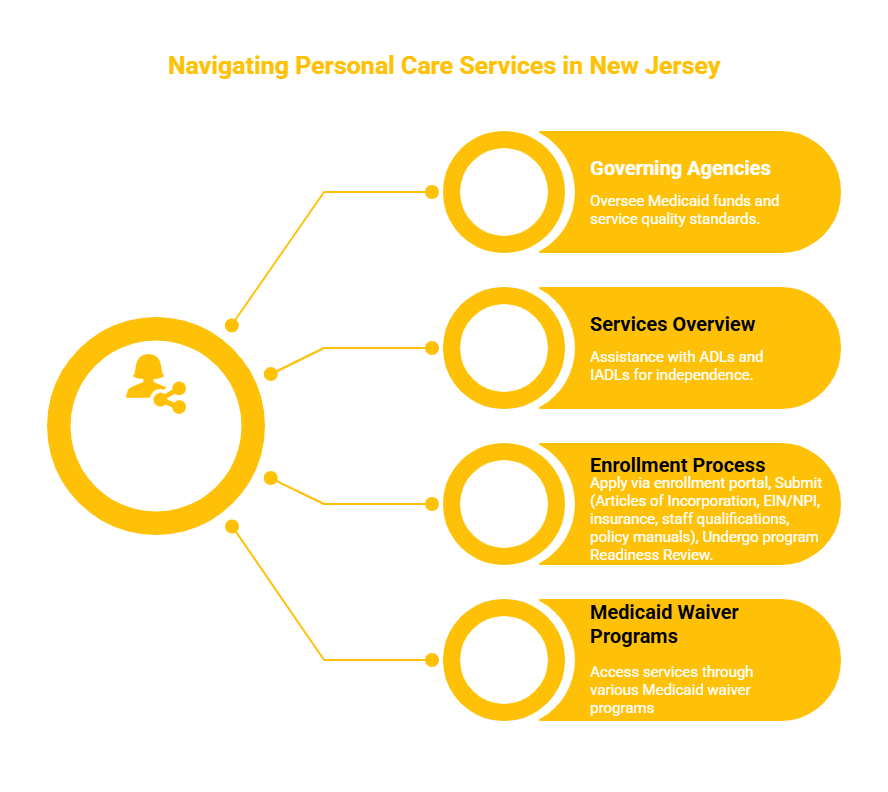
The regulatory framework for personal care in New Jersey is a multi-tiered hierarchy designed to ensure high-quality, person-centered care while maintaining the fiscal integrity of the Medicaid program. At the state level, the New Jersey Department of Human Services (DHS) serves as the primary authority, managing the intricacies of provider enrollment, service authorization, and the reimbursement process for all Medicaid-funded activities.
The Division of Aging Services (DoAS) works in tandem with the DHS to maintain operational compliance, conducting oversight to ensure that service delivery aligns with the established quality standards for HCBS waiver programs. At the federal level, the Centers for Medicare & Medicaid Services (CMS) provides the overarching regulatory structure. CMS oversight mandates that New Jersey’s programs strictly adhere to national standards for person-centered planning, participant protections, and the ethical delivery of long-term care services.
Operational Scope: Defining Covered Personal Care Activities
Personal Care Services are designed to bridge the gap between medical necessity and daily functional independence. When a participant is approved for services, providers are authorized to deliver specific, non-skilled supports that enable the individual to remain safely in their home environment. The scope of these activities is strictly governed by the participant's ISP, ensuring that care is targeted, necessary, and documented according to program guidelines.
- Personal Hygiene: Comprehensive support for bathing, grooming, oral care, and dressing.
- Mobility Assistance: Professional guidance with transfers, ambulation, and physical positioning to prevent injury.
- Toileting and Incontinence Care: Consistent support with bathroom use and sanitary maintenance.
- Nutritional Support: Meal preparation, feeding assistance, and monitoring hydration levels.
- Environmental Maintenance: Essential light housekeeping, bed making, and laundry to ensure a sanitary home.
- Medication and Safety: Non-skilled medication reminders and active monitoring to ensure a hazard-free living environment.
- Social Engagement: Facilitating companionship and emotional support to promote overall mental wellness.
The Roadmap to Provider Enrollment and Licensure
The transition from a business entity to an authorized Medicaid provider involves a rigorous, multi-phase verification process. Founders must begin by establishing a formal business structure through the New Jersey Division of Revenue and Enterprise Services, followed by obtaining a federal EIN and a Type 2 NPI. Because Medicaid funding is tied to high-stakes compliance, providers must maintain comprehensive general and professional liability insurance from the outset.
Following organizational formation, providers must enroll through the New Jersey Medicaid Provider Enrollment Portal. This phase is not merely administrative; it involves a Readiness Review where the DHS and DoAS assess the agency’s infrastructure. Agencies must demonstrate that they possess fully developed policies regarding care planning, safety protocols, and staff credentialing. Only after these internal systems are vetted and the agency receives official approval can the provider begin billing for authorized Personal Care Services.
Building a Compliant Staffing and Documentation Infrastructure
A personal care agency is only as strong as its documentation and staff training programs. Regulatory agencies require detailed, audit-ready manuals that govern everything from initial participant intake and assessment to ongoing quality assurance and HIPAA-compliant data management. Policies must clearly outline staff credentialing requirements, ensuring that every Direct Support Professional (DSP) and Personal Care Aide (PCA) has undergone thorough background checks, health screenings, and formal training in infection control.
Staffing requirements are tiered based on operational roles. A Program Director, ideally holding a bachelor's degree in healthcare or social services, is expected to oversee the clinical and administrative compliance of the agency. PCAs and DSPs must hold a high school diploma or GED, maintain active CPR/First Aid certification, and participate in ongoing competency evaluations. These educational mandates ensure that caregivers are not only capable of performing ADLs but are also trained to recognize and report changes in a participant's condition effectively.
Frequently Asked Questions
What specific Medicaid waiver programs support these services?
Personal Care Services in New Jersey are funded through several specific waiver initiatives, including the Community Care Program for the Elderly and Disabled (CCPED), the Supports Program Waiver, the Acquired Brain Injury (ABI) Waiver, the Personal Care Assistant (PCA) Waiver, and the broader Home and Community-Based Services (HCBS) Waiver.
How long should a new agency expect the launch process to take?
The timeline typically spans several months. Business formation and initial compliance preparation require 1–2 months, followed by 2–3 months for staff hiring and credentialing. The formal Medicaid Provider Enrollment and Readiness Review usually takes 60–90 days, with an additional 30–45 days required for final billing setup and service launch.
What documentation is essential for a successful Medicaid audit?
Providers must maintain rigorous records including Articles of Incorporation, NPI/EIN verification, proof of insurance, and a comprehensive Policy & Procedure Manual. Essential documentation also includes signed ISP compliance records, staff training logs, background check results, and detailed daily service notes that justify the billing codes submitted to the Medicaid program.
Waiver Consulting Group’s Support Services
Waiver Consulting Group assists agencies in establishing a robust foundation for Medicaid-compliant Personal Care Services. Our support encompasses the end-to-end development of the agency, including guidance on business registration, Medicaid enrollment, and licensing applications. We provide templates for comprehensive policy manuals, staff training curricula, and care documentation systems designed to meet state audit standards.
Additionally, we assist in the development of financial management workflows and quality assurance systems to ensure that billing practices remain audit-ready. By providing structured strategies for community outreach and operational readiness, our services help agencies navigate the complex requirements of the New Jersey Department of Human Services and the Division of Aging Services effectively.
Key Takeaway: Launching a Personal Care Services provider in New Jersey is a high-responsibility endeavor that requires a strict, continuous commitment to state and federal Medicaid regulations. Success depends on the proactive development of clinical policies, rigorous staff credentialing, and the ability to maintain audit-ready documentation for every authorized service hour delivered to program participants.
Last verified: October 2023. This information is for educational purposes only and does not constitute legal or professional advice. Requirements for Medicaid provider enrollment may change; always verify current statutes and regulations directly with the New Jersey Department of Human Services and the Centers for Medicare & Medicaid Services (CMS) before making business decisions.