PERSONAL CARE SERVICES PROVIDER IN NEW HAMPSHIRE
By Fatumata Kaba · 2025-07-27 · 5 min read
Becoming a Personal Care Services (PCS) provider in New Hampshire requires navigating a complex regulatory landscape managed by the Department of Health and Human Services (DHHS). Agencies must successfully integrate administrative compliance, staff credentialing, and clinical documentation standards to provide essential home and community-based support to vulnerable residents under various Medicaid HCBS waiver programs.
What Are the Governing Structures and Regulatory Expectations?
The delivery of Personal Care Services in New Hampshire is overseen by a multi-tiered regulatory framework. At the state level, the New Hampshire Department of Health and Human Services (DHHS) serves as the primary authority, managing Medicaid waiver funding, provider enrollment, and reimbursement protocols. The Bureau of Elderly and Adult Services (BEAS) works closely with DHHS to ensure that service delivery adheres to established quality standards and that providers remain in full compliance with state and federal expectations.
Federal oversight is provided by the Centers for Medicare & Medicaid Services (CMS). CMS ensures that all Medicaid-funded services align with HCBS quality requirements, person-centered planning mandates, and robust participant protection standards. Providers must understand that their operations are not merely business entities but are extensions of a public safety net, requiring rigorous adherence to clinical documentation and ethical standards to maintain their standing as an approved Medicaid provider.
What Scope of Services Must a Provider Deliver?
Personal Care Services are designed to support individuals with disabilities, chronic illnesses, or age-related conditions in maintaining their independence within their own homes. These services focus on Activities of Daily Living (ADLs) and Instrumental Activities of Daily Living (IADLs). Each participant’s care must be dictated by their Individualized Service Plan (ISP), which outlines the specific frequency and nature of the support required.
- Personal Hygiene Assistance: Providing help with bathing, grooming, oral care, and dressing.
- Mobility Support: Assisting with transfers, ambulation, and physical positioning.
- Toileting and Incontinence Care: Offering necessary assistance with bathroom use and ongoing hygiene maintenance.
- Meal Preparation and Feeding: Preparing nutritious meals, assisting with intake, and ensuring proper hydration.
- Housekeeping and Laundry: Managing light cleaning, bed making, and essential laundry tasks.
- Medication Reminders: Providing non-skilled support to ensure participants follow their medication schedules.
- Companionship and Social Engagement: Fostering mental health through social interaction and emotional support.
- Safety Monitoring: Maintaining a secure environment and proactively preventing accidents.
What Are the Prerequisites for Licensure and Enrollment?
The journey to becoming an approved provider begins with establishing a formal business entity registered with the New Hampshire Secretary of State. Once the business is formed, the agency must secure a federal Employer Identification Number (EIN) and a Type 2 National Provider Identifier (NPI). These are the foundational credentials required for any entity seeking to engage in the Medicaid billing ecosystem.
Beyond basic business registration, providers must obtain necessary licensure as a Personal Care Agency from the DHHS. This process includes securing comprehensive general and professional liability insurance to protect the agency and its clients. Furthermore, the agency must develop a comprehensive policy and procedure manual that details personal care planning, rigorous safety protocols, and systematic staff training. Ensuring that all staff have cleared necessary background checks and health screenings is a mandatory prerequisite before any service delivery can commence.
How Does the Medicaid Provider Enrollment Process Work?
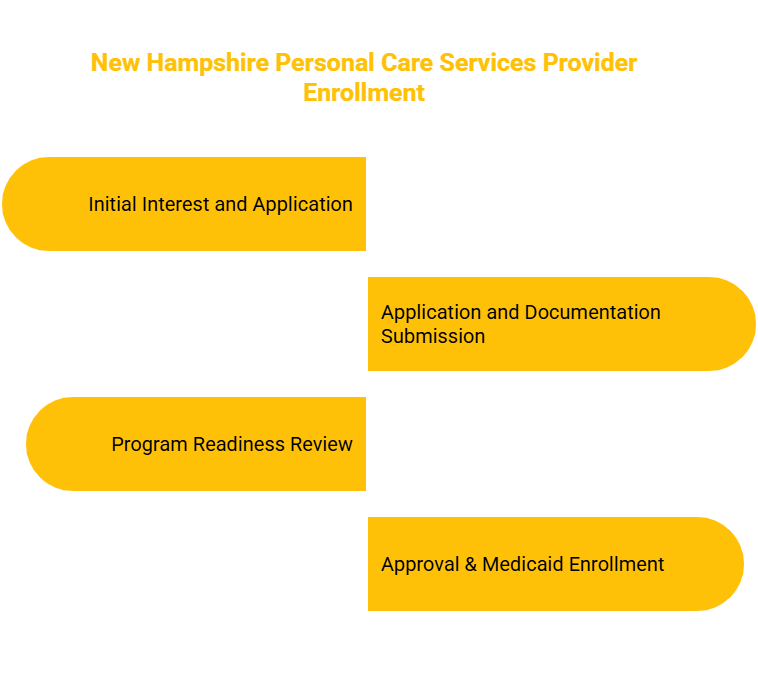
The enrollment process is a structured sequence that begins with the submission of an application through the New Hampshire Medicaid Provider Enrollment Portal. During this phase, applicants must provide detailed documentation, including Articles of Incorporation, proof of EIN/NPI, insurance certificates, and comprehensive staff qualification records. It is critical that all submissions are accurate to avoid delays in the review process.
Once the initial application is filed, DHHS and BEAS will conduct a Program Readiness Review. This evaluation scrutinizes the provider’s operational readiness, specifically looking at staff training modules, emergency care protocols, and safety measures. If the agency meets all state standards, they will be formally approved for Medicaid enrollment. Following this approval, the provider is authorized to use designated billing codes to request reimbursement for services rendered to waiver participants.
What Are the Critical Staffing and Compliance Standards?
Effective service delivery relies on a well-trained workforce. Agencies are typically led by a Personal Care Program Director, who should hold a bachelor’s degree in healthcare or social services and possess relevant supervisory experience. Under the director’s guidance, Personal Care Aides (PCAs) and Direct Support Professionals (DSPs) carry out the daily caregiving tasks. These staff members are required to hold a high school diploma or GED, possess current CPR/First Aid certification, and undergo thorough background clearances.
Continuous training is a cornerstone of compliance. All personnel must complete rigorous education regarding ADL/IADL assistance, safety and infection control, and HIPAA compliance. Furthermore, the agency must implement a system for annual competency evaluations and ongoing professional development to ensure that staff members stay current with best practices in client safety and wellness monitoring.
Frequently Asked Questions
What specific Medicaid waivers cover Personal Care Services?
Personal Care Services in New Hampshire are authorized under several Medicaid HCBS waivers, including the Choices for Independence (CFI) Waiver, the Developmental Disabilities (DD) Waiver, the Acquired Brain Disorder (ABD) Waiver, the In-Home Support (IHS) Waiver for Children, and the general Home and Community-Based Services (HCBS) Waiver.
How long should a new agency expect the launch process to take?
The timeline typically spans several months. Business formation and compliance preparation usually take 1–2 months, followed by 2–3 months for hiring and program development. The Medicaid enrollment and readiness review process requires approximately 60–90 days, with an additional 30–45 days for billing system setup and service launch.
What documentation is essential for an agency’s Policy and Procedure manual?
A compliant manual must include intake and assessment procedures, care planning guidelines, staff training and credentialing requirements, HIPAA and privacy policies, detailed emergency and infection control protocols, and comprehensive documentation standards for Medicaid billing and quality assurance.
Key Takeaway for Agency Founders
The successful launch of a Personal Care Services agency in New Hampshire hinges on strict adherence to the standards set by the DHHS and BEAS. Founders must focus on building a robust infrastructure that prioritizes participant safety, accurate Medicaid billing, and continuous staff development. By aligning operational processes with the requirements of the HCBS waiver programs from day one, providers ensure both regulatory compliance and the delivery of high-quality care to their participants.
Waiver Consulting Group provides specialized assistance for agencies aiming to launch Medicaid-compliant Personal Care Services. Our services cover business registration, Medicaid enrollment, the development of comprehensive policy manuals, staff credentialing frameworks, and the implementation of quality assurance systems to ensure long-term sustainability and compliance.
Last verified: 2024. This information is intended for educational purposes for healthcare provider agencies and does not constitute legal or financial advice. Please consult the New Hampshire Department of Health and Human Services and current state administrative rules for the most recent updates regarding Medicaid provider enrollment and program requirements.