PERSONAL CARE SERVICES PROVIDER IN MAINE
By Fatumata Kaba · 2025-08-12 · 6 min read
ENABLING INDEPENDENT LIVING THROUGH COMPASSIONATE, HANDS-ON SUPPORT FOR DAILY ACTIVITIES
Personal Care Services (PCS) in Maine are essential supports designed to assist individuals who face challenges with daily living activities due to aging, physical disabilities, developmental disabilities, or chronic health conditions. By providing hands-on assistance and supervision, these services empower participants to remain in their own homes and engage with their local communities, effectively reducing the necessity for institutional placement in nursing facilities.
PCS are delivered through the MaineCare (Medicaid) program under several specific pathways, including the Section 19 Elderly and Adults with Disabilities Waiver, Section 96 Private Duty Nursing and Personal Care, and various other long-term services and supports (LTSS) options. Establishing a provider agency requires a deep understanding of the regulatory landscape, rigorous attention to compliance, and a commitment to maintaining the high standards of care mandated by the Maine Department of Health and Human Services (DHHS).
What Are the Governing Agencies and Regulatory Frameworks?
The administration of Medicaid-funded PCS in Maine is a collaborative effort involving state and federal oversight. The Maine Department of Health and Human Services (DHHS) serves as the primary governing entity, specifically through the Office of MaineCare Services (OMS), which administers all Medicaid-funded PCS under applicable waiver programs and the State Plan.
In addition to OMS, the Office of Aging and Disability Services (OADS) plays a critical role in defining eligibility requirements, monitoring provider quality, and authorizing services under Sections 19, 20, 21, and 29. At the federal level, the Centers for Medicare & Medicaid Services (CMS) provides the necessary oversight to ensure that all PCS delivery remains in strict accordance with the Home and Community-Based Services (HCBS) standards required under 1915(c) waivers and State Plan services.
What Services Do Personal Care Providers Deliver?
Personal Care Services are defined by non-medical assistance that enables a participant to manage their Activities of Daily Living (ADLs) and Instrumental Activities of Daily Living (IADLs). The primary goal is to ensure the participant can live safely and independently, with all care delivered based on an individualized Plan of Care (POC) or Service Plan approved by the state.
Approved services typically include the following:
- Bathing, dressing, grooming, and toileting assistance.
- Assistance with ambulation, transfers, and overall mobility.
- Meal preparation, feeding support, and nutritional monitoring.
- Light housekeeping and laundry tasks directly related to the participant’s personal care needs.
- Medication reminders and general health monitoring.
- Companionship, safety supervision, and escort services for appointments or essential errands.
What Are the Licensing and Provider Approval Requirements?
Launching a PCS agency in Maine requires a structured approach to business registration and regulatory compliance. Prospective providers must be properly registered with the Maine Secretary of State and hold a valid IRS Employer Identification Number (EIN) and a Type 2 National Provider Identifier (NPI). Beyond business registration, providers must ensure their administrative infrastructure meets state expectations regarding risk management and clinical oversight.
General prerequisites for operational compliance include:
- Enrolling with MaineCare as a designated PCS or Home-Based Care Provider.
- Maintaining robust general liability and workers’ compensation insurance coverage.
- Developing a comprehensive Personal Care Services Policy & Procedure Manual that governs every aspect of operations.
- Ensuring all staff undergo mandatory background checks, elder abuse screenings, and possess necessary CNA or PCA certifications.
- Ensuring strict adherence to HIPAA regulations, state health statutes, and meticulous documentation standards.
How Do You Navigate the Provider Enrollment Process?
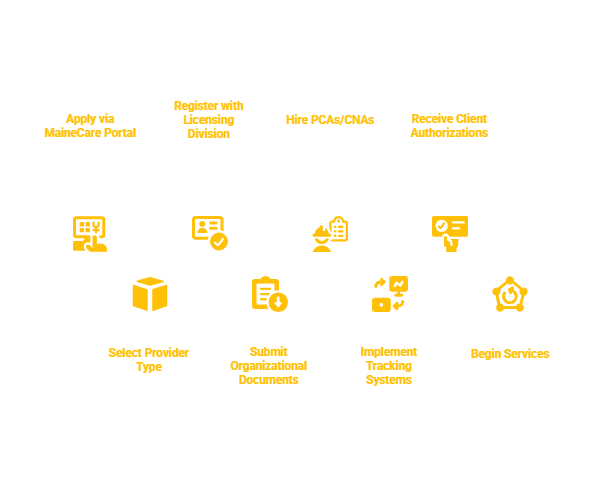
The transition from a business entity to an active MaineCare provider involves a four-phase enrollment lifecycle. Initially, applicants must utilize the MaineCare Provider Enrollment Portal to select the appropriate provider type—such as Section 96 Personal Care or Section 19 Waiver—and submit the required organizational credentials. This stage is foundational, as selecting the incorrect classification can lead to significant delays in reimbursement.
Following initial portal submission, the agency must register with the Division of Licensing and Certification where applicable and formalize its service delivery protocols. This includes the development of standardized care plan templates and administrative policies. The third phase focuses on staff credentialing, which involves hiring certified personnel and establishing internal systems to track training, hours worked, and quality performance. Finally, once approved, the provider enters the service launch phase, receiving client authorizations from OADS, case managers, or service coordinators to begin billing according to established MaineCare codes.
What Documentation and Staffing Standards Must Be Met?
Audit readiness is a constant requirement for MaineCare providers. Agencies must maintain a library of documentation that validates every aspect of their operations, including Articles of Incorporation, NPI confirmation, and proof of insurance. Furthermore, the Policy & Procedure Manual must be a living document, containing detailed protocols for client intake, daily visit logs, incident reporting, grievance procedures, and emergency response plans.
Staffing requirements are equally stringent to ensure high-quality care. Programs require dedicated supervision, often by an RN or a qualified supervisor, responsible for conducting quality reviews and ensuring care plan compliance. All staff members must receive documented training on:
- HIPAA and the maintenance of participant confidentiality.
- Infection control and proactive elder abuse prevention.
- Accurate documentation of ADLs and IADLs to meet billing requirements.
- Emergency preparedness protocols.
- Maine-specific mandatory reporting laws regarding the safety of vulnerable adults.
Frequently Asked Questions
What is the typical timeline to launch a new PCS agency in Maine?
The timeline varies by agency readiness but generally follows a 6 to 9-month arc. Business setup and staff hiring often take 1–2 months, followed by a 60–90 day period for MaineCare enrollment and licensing. Policy development usually takes 3–4 weeks, with service launch occurring on a rolling basis following receipt of participant authorizations.
Are there specific waiver programs under which providers can operate?
Yes, providers may offer services under several programs, including Section 19 (Elderly and Adults with Disabilities), Section 96 (Private Duty Nursing and Personal Care), Sections 21 and 29 (Intellectual and Developmental Disabilities), and Section 20 (Children with Complex Medical Needs), as well as the Money Follows the Person (MFP) program.
What is the role of the Program Supervisor?
The Program Supervisor, who must be an RN or someone with significant experience in personal care settings, is responsible for the oversight of staff. Their role includes ensuring that care plans are followed, conducting performance reviews, and verifying that all services are delivered and documented in compliance with MaineCare regulations.
Key Takeaway
Success as a Personal Care Services provider in Maine requires a dedicated focus on regulatory compliance, precise documentation, and the cultivation of strong relationships with OADS and local case managers. By prioritizing the development of a robust Policy & Procedure Manual and ensuring that all staff are fully credentialed and trained, agency administrators can build a sustainable organization that successfully supports the independence and safety of Maine’s most vulnerable populations.
WAIVER CONSULTING GROUP’S START-UP ASSISTANCE SERVICE — MAINE PERSONAL CARE SERVICES PROVIDER: WCG helps home care providers, CNAs, and entrepreneurs launch fully compliant Personal Care Services under MaineCare and state waiver programs. Scope of Work: MaineCare and waiver enrollment assistance; PCS Policy & Procedure Manual customized to Maine rules; Staff onboarding tools and credentialing checklists; Daily log sheets, consent forms, and supervision templates; Billing system guidance and audit readiness checklists; Referral strategies with OADS, hospitals, and case managers.
Last verified: 2024. This content is for informational purposes only and does not constitute legal or professional advice. Always verify current MaineCare policies through official state channels.