PERSONAL CARE SERVICES PROVIDER IN KANSAS
By Fatumata Kaba · 2025-07-24 · 5 min read
Becoming a Personal Care Services (PCS) provider in Kansas requires a strategic approach to navigating the regulatory framework established by the Kansas Department of Health and Environment (KDHE) and the Kansas Department for Aging and Disability Services (KDADS). This article serves as an authoritative guide for agency founders and administrators looking to provide non-medical, essential daily living support to KanCare participants under various Home and Community-Based Services (HCBS) waiver programs.
Personal Care Services are the cornerstone of the state’s effort to support independence and prevent unnecessary institutionalization for individuals with disabilities, chronic health conditions, or age-related needs. By delivering high-quality, person-centered care, providers play a vital role in the Kansas healthcare ecosystem. The following sections outline the essential steps, requirements, and compliance standards necessary to launch and maintain a successful agency in the Sunflower State.
How Do Governing Agencies Regulate Personal Care Services in Kansas?
The provision of Personal Care Services in Kansas is governed by a multi-tiered regulatory structure that ensures quality, safety, and fiscal responsibility. At the federal level, the Centers for Medicare & Medicaid Services (CMS) provides oversight, setting the foundational standards for Medicaid programs across the United States. These federal guidelines dictate the requirements for service quality, participant safety, and compliance, which the state of Kansas must incorporate into its waiver programming.
At the state level, the Kansas Department of Health and Environment (KDHE), specifically the Division of Health Care Finance, serves as the primary authority for Medicaid eligibility, provider enrollment, and reimbursement processes. Meanwhile, the Kansas Department for Aging and Disability Services (KDADS) acts as the program administrator, managing the HCBS waiver programs and establishing the specific service guidelines for PCS. Additionally, Managed Care Organizations (MCOs) under the KanCare program play a direct role in daily operations by authorizing individual services, developing Person-Centered Service Plans (PCSP), and reimbursing providers for delivered care.
What Services are Included Under the Personal Care Scope?
Personal Care Services in Kansas focus on non-medical, hands-on assistance designed to help participants live independently in their homes and communities. Every service delivered must be directly linked to the participant’s approved Person-Centered Service Plan. Providers are responsible for ensuring that the care provided does not duplicate services already covered by informal supports or other programs.
Approved providers generally offer a range of support tailored to the unique functional needs of the participant. These services generally encompass:
- Assistance with Activities of Daily Living (ADLs) such as bathing, dressing, toileting, grooming, eating, and mobility.
- Help with Instrumental Activities of Daily Living (IADLs) including meal preparation, laundry, light housekeeping, and medication reminders.
- Supervision, monitoring, and cueing for individuals with cognitive impairments to ensure safety.
- Physical assistance with transfers and mobility within the home environment.
- Observation and reporting of basic health changes to supervisors to ensure continuity of care.
- Community support related to specific functional needs when clearly authorized in the PCSP.
What are the Licensing and Administrative Requirements for New Providers?
Establishing a compliant agency involves several foundational administrative steps. Before an agency can begin serving participants, it must achieve legal status and establish a formal business identity. This includes registering the business with the Kansas Secretary of State and obtaining a federal Employer Identification Number (EIN) from the IRS. Additionally, all providers must secure a Type 2 National Provider Identifier (NPI) to participate in the Medicaid system.
Beyond basic business registration, agencies must demonstrate financial and operational stability. This includes maintaining adequate general and professional liability insurance to protect both the business and the participants. Founders must also develop robust internal policies covering service delivery, safety protocols, documentation standards, and participant rights. Compliance with state-mandated background checks and staff training requirements is non-negotiable, as these measures protect vulnerable populations served under the waiver programs.
How Do You Navigate the Kansas Provider Enrollment Process?
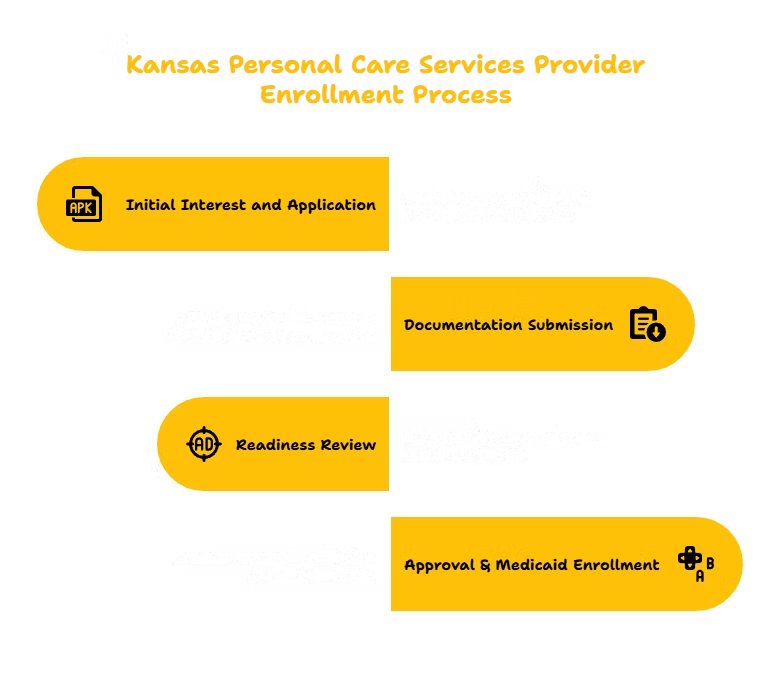
The enrollment journey is a sequenced process that requires attention to detail. Initially, providers must register through the Kansas Medical Assistance Program (KMAP) portal to initiate the application for Personal Care Services. Concurrent with the KMAP application, the agency must contact the three KanCare MCOs—Sunflower Health Plan, Aetna Better Health of Kansas, and UnitedHealthcare Community Plan—to initiate the specific credentialing process required for reimbursement.
During the enrollment phase, the provider will be required to submit substantial documentation, including Articles of Incorporation, proof of insurance, and comprehensive policy manuals. Regulatory bodies, such as KDADS or the MCOs, may conduct a readiness review. This review evaluates the agency’s capacity to manage participant files, maintain accurate documentation, and follow service protocols. Once approved, the agency will receive assigned billing codes, which are typically structured around 15-minute service units, allowing the provider to begin service delivery.
What are the Essential Staffing and Training Standards?
The success of a Personal Care Services agency relies heavily on the competency of its staff. The Program Supervisor role requires an individual with demonstrated experience in healthcare, social services, or personal assistance oversight, along with a clean background check. Similarly, all Personal Care Aides must undergo rigorous screening. While a high school diploma or GED is generally expected, the primary focus is on ensuring aides are capable of performing the specific ADLs and IADLs required by the participants they serve.
Training protocols must be comprehensive and ongoing. Before providing care, staff must complete mandated training modules, including:
- HIPAA compliance, confidentiality, and understanding participant rights.
- Emergency response protocols, abuse prevention, and infection control techniques.
- Specific training for ADL/IADL tasks relevant to individual participant care plans.
- Annual performance evaluations and ongoing continuing education to maintain service quality.
Frequently Asked Questions
Which Medicaid waiver programs cover Personal Care Services in Kansas?
Personal Care Services are authorized under the Frail Elderly (FE) Waiver, Physical Disability (PD) Waiver, Intellectual/Developmental Disability (IDD) Waiver, Brain Injury (BI) Waiver, and the Technology Assisted (TA) Waiver.
What is the typical timeline for launching a new PCS agency?
The launch process generally spans 6 to 9 months, including 1–2 months for business formation, 2–3 months for hiring and policy development, 60–90 days for KMAP and MCO credentialing, and 30–45 days for final billing setup.
What documentation is critical for maintaining audit readiness?
Providers must maintain organized records of participant intake, care plan implementation, service logs, incident reports, infection control records, and verified staff training logs, all of which must be compliant with Medicaid standards.
Key Takeaway
Entering the Kansas HCBS market as a Personal Care Services provider offers an opportunity to provide essential support to the state’s most vulnerable citizens, provided the agency strictly adheres to the regulatory requirements set by KDHE, KDADS, and the MCOs. By focusing on compliant administrative structures, thorough staff training, and meticulous documentation, new agencies can build a sustainable, high-quality service operation that meets the stringent demands of the KanCare system.
Last verified: August 2024. This information is intended for educational purposes only and does not constitute legal or professional advice. Requirements for Kansas Medicaid programs are subject to change; always refer to official KMAP bulletins, KDADS policy manuals, and MCO provider handbooks for the most current regulations and guidance.