PERSONAL CARE SERVICES PROVIDER IN IOWA
By Fatumata Kaba · 2025-07-22 · 5 min read
Personal Care Services in Iowa empower individuals with disabilities, chronic illnesses, or aging-related needs to live independently in their homes rather than in institutional settings. By providing essential hands-on support with Activities of Daily Living (ADLs) and Instrumental Activities of Daily Living (IADLs), these providers function as a vital component of the state’s Home and Community-Based Services (HCBS) waiver framework.
What Are the Governing Agencies Overseeing Personal Care Services?
The regulatory landscape for Personal Care Services in Iowa is defined by a multi-tiered structure that ensures federal compliance and local oversight. The Iowa Department of Health and Human Services (HHS), through the Iowa Medicaid Enterprise (IME), serves as the primary state administrator. This entity is responsible for managing waiver programs, overseeing provider enrollment, processing service authorizations, and managing billing integrity.
In addition to state-level administration, Managed Care Organizations (MCOs) play a critical role in the day-to-day operations of the program. Because most Iowa Medicaid participants receive services through managed plans, these MCOs coordinate individual service authorizations and handle the reimbursement process for providers. At the federal level, the Centers for Medicare & Medicaid Services (CMS) provides oversight to ensure all personal care delivery aligns with national safety, quality, and person-centered care standards.
How Do Providers Deliver Quality Personal Care Services?
Personal Care Services are defined by their focus on hands-on assistance, which is customized to meet the unique requirements of each participant as outlined in their Individualized Service Plan (ISP). Providers are responsible for delivering services that allow participants to manage their daily routines safely within their home environment. This ensures that the participant can maintain their independence while avoiding the need for high-acuity institutional care.
Approved providers generally deliver support in the following core areas:
- Assistance with ADLs such as bathing, grooming, toileting, dressing, eating, and mobility.
- Support with IADLs such as preparing meals, light housekeeping, laundry, and medication reminders.
- Cueing and supervision for participants who need prompting to complete tasks.
- Transfer and ambulation assistance to help participants move safely within the home.
- Basic health observation and reporting changes to supervisors.
- Support with community outings when aligned with the participant’s Individualized Service Plan (ISP).
What Are the Licensing and Provider Approval Requirements?
Becoming an approved Medicaid provider in Iowa requires a rigorous adherence to administrative and operational prerequisites. Before initiating the enrollment process, a business entity must be formally registered with the Iowa Secretary of State. Providers must also obtain a valid Employer Identification Number (EIN) from the IRS and a Type 2 National Provider Identifier (NPI) to function within the Medicaid billing system.
Operational stability is a core requirement for approval. Prospective agencies must maintain comprehensive general and professional liability insurance to protect both the agency and the participants. Furthermore, applicants must develop robust internal policies covering incident reporting, emergency response, and participant-centered service delivery. All staff members must undergo thorough background checks and complete mandatory training regarding abuse prevention and personal care assistance before having contact with participants.
What Is the Step-by-Step Iowa Provider Enrollment Process?
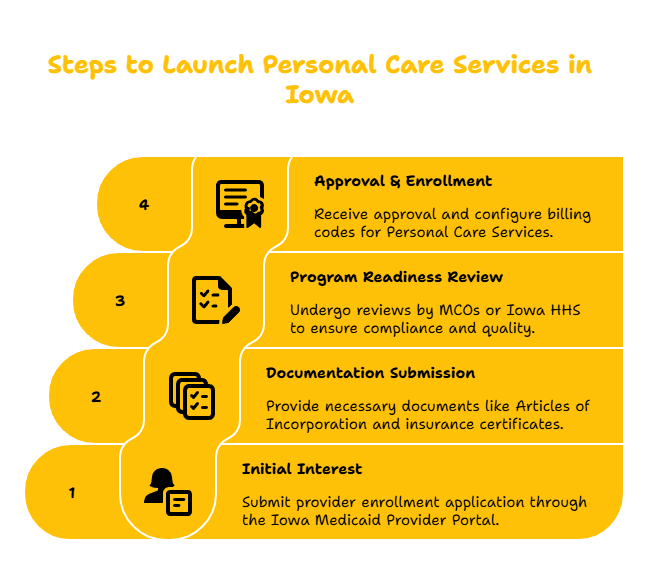
The enrollment process is a structured sequence designed to verify that a provider is ready to meet the standards set by Iowa HHS and the respective MCOs. It begins with the submission of an application through the Iowa Medicaid Portal Access (IMPA). During this phase, agencies must provide foundational documentation, including Articles of Incorporation, proof of NPI/EIN, insurance certificates, and comprehensive operational policies.
Once the initial application is filed, the program enters a readiness review phase. Iowa HHS or the MCOs may conduct an audit of the agency’s infrastructure. This includes evaluating staffing standards, the integrity of participant documentation systems, and the efficacy of quality control mechanisms. Upon successful completion of these reviews, the provider is officially enrolled and may begin configuring billing codes, which are typically processed in 15-minute or hourly increments depending on the specific waiver requirements.
What Essential Documentation Must Providers Maintain?
Audit readiness is a fundamental requirement for any Personal Care Services provider. Maintaining an organized, HCBS-compliant Policy & Procedure Manual is the cornerstone of a successful agency. This manual must be readily available for review by oversight agencies and should clearly outline how the agency manages the entire participant lifecycle, from initial intake and assessment to ongoing care planning.
Documentation requirements also include detailed records regarding staff and service delivery. Essential components include:
- Participant intake, assessment, and care planning procedures.
- Personal care task protocols and documentation standards.
- Emergency preparedness and critical incident reporting logs.
- HIPAA confidentiality, participant rights, and grievance handling procedures.
- Staff credentialing, background checks, training logs, and competency evaluations.
- Medicaid billing, time tracking, and audit readiness documentation.
Frequently Asked Questions
What waivers authorize Personal Care Services in Iowa?
Personal Care Services are currently authorized under several Iowa Medicaid waivers, including the Intellectual Disability (ID) Waiver, the Health and Disability (HD) Waiver, the Brain Injury (BI) Waiver, the Elderly Waiver, and the Children’s Mental Health (CMH) Waiver, where applicable.
What are the core requirements for Direct Support Professionals?
Staff members, including Personal Care Aides and Direct Support Professionals, must possess at least a high school diploma or GED and clear all required background screenings. It is preferred that they hold CPR and First Aid certifications. Additionally, all staff must complete mandatory training in HIPAA, participant rights, emergency preparedness, infection control, and person-centered care.
What is the typical timeline for starting a provider agency?
The process generally takes 6 to 10 months in total. This includes 1–2 months for business formation, 1–2 months for staffing and credentialing, 60–90 days for Medicaid enrollment and readiness reviews, and 30–45 days for final billing system configuration.
Key Takeaway
Establishing a successful Personal Care Services agency in Iowa requires meticulous attention to regulatory compliance, staff training, and administrative organization. By aligning business operations with the guidelines established by the Iowa Department of Health and Human Services and Managed Care Organizations, providers ensure they are positioned to deliver essential support while maintaining ongoing Medicaid eligibility and audit readiness.
Last verified: November 2024. The information provided in this article is for educational purposes and does not constitute legal or professional advice. Always consult with the official Iowa Medicaid Enterprise (IME) documentation and relevant state regulations for the most current guidance on provider enrollment and program compliance.