PERSONAL CARE SERVICES PROVIDER IN INDIANA
By Watchen Roberts · 2025-07-21 · 6 min read
Becoming a Personal Care Services (PCS) provider in Indiana requires a structured approach to meeting the rigorous standards set by the Indiana Family and Social Services Administration (FSSA) and federal guidelines. This service model is essential for supporting individuals with disabilities, chronic health conditions, or aging-related limitations to maintain independence and dignity within their homes and communities, thereby reducing the necessity for institutional placement.
Providers must navigate specific enrollment, licensing, and operational requirements dictated by the Office of Medicaid Policy and Planning (OMPP), the Division of Aging, and the Division of Disability and Rehabilitative Services (DDRS). By aligning business operations with these state and federal frameworks, agencies can successfully deliver critical hands-on support while ensuring long-term compliance and sustainability.
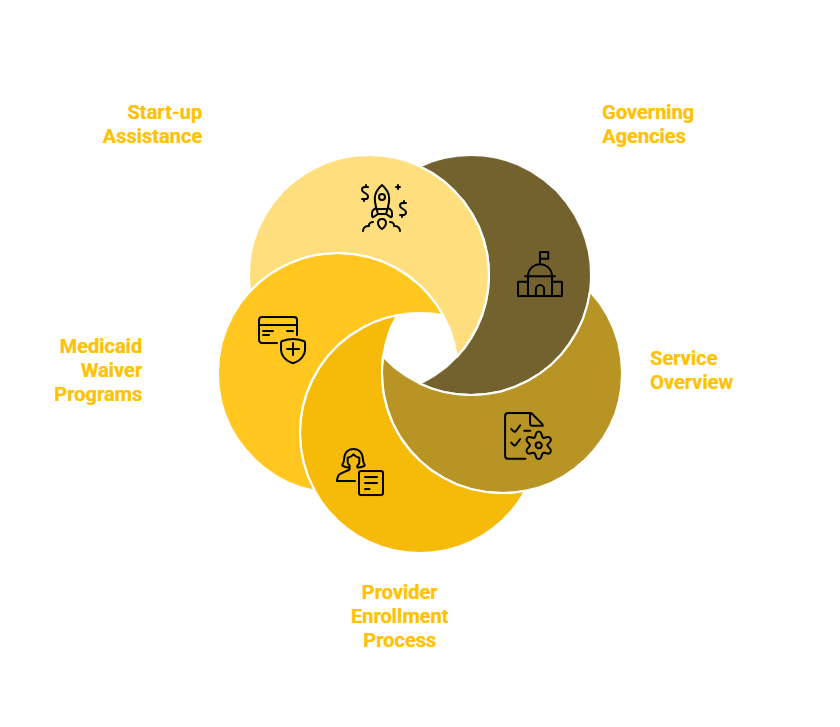
Understanding the Governing Agency Landscape
The regulatory environment for Indiana Personal Care Services is overseen by a multi-tiered hierarchy of agencies. At the state level, the Indiana Family and Social Services Administration (FSSA) serves as the primary authority, housing the Office of Medicaid Policy and Planning (OMPP) and the Division of Aging. These entities are responsible for the administration of Medicaid funding, the oversight of provider enrollment, the establishment of service standards, and the management of reimbursement processes.
Beyond general administrative oversight, specific populations are served through the Division of Disability and Rehabilitative Services (DDRS), which governs service authorization for programs under various Home and Community-Based Services (HCBS) waivers. On the federal level, the Centers for Medicare & Medicaid Services (CMS) provides the overarching regulatory structure. CMS ensures that all Medicaid-funded PCS programs adhere strictly to the HCBS Settings Rule, which mandates participant-centered planning and high-quality, community-integrated care standards.
- FSSA (OMPP/Division of Aging): Manages Medicaid funding, provider enrollment, and reimbursement.
- DDRS: Manages service authorizations specifically for disability-related HCBS waivers.
- CMS: Provides federal oversight to ensure compliance with the HCBS Settings Rule and quality benchmarks.
Defining the Scope of Personal Care Services
Personal Care Services are designed to provide direct, hands-on assistance to participants who cannot complete essential tasks independently due to physical or cognitive limitations. To be billable, these services must be formally documented and authorized within the participant’s Individualized Support Plan (ISP) or other Medicaid-approved service plans. Providers are expected to act not just as caregivers, but as monitors who can identify and report shifts in a participant’s condition.
The scope of service includes a comprehensive range of support, from physical assistance to health monitoring. Providers must ensure that every staff member understands the boundary between service provision and the preservation of participant autonomy. Services must be tailored to the individual’s specific needs as outlined in their care plan, ensuring that the assistance provided fosters independence rather than creating dependency.
- ADL Support: Bathing, grooming, dressing, toileting, eating, transferring, and mobility.
- IADL Support: Light housekeeping, meal preparation, laundry, and medication reminders.
- Safety & Monitoring: Safety supervision, cueing for tasks, and reporting changes in health status.
- Community Support: Assistance during outings, medical appointments, or community activities.
Navigating Licensing and Provider Approval Requirements
Launching a PCS agency requires a meticulous approach to administrative and operational readiness. Before a provider can be approved, they must formalize their business entity through the Indiana Secretary of State and obtain the necessary federal identifiers, including an EIN and a Type 2 NPI. These foundational steps ensure the business is legally recognized and capable of entering into a provider agreement with the state.
Operational compliance is evaluated through a readiness review process. Providers must establish a robust internal infrastructure that covers everything from participant safety to documentation protocols. This includes securing appropriate liability insurance and developing a comprehensive policy and procedure manual that serves as the blueprint for the agency’s daily operations. Documentation must be audit-ready, reflecting compliance with both state regulations and Medicaid billing standards.
- Registration: Business entity filing with the Indiana Secretary of State.
- Identifiers: IRS EIN and Type 2 NPI.
- Insurance: Mandatory general and professional liability coverage.
- Internal Controls: Policies on incident reporting, staff training, and participant-centered service delivery.
The Indiana Provider Enrollment and Readiness Process
The enrollment journey is a multi-phase process that begins in the Indiana Medicaid Provider Portal. Providers must submit a formal application specifically for Personal Care Services under the relevant HCBS waivers or the Medicaid State Plan. During this phase, the applicant must provide extensive documentation, including articles of incorporation, proof of insurance, and detailed staff credentialing information.
Following the submission, the FSSA conducts a program readiness review. This is a critical stage where the state verifies that the applicant has the capacity to protect participants and document services correctly. Once the readiness review is successfully cleared, the provider is enrolled and assigned the appropriate billing codes. It is essential to note that these services are typically billed in 15-minute increments, requiring precise tracking and administrative accuracy.
Staffing, Training, and Regulatory Compliance
The quality of a Personal Care Services program is inherently tied to the competence of its staff. The agency must appoint a Program Supervisor, preferably with a background in nursing, social work, or human services, to manage the delivery of care and ensure compliance with all policies. Direct Support Professionals (DSPs) or Personal Care Aides must meet minimum educational requirements, such as a high school diploma or GED, and hold relevant certifications like CPR/First Aid.
Ongoing training is a non-negotiable component of compliance. All personnel must receive initial and recurring training on ADL/IADL assistance, HIPAA confidentiality, infection control, and emergency response procedures. Furthermore, annual competency evaluations are required to ensure that staff members continue to meet the agency’s standards and the state’s evolving regulatory requirements.
- Supervisor Qualifications: Professional background in human services or health, supervisory experience, and background clearance.
- Aide Qualifications: High school diploma/GED, CPR/First Aid, and mandatory state-approved training.
- Mandatory Training: HIPAA compliance, abuse prevention, emergency response, and core caregiving competencies.
Frequently Asked Questions
What types of Medicaid programs cover Personal Care Services in Indiana?
Personal Care Services are covered through the Indiana Medicaid State Plan and several HCBS waiver programs, including the Community Integration and Habilitation (CIH) Waiver, the Family Supports Waiver (FSW), the Aged and Disabled (A&D) Waiver, and the Traumatic Brain Injury (TBI) Waiver.
How long does the launch process typically take for a new provider?
The timeline varies based on organizational readiness, but generally, the process spans several months. Business formation and policy development typically take 1–2 months, staff credentialing and training take 2–3 months, the Medicaid enrollment and readiness review take 60–90 days, and final billing setup takes 30–45 days.
What documentation is required for the Medicaid Provider Enrollment application?
Providers must submit documentation including business registration (Secretary of State), EIN and NPI confirmation, proof of liability insurance, and a comprehensive Policy & Procedure Manual that covers intake, emergency preparedness, HIPAA, incident reporting, and audit-ready service tracking.
Key Takeaway
Establishing a successful Personal Care Services agency in Indiana requires a dual focus: strict adherence to the regulatory requirements set forth by the FSSA and a steadfast commitment to participant-centered care. By maintaining rigorous documentation, investing in qualified staff training, and ensuring full transparency in Medicaid billing, agencies can provide essential support to vulnerable populations while building a stable, compliant, and sustainable healthcare business.
Last verified June 2024. This information is provided for educational purposes and should not be considered legal or formal consulting advice. Regulations regarding Indiana Medicaid waivers are subject to change; providers are encouraged to monitor updates from the Indiana Family and Social Services Administration (FSSA) and the Centers for Medicare & Medicaid Services (CMS) regularly.