PERSONAL CARE SERVICES PROVIDER IN COLORADO
By Fatumata Kaba · 2025-07-06 · 5 min read
Personal Care Services (PCS) in Colorado allow healthcare agencies to provide vital, non-medical support to individuals who require assistance with daily tasks to remain living independently in their own homes. By becoming an approved Medicaid provider, agencies play a critical role in the state's Home and Community-Based Services (HCBS) ecosystem, delivering essential care under programs like the Elderly, Blind, and Disabled (EBD), Brain Injury (BI), and Community Mental Health Supports (CMHS) waivers.
What Are Personal Care Services and Who Do They Serve?
Personal Care Services are designed to bridge the gap between complete independence and institutional care. By providing routine assistance with Activities of Daily Living (ADLs) and Instrumental Activities of Daily Living (IADLs), these services prevent premature institutionalization and uphold the participant's dignity and autonomy. The services are strictly guided by a person-centered service plan, ensuring that the care delivered is tailored to the specific needs of the individual as determined by their case manager.
Approved providers focus on essential support tasks, including personal hygiene, mobility, and nutritional assistance. These services must be authorized by a Case Management Agency (CMA), which serves as the gatekeeper for service delivery under Colorado Medicaid waivers. Maintaining compliance with these person-centered plans is not merely a operational requirement; it is a regulatory mandate enforced by the Colorado Department of Health Care Policy and Financing (HCPF) and the Centers for Medicare & Medicaid Services (CMS).
- Bathing, dressing, grooming, and hygiene assistance
- Mobility support and transferring
- Medication reminders (non-administration)
- Meal preparation and assistance with eating
- Light housekeeping related to personal care
- Laundry and linen changes
- Toileting and incontinence care
- Documentation of hours and tasks completed
How Do Agencies Obtain Licensing and Medicaid Authorization?
Entering the Colorado home care market requires a dual-track process involving both state licensing and federal/state Medicaid enrollment. First, an agency must secure a Class B Home Care Agency License from the Colorado Department of Public Health and Environment (CDPHE). This licensing process verifies that the agency has established rigorous emergency plans, operational policies, and staff training procedures necessary for safe operation.
Once the Class B license is secured, the provider must enroll in the Colorado Medicaid program via the Gainwell Technologies Provider Portal. During this stage, the agency must be prepared to demonstrate that its business structure, NPI (Type 2), and operational capacity meet all state requirements. This phase effectively connects the agency to the billing infrastructure, enabling the reimbursement of services delivered under HCBS waivers.
What Are the Essential Staffing and Training Mandates?
The quality of a Personal Care Services agency is defined by its frontline staff—the Personal Care Workers (PCWs). Agencies are responsible for ensuring that all staff meet baseline requirements, which include a high school diploma or GED (recommended), successful completion of background checks, and documented TB clearance. Furthermore, while CPR and First Aid certifications are recommended, ensuring staff possess the actual competency to perform ADL and IADL support is non-negotiable.
The Agency Supervisor plays an equally vital role, tasked with the oversight of scheduling, ongoing supervision, and stringent quality assurance. Compliance is a continuous process that requires maintaining detailed records of staff orientation, annual training refreshers, and competency evaluations. Agencies must be particularly vigilant in training staff on HIPAA compliance, client confidentiality, mandated abuse reporting, and standardized infection control procedures.
How to Manage Documentation and Compliance?
Documentation is the backbone of Medicaid reimbursement. Auditors from HCPF and federal partners evaluate providers based on the consistency and accuracy of their records. Every task performed must be logged and verified in accordance with the participant’s service plan. Inadequate documentation is a primary cause for payment recoupment and regulatory sanctions, making it essential to have a robust internal audit system.
Agencies must maintain a comprehensive policy and procedure manual that serves as a roadmap for daily operations. This manual should cover every aspect of the agency’s interaction with the participant, from intake and eligibility verification to grievance procedures and incident reporting. By institutionalizing these protocols, providers protect both the health of the participant and the sustainability of the business.
- Articles of Incorporation or proof of business registration
- IRS EIN Letter and NPI confirmation
- CDPHE Class B Home Care Agency License
- Daily task logs and service verification sheets
- Confidentiality and HIPAA compliance policies
- Emergency preparedness and abuse prevention
- Staff orientation, training, and supervision documentation
What is the Typical Timeline to Launch a Service?
The launch of a Personal Care Services agency involves several distinct phases that require careful coordination. Business formation, including LLC registration and obtaining the EIN, is typically the fastest phase, usually spanning one to two weeks. The more complex regulatory hurdles follow, with the CDPHE licensing process taking anywhere from 45 to 90 days. This is followed by Medicaid provider enrollment, which generally takes 30 to 60 days.
It is important to note that the final phase—building referral relationships with CMAs—should be treated as an ongoing, iterative process. While the administrative milestones are fixed, the success of the agency depends on its ability to integrate into the local continuum of care. Proactive networking with case managers and community partners is essential to ensuring that once the agency is authorized to bill, it is positioned to receive service authorizations.
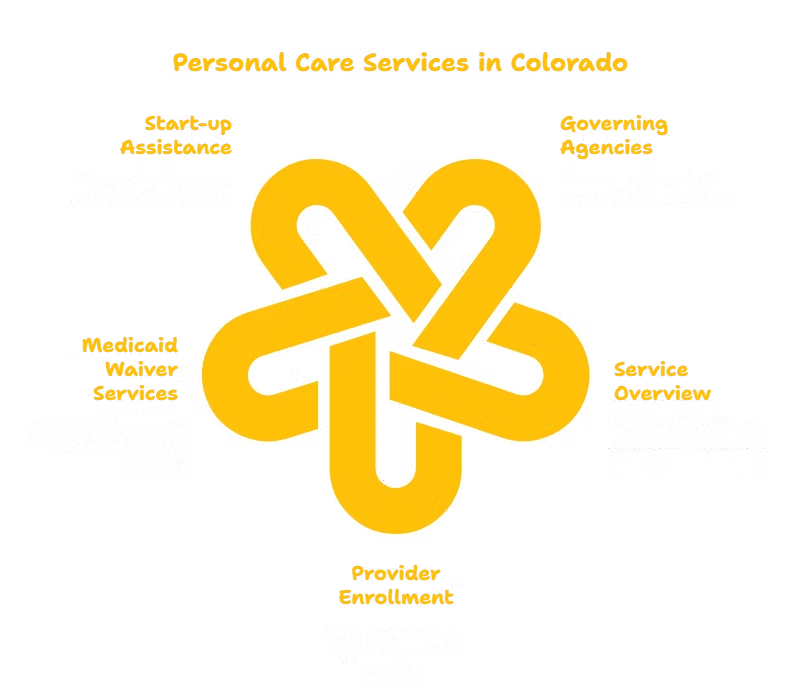
Frequently Asked Questions
How are Personal Care Services reimbursed?
Services are reimbursed through Colorado Medicaid once the provider is enrolled with the state and services are authorized for a participant. Reimbursement is based on documented, authorized hours of service delivered in accordance with the individual’s person-centered service plan.
What is the role of a Case Management Agency (CMA)?
A CMA is responsible for assessing participant needs, developing the person-centered service plan, and managing the authorization of waiver services. They act as the primary liaison between the Medicaid recipient and the care provider.
What happens during a CDPHE inspection?
During the licensing inspection, CDPHE officials review the agency’s emergency protocols, staff training records, policy manuals, and operational procedures to ensure they comply with state home care regulations and protect the health and safety of participants.
Support for Start-Up Agencies
Waiver Consulting Group provides comprehensive assistance to agencies, entrepreneurs, and healthcare professionals aiming to launch compliant Personal Care Services. Our support covers the technical aspects of the startup process, including business registration, Class B license application support, Medicaid provider enrollment, and the creation of essential operational documentation. We also provide templates for shift logs, incident reports, and staff credentialing trackers to streamline the transition to a fully operational, compliant agency. Our focus is to provide the infrastructure needed to navigate Colorado's complex regulatory environment effectively.
Key Takeaway: Success as a Personal Care Services provider in Colorado relies on strict adherence to both state licensing requirements (CDPHE) and Medicaid operational standards (HCPF). By prioritizing compliant documentation, staff competency, and strong relationships with Case Management Agencies, new providers can effectively serve vulnerable populations while maintaining a sustainable business model.
Last verified: 2024. This information is provided for educational purposes only and does not constitute legal or financial advice. Consult with the Colorado Department of Health Care Policy and Financing (HCPF) or a qualified legal professional to confirm current regulations, as state and federal policies may change. Waiver Consulting Group is a private consultancy and is not an agency of the state or federal government.