PERSONAL CARE SERVICES PROVIDER IN CALIFORNIA
By Fatumata Kaba · 2025-07-07 · 5 min read
Personal Assistance Services (PAS) in California provide essential, non-medical, one-on-one support for individuals with intellectual and developmental disabilities (IDD) who require assistance with daily living. These services are authorized through the California Department of Developmental Services (DDS) via the 21 regional centers under the Lanterman Act, ensuring that consumers receive tailored care that promotes independence and community integration.
What Are Personal Assistance Services and How Are They Authorized?
Personal Assistance Services (PAS) function as a critical support layer for individuals with IDD, focusing on Activities of Daily Living (ADLs) and Instrumental Activities of Daily Living (IADLs). By providing hands-on support in the least restrictive environment, PAS allows consumers to remain in their own homes while maintaining their personal autonomy. These services are not intended to be medical in nature, but rather serve to facilitate the tasks necessary for a safe and dignified life.
Authorization for these services is rooted in the Individual Program Plan (IPP). The IPP acts as the roadmap for the consumer's needs, and regional centers serve as the primary coordinators and monitors for service delivery. Under the Lanterman Act, regional centers must ensure that service providers are capable of meeting the specific goals outlined in the IPP, making the alignment between provider capabilities and consumer needs a priority for vendorization.
Who Governs the Delivery of PAS in California?
The oversight structure for PAS in California is multi-layered, involving both state-level departments and regional entities. The California Department of Developmental Services (DDS) provides the overarching policy guidance and regulatory framework for services under the Lanterman Act. Regional centers are the direct point of contact for providers, as they handle the specific authorization, coordination, and monitoring of PAS for eligible consumers in their catchment areas.
At the state and federal level, the California Department of Health Care Services (DHCS) administers the Medi-Cal funding that supports eligible services under various Home and Community-Based Services (HCBS) waivers. Furthermore, the federal Centers for Medicare & Medicaid Services (CMS) ensures that all services delivered comply with federal person-centered standards. Providers must remain aware of this hierarchy to ensure that their administrative practices align with both state-specific mandates and federal funding requirements.
What Are the Operational Prerequisites for New Providers?
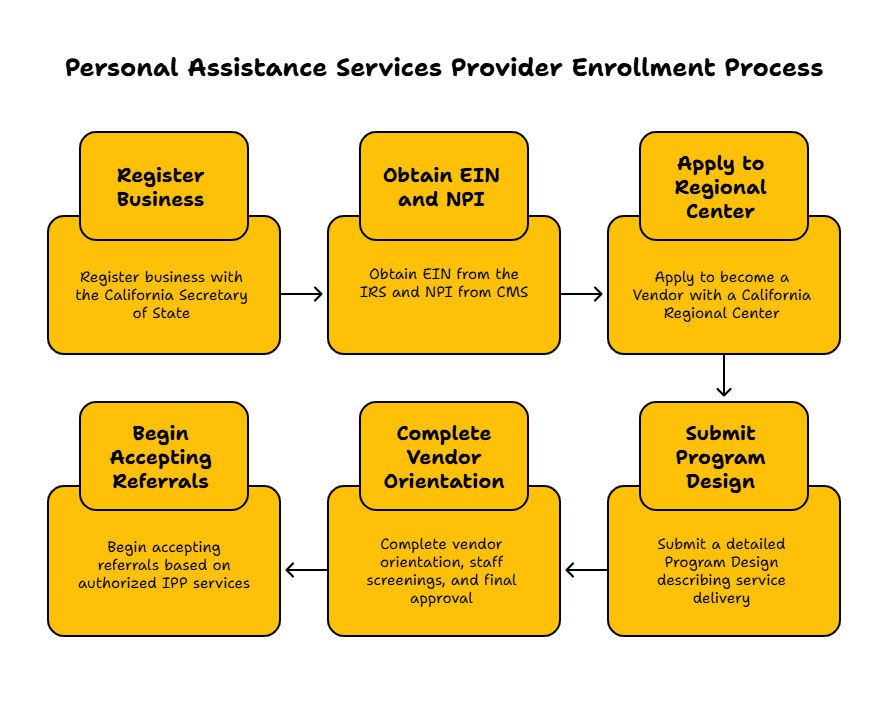
Establishing a PAS provider agency requires a rigorous commitment to administrative and legal compliance. Before approaching a regional center for vendorization, a prospective provider must complete basic business registration with the California Secretary of State and obtain a federal Employer Identification Number (EIN). Furthermore, securing a National Provider Identifier (NPI Type 2) is a mandatory step for formal recognition within the healthcare and human services systems.
Beyond legal registration, providers must develop a robust, detailed Program Design. This document serves as the foundation of the business, outlining the model of service delivery, the qualifications of the staff, and the specific strategies for client engagement. The following operational elements must be in place before beginning the vendorization process:
- Evidence of comprehensive general liability and workers’ compensation insurance.
- A standardized system for conducting and tracking Live Scan fingerprinting and background checks for all personnel.
- A documented HIPAA-compliant infrastructure to ensure the privacy of participant records.
- Clear policies for incident reporting, emergency responses, and the documentation of daily service logs.
How Do You Navigate the Regional Center Vendorization Process?
The transition from a business entity to an authorized service provider involves a structured sequence of steps known as vendorization. The provider must first contact their target regional center to request a vendor application packet specifically for Service Code 062. This process involves submitting the previously developed Program Design along with all required business, insurance, and staff documentation to the regional center's vendorization department.
The timeline for this phase generally spans 30 to 60 days, though it can fluctuate based on the specific requirements of the local regional center. Once the application is submitted, the regional center will review the proposed services against the needs of their consumer population. Upon approval, the provider must participate in orientation sessions to ensure they understand the reporting, billing, and oversight requirements associated with the Lanterman Act and regional center policies.
What Are the Staffing and Training Mandates for PAS Agencies?
The quality of a PAS program is heavily dependent on the competence and reliability of the Direct Support Professionals (DSPs). A successful agency must implement a thorough hiring and onboarding strategy that includes validating high school diplomas or equivalencies, performing comprehensive background checks, and ensuring that all staff hold current CPR and First Aid certifications. Experience in supporting individuals with disabilities is highly preferred and serves as a vital component in matching staff to consumer needs.
Internal training programs must be established to keep staff compliant with both industry standards and regional center expectations. Ongoing education for employees should cover the following core areas:
- Person-centered service delivery methods specifically aligned with the IPP.
- Techniques for providing assistance with ADLs and IADLs.
- Mandated reporting protocols and specialized abuse prevention strategies.
- Procedures for documentation, record-keeping, and the utilization of HIPAA-compliant incident reporting tools.
Frequently Asked Questions
What is the primary funding source for PAS in California?
The primary funding source for Personal Assistance Services under Service Code 062 is the California Regional Center system, operating under the mandates of the Lanterman Act. In specific scenarios involving eligible Medi-Cal recipients, services may also be supported through HCBS Waivers or the Self-Determination Program (SDP).
How long does it take to become a fully operational provider?
The launch process generally moves through four phases: business formation (1–2 weeks), regional center vendorization (30–60 days), staff hiring and training (2–4 weeks), and ongoing service activation. Total time to launch typically ranges from two to three months, depending on the speed of administrative processing.
What must be included in the provider’s policy and procedure manual?
An effective manual must include protocols for intake and IPP alignment, daily service documentation, participant rights, HIPAA compliance, emergency response, incident reporting, staff supervision, and grievance resolution procedures. These documents must be readily available for review during regional center audits.
Key Takeaway: Successfully operating as a Personal Assistance Services provider in California requires strict adherence to the Lanterman Act, proactive alignment with individual regional center requirements, and a persistent focus on maintaining high-quality documentation and staff training standards to ensure continuous compliance and optimal support for the IDD community.
Last verified: October 2023. Disclaimer: This article is for informational purposes only and does not constitute legal or professional advice. Always consult with the California Department of Developmental Services or your local Regional Center for the most current regulations, statutes, and program requirements.