PERSONAL CARE SERVICES PROVIDER IN ARKANSAS
By Fatumata Kaba · 2025-07-06 · 5 min read
Personal Care Services in Arkansas provide essential non-medical, hands-on assistance to individuals who require help with activities of daily living due to age, physical disability, or chronic health conditions. By operating under the Arkansas Medicaid State Plan and various Home and Community-Based Services (HCBS) waiver programs, providers serve as the primary support system that enables vulnerable residents to remain in their homes and avoid unnecessary institutionalization.
Launching a Personal Care Services agency in Arkansas is a highly regulated undertaking that requires meticulous coordination between state health departments and federal Medicaid authorities. Prospective providers must navigate a multi-layered framework of licensure, credentialing, and strict operational compliance to ensure they meet the health and safety standards mandated by the Arkansas Department of Human Services (DHS) and the Centers for Medicare & Medicaid Services (CMS).
Understanding the Regulatory Landscape for Arkansas Personal Care
The regulatory structure for personal care in Arkansas is designed to ensure consistent, high-quality delivery of home-based support. The Arkansas Department of Human Services (DHS), through its Office of Long Term Care (OLTC), acts as the primary regulatory body responsible for overseeing agency operations and monitoring compliance with state standards. Their role is to protect participant welfare by enforcing rigorous service delivery protocols.
Parallel to the state oversight, the Arkansas Medicaid program, administered by the Division of Medical Services (DMS), manages the fiscal and enrollment aspects of the provider network. Agencies must maintain alignment with CMS federal guidelines to qualify for Medicaid reimbursement. Understanding these governing agencies is the first step for any administrator aiming to build a sustainable and compliant home care business within the state.
Operational Prerequisites and Business Formation
Before an agency can apply for licensure, it must first establish a formal business entity and secure the necessary administrative infrastructure. This includes registering the business with the Arkansas Secretary of State, obtaining a valid Employer Identification Number (EIN) from the IRS, and securing a Type 2 National Provider Identifier (NPI). These elements are foundational, as they identify the agency in all federal and state reporting systems.
Beyond basic business registration, agencies must prepare their administrative environment for external scrutiny. This includes purchasing comprehensive general liability and worker’s compensation insurance to protect both the agency and its workforce. Developing a robust, compliant documentation system—covering everything from client intake to billing—is essential for surviving the rigorous audits that are standard practice within the Arkansas Medicaid ecosystem.
- Registering the business entity with the Arkansas Secretary of State
- Obtaining a federal EIN and a Type 2 NPI for billing purposes
- Securing adequate general liability and worker’s compensation insurance coverage
- Developing a comprehensive administrative policy and procedure manual
Navigating the Licensing and Medicaid Enrollment Process
The path to authorization follows a sequential, phase-based approach. The initial phase involves applying for a home care agency license through the Arkansas Department of Health (ADH). This process requires the submission of detailed operational policies, infection control procedures, staff rosters, and comprehensive training materials. Following the submission, agencies must pass a formal on-site inspection and an administrative review to verify their capacity to deliver safe services.
Once licensure is secured, the agency must transition to Medicaid enrollment via the Arkansas Medicaid Provider Portal. This stage involves submitting all licensure credentials and signing provider agreements with the state. Upon successful enrollment and the issuance of a provider number, the agency is then positioned to coordinate with case managers and local Area Agencies on Aging (AAAs) to receive client referrals and initiate care authorizations.
Staffing, Training, and Clinical Supervision Standards
The quality of personal care is directly linked to the qualifications and professional oversight of the staff. Every agency must employ a Personal Care Supervisor, who must be a licensed Registered Nurse (RN) or Licensed Practical Nurse (LPN) in Arkansas. This supervisor is responsible for the critical functions of training personal care aides (PCAs), conducting client assessments, and providing ongoing clinical supervision to ensure care plans are being followed correctly.
Personal Care Aides are the backbone of the service delivery model. To be eligible for employment, an aide must possess at least a high school diploma or its equivalent, hold current CPR and First Aid certifications, and successfully complete a DHS-approved PCA training program. Furthermore, all staff must undergo mandatory background checks and registry clearances to ensure the safety of the participants they serve.
- Mandatory completion of DHS-approved PCA training programs
- Ongoing annual skills review and continuing education requirements
- Strict adherence to confidentiality and mandatory reporting protocols
- Documented training in lifting techniques, infection control, and ADL assistance
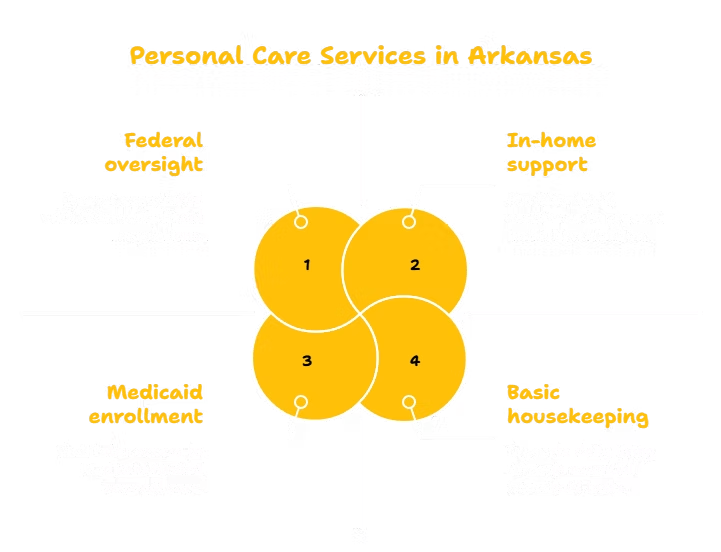
Service Delivery Under Medicaid Waiver Programs
Arkansas provides personal care services through several different pathways, each tailored to meet specific population needs. The Arkansas Medicaid State Plan Personal Care Program provides a standard tier of support, while the ARChoices in Homecare Waiver and the Independent Choices Program offer more flexibility for eligible elderly and disabled residents. Additionally, the Community and Employment Supports (CES) Waiver provides support for individuals with developmental disabilities.
In all these programs, the provider’s role remains consistent: to deliver hands-on assistance with activities of daily living (ADLs), provide essential in-home monitoring, and document progress toward the goals established in the client’s care plan. Effective coordination with case managers is vital, as this ensures the services rendered remain aligned with the evolving needs of the participant and the requirements of the authorizing waiver program.
Frequently Asked Questions
What is the typical timeline for launching a new agency?
The timeline varies based on the agency's readiness, but generally, business formation takes 1–2 weeks, the ADH licensing phase takes 60–90 days, Medicaid enrollment takes 30–60 days, and staff training takes 30–45 days.
What specific documentation must an agency maintain for audit purposes?
Agencies must maintain thorough records including, but not limited to, intake and assessment documentation, detailed ADL support logs, care plan implementation tracking, staff training/hiring records, incident reports, grievance logs, and verified billing timesheets.
How do providers receive client referrals?
Once a provider is fully licensed and enrolled with Arkansas Medicaid, they should actively network with local case managers, Area Agencies on Aging (AAAs), and regional hospital discharge planners to facilitate client referrals and service authorizations.
Key Takeaway
Launching a Personal Care Services agency in Arkansas is a complex process that demands strict adherence to state licensing, Medicaid enrollment procedures, and federal oversight standards. Success depends on the administrator’s ability to build a compliant infrastructure, hire qualified clinical supervisors, and maintain meticulous documentation that proves the agency's commitment to quality care and participant safety.
Last verified: May 2024. The information provided in this article is for educational purposes only and does not constitute legal or professional consulting advice. Prospective providers should consult directly with the Arkansas Department of Human Services and the Arkansas Department of Health for the most current regulatory requirements and application materials.