PERSONAL CARE ATTENDANT (PCA) SERVICES PROVIDER IN NEW MEXICO
By Fatumata Kaba · 2025-09-05 · 5 min read
Personal Care Attendant (PCA) Services in New Mexico serve as a cornerstone of the state's Medicaid Home and Community-Based Services (HCBS) waiver programs, providing essential support to individuals with disabilities, chronic illnesses, or age-related conditions. By facilitating assistance with Activities of Daily Living (ADLs) and Instrumental Activities of Daily Living (IADLs), these services enable participants to maintain independence and enhance their quality of life within their own homes and communities. This guide outlines the regulatory framework, enrollment requirements, and operational steps necessary for provider agencies to successfully offer PCA services in New Mexico.
What Are the Governing Agencies and Regulatory Bodies for PCA Services?
The delivery of Medicaid-funded PCA services in New Mexico is overseen by a structured network of state and federal entities. These organizations ensure that services are provided according to strict quality, safety, and fiscal standards, protecting the rights of participants and the integrity of the Medicaid program.
The New Mexico Human Services Department (HSD) acts as the primary agency responsible for administering Medicaid waiver funding. HSD manages the crucial aspects of provider enrollment, service authorization, and the reimbursement processes that allow agencies to operate effectively. Complementing this, the Developmental Disabilities Supports Division (DDSD) focuses on the ground-level quality standards and compliance protocols necessary for service delivery under specific HCBS waivers.
On a federal level, the Centers for Medicare & Medicaid Services (CMS) provides the overarching regulatory structure. CMS ensures that New Mexico’s programs align with federal mandates concerning person-centered planning, participant protections, and the overall quality of care delivered in home and community-based settings.
What Scope of Services Can a PCA Provider Deliver?
PCA services are designed to address the specific needs identified in a participant's Individualized Service Plan (ISP). These services are meant to bridge the gap between complete independence and the need for institutional care, providing the necessary support to maintain well-being in a residential environment.
Approved providers are authorized to deliver a broad range of support, including but not limited to:
- Personal Hygiene Assistance: Support with bathing, grooming, oral care, and dressing.
- Mobility Support: Assistance with transfers, ambulation, and positioning to prevent injury.
- Toileting and Incontinence Care: Dignified support with bathroom use and ongoing hygiene maintenance.
- Meal Preparation and Feeding: Nutritional support through balanced meal preparation, hydration monitoring, and feeding assistance.
- Housekeeping and Laundry: Light cleaning tasks, bed making, and laundry management.
- Medication Reminders: Non-skilled assistance in adhering to prescribed medication schedules.
- Safety and Social Engagement: Providing companionship and social interaction while conducting active safety monitoring to prevent accidents.
How Do Agencies Meet Licensing and Provider Approval Requirements?
Establishing a PCA provider agency in New Mexico requires a systematic approach to business formation and regulatory compliance. Before an agency can bill Medicaid, it must establish legal status and meet the specific criteria set forth by the state departments governing healthcare delivery.
The foundational requirements include registering the business entity with the New Mexico Secretary of State and obtaining a Federal Employer Identification Number (EIN) from the IRS, along with a National Provider Identifier (NPI) Type 2. Additionally, providers must secure a Personal Care Agency License from the New Mexico Department of Health (NMDOH). These steps must be supported by comprehensive general and professional liability insurance to protect the agency and the participants it serves.
Agencies must also develop robust internal infrastructures, including formal policies for personal care planning, rigorous safety protocols, and systematic staff training programs. Demonstrating that the agency has established processes for background checks, health screenings, and professional development is essential for gaining authorization to serve Medicaid participants.
What Is the Process for New Mexico Medicaid Provider Enrollment?
The transition from a business entity to an authorized Medicaid provider involves a multi-phased enrollment and readiness process. This process ensures that the provider is capable of meeting the operational and clinical standards required by the HSD and DDSD.
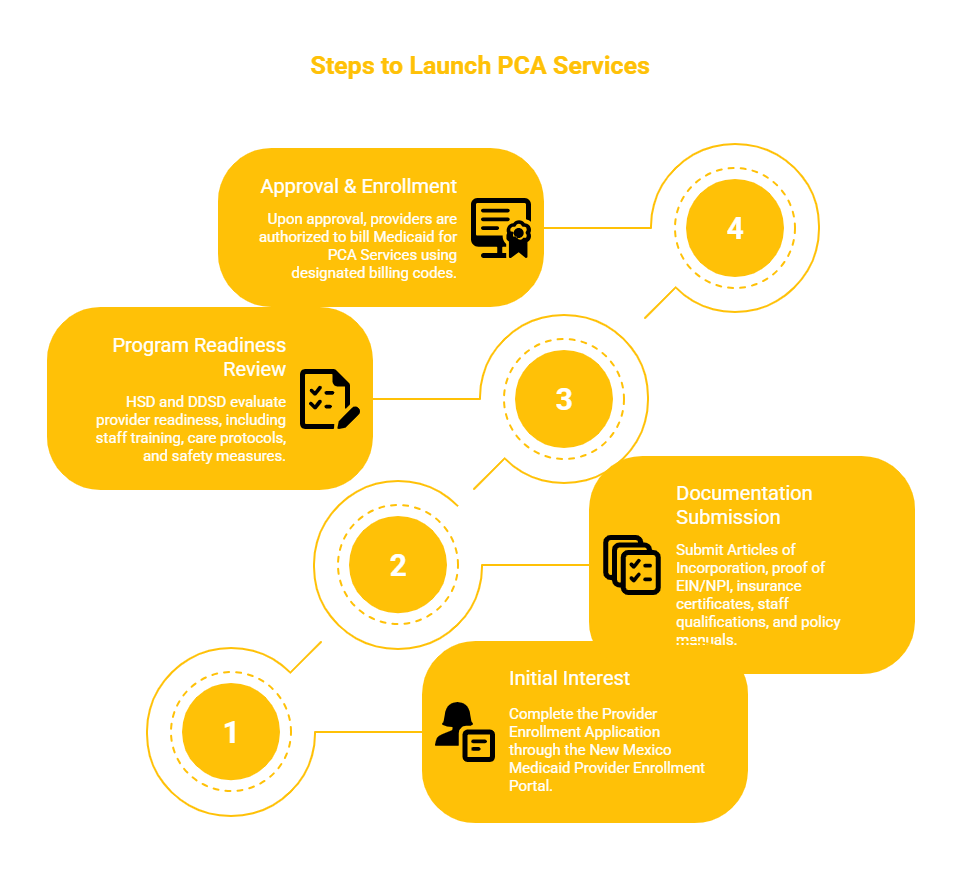
The sequence begins with the submission of a formal Provider Enrollment Application through the New Mexico Medicaid Provider Enrollment Portal. Applicants must provide comprehensive documentation, including Articles of Incorporation, proof of valid licensure, and evidence of insurance coverage. This stage requires meticulous attention to detail to ensure that all business and credentialing information is accurately reflected in the Medicaid management system.
Following the submission, the HSD and DDSD conduct a Program Readiness Review. This evaluation scrutinizes the provider’s operational readiness, including the quality of care protocols, staff training materials, and safety measures. Once the agency passes this review and is formally approved, they are authorized to begin billing for PCA services using the designated Medicaid billing codes.
How Must Agencies Manage Staffing and Training Requirements?
The quality of PCA services is largely determined by the competency and preparedness of the staff. Agencies are responsible for recruiting, training, and retaining a workforce that meets specific educational and experiential benchmarks, ensuring that every participant receives high-quality, safe care.
The organizational structure typically requires a PCA Program Director, who holds a bachelor’s or associate degree in a relevant healthcare or social services field, along with prior supervisory experience. PCAs and Direct Support Professionals (DSPs) are expected to hold at least a high school diploma or GED, possess valid CPR/First Aid certifications, and successfully clear state-mandated background checks.
Beyond initial hiring, all staff members must complete mandatory training modules, which include:
- Personal care skills training focusing on ADLs and IADLs.
- Comprehensive safety and infection control protocols.
- HIPAA compliance and education on participant rights.
- Ongoing professional development, including annual competency evaluations and wellness monitoring updates.
Frequently Asked Questions
What Medicaid waiver programs allow for PCA services?
PCA services are authorized under several New Mexico Medicaid waivers, including the Developmental Disabilities (DD) Waiver, the Mi Via Waiver, the Medically Fragile Waiver, the Supports Waiver, and the standard Home and Community-Based Services (HCBS) Waiver.
What is the typical timeline to launch a PCA agency?
The launch process generally spans several months. Business formation and compliance preparation usually take 1–2 months; staff hiring and program development take 2–3 months; the Medicaid enrollment and readiness review process typically takes 60–90 days; and final billing setup can take an additional 30–45 days.
What documentation is essential for a Policy & Procedure Manual?
A comprehensive manual must include participant intake and care planning, specific assistance guidelines, staff credentialing procedures, documentation standards for billing, HIPAA and grievance policies, emergency response protocols, and quality assurance monitoring systems.
Key Takeaway
Successfully operating as a PCA services provider in New Mexico requires strict adherence to the regulatory standards established by the HSD, DDSD, and CMS. By focusing on compliant business registration, rigorous staff training, and meticulous adherence to the Individualized Service Plan, agencies can provide the essential, person-centered support that enables participants to thrive within their communities.
Last verified: October 2023. Disclaimer: This article is for informational purposes only and does not constitute legal or professional consulting advice. Requirements for Medicaid waiver programs are subject to change; always verify current regulations through official state websites and the New Mexico Medicaid Provider Enrollment Portal.