PERSONAL CARE ASSISTANT (PCA) SERVICES PROVIDER IN MASSACHUSETTS
By Fatumata Kaba · 2025-08-08 · 5 min read
Supporting Independence Through Consumer-Directed Personal Care for Individuals with Chronic Illness or Disabilities
In Massachusetts, Personal Care Assistant (PCA) services function through a unique, consumer-directed model administered by MassHealth, the state’s Medicaid program. Unlike traditional agency-based care models, this system empowers MassHealth members to act as the legal employers of their own PCAs, while Personal Care Management (PCM) agencies provide the essential administrative, clinical, and evaluative support necessary to ensure program compliance and service quality.
How Does the Massachusetts PCA Governance Structure Operate?
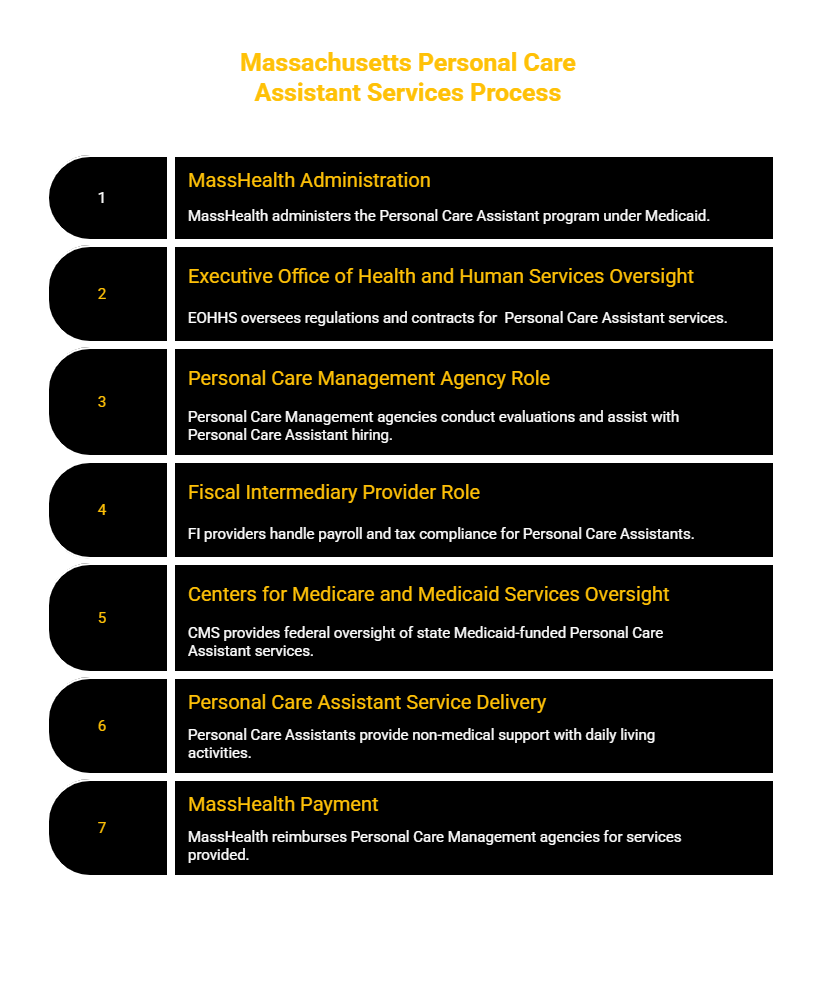
The delivery of PCA services in Massachusetts requires a coordinated effort between several state and private entities. At the top of the hierarchy is MassHealth, which funds the program under the Medicaid State Plan, and the Executive Office of Health and Human Services (EOHHS), which holds the regulatory authority to set policies and manage the contracts for PCM agencies. These agencies serve as the primary operational partner for consumers, facilitating access through rigorous assessments and ongoing management support.
Supporting the consumer-directed model are Fiscal Intermediary (FI) providers. These organizations perform the back-office functions that individuals may find burdensome, specifically handling complex tasks like payroll, state and federal tax withholdings, and processing timesheets for PCA workers. Federal oversight is provided by the Centers for Medicare & Medicaid Services (CMS) to ensure that the state’s program remains compliant with national Medicaid standards for long-term services and supports.
What Services Do Personal Care Assistants Provide to Consumers?
Personal Care Assistants are tasked with delivering essential non-medical support that allows individuals with chronic illnesses or physical disabilities to remain living independently in their homes and communities. These services are categorized into Activities of Daily Living (ADLs) and Instrumental Activities of Daily Living (IADLs), and they are strictly authorized based on a documented medical necessity through a formal PCA Evaluation.
Typical authorized tasks include:
- Hands-on assistance with bathing, grooming, and dressing.
- Toileting, hygiene, and bowel/bladder care support.
- Nutritional assistance, including eating and meal preparation.
- Physical mobility assistance, such as transferring and ambulation.
- Household maintenance tasks including laundry, light housekeeping, and grocery shopping.
- Essential cueing and supervision for individuals requiring memory support or behavioral monitoring.
What Are the Eligibility Requirements for the Consumer-Directed Model?
Participation in the PCA program is restricted to individuals who meet specific financial and functional criteria. The individual must be actively enrolled in MassHealth (either Standard or CommonHealth coverage). Furthermore, the candidate must demonstrate a verified need for hands-on, physical assistance with at least two or more Activities of Daily Living (ADLs) as determined by a clinical evaluation.
Beyond the medical and financial requirements, the program operates on a self-directed philosophy. This means that the consumer or their authorized surrogate must be capable of assuming the role of the employer. This includes the responsibility to recruit, interview, hire, train, schedule, and, if necessary, terminate their own PCAs. The PCM agency acts as a guide to help the consumer develop these functional skills, but the consumer retains full control over the daily management of their staff.
How Do Organizations Become Certified as a PCM Agency?
Becoming a Personal Care Management (PCM) agency is a rigorous process that requires an organization to be awarded a specific contract by MassHealth. Prospective providers must typically operate as a nonprofit or public entity to be eligible. The organization must demonstrate significant expertise in disability advocacy, complex care planning, and the ability to conduct professional ADL assessments. Because these agencies act as the gatekeepers of the program, they must maintain high standards for staff qualifications and administrative infrastructure.
Infrastructure and documentation requirements for potential PCM agencies include:
- Proof of nonprofit status, such as Articles of Incorporation and 501(c)(3) verification.
- Demonstrated capacity for multilingual and culturally competent service delivery.
- Detailed policies governing consumer rights, grievance procedures, and HIPAA compliance.
- Professional credentials for staff, including Registered Nurses (RNs) or licensed therapists.
- Systems for managing MassHealth contract compliance and data security.
What Staffing and Training Standards Must PCM Agencies Maintain?
The efficacy of a PCM agency depends heavily on its personnel. Key roles include the PCA Evaluator, typically an RN or a licensed therapist, who performs the initial and periodic functional skills assessments. These assessments are the foundation for the Prior Authorization (PA) process that MassHealth requires before services can begin. The PCA Skills Trainer plays an equally vital role, providing the education and resources necessary for consumers to act as competent employers.
Administrative oversight is usually managed by a Program Coordinator, who ensures that all documentation meets the strict requirements set forth by MassHealth. All staff members must undergo comprehensive training covering the MassHealth PCA training manual, ADA compliance, person-centered care practices, and cultural competency. Maintaining accurate records of this training is a mandatory part of the agency's ongoing compliance responsibilities.
Frequently Asked Questions
Can a family member be hired as a PCA?
Yes, under the MassHealth consumer-directed model, consumers may hire family members to serve as their PCA, provided those individuals meet the hiring requirements and are not legally barred from the role. The consumer remains the employer and is responsible for ensuring the family member performs the authorized duties as outlined in the service plan.
How does the Fiscal Intermediary (FI) interface with the PCM agency?
While the PCM agency focuses on clinical assessments and consumer training, the FI focuses on financial operations. They operate the systems for Electronic Visit Verification (EVV), process timesheets, and manage payroll. The PCM agency provides the authorization data that the FI needs to issue payments to the PCAs.
What happens if a consumer can no longer manage their own care?
If a consumer loses the capacity to manage their own care, they may appoint a surrogate to take on the employer responsibilities. The PCM agency assists in the transition to a surrogate model, ensuring that the individual continues to receive necessary services without interruption.
Key Takeaway: The Massachusetts PCA program succeeds by shifting the burden of care management to the consumer while providing them with the necessary structural support from specialized PCM agencies. Organizations looking to enter this space must prioritize strict adherence to MassHealth documentation standards, maintain high-quality clinical evaluators, and foster seamless integration with Fiscal Intermediary systems to ensure that Medicaid members receive consistent, reliable care.
Last verified: 2024. This information is intended for educational purposes only and does not constitute legal or professional advice. Requirements for MassHealth programs are subject to change; please consult the official MassHealth website at https://www.mass.gov/topics/masshealth or contact MassHealth directly at 1-800-841-2900 for the most current regulatory guidance.