PERSONAL ATTENDANT SERVICES PROVIDER IN WEST VIRGINIA
By Fatumata Kaba · 2026-04-14 · 5 min read
ENABLING INDEPENDENT LIVING FOR ELIGIBLE ADULTS THROUGH DAILY SUPPORT WITH ACTIVITIES OF DAILY LIVING IN HOME SETTINGS
Personal Attendant Services (PAS) in West Virginia provide essential, non-medical, hands-on assistance designed to help Medicaid-eligible aged or disabled individuals maintain their independence within their own homes. These services are primarily facilitated through the Aged and Disabled Waiver (ADW), a program managed by the West Virginia Department of Health and Human Resources (WVDHHR) in conjunction with the Bureau for Medical Services (BMS).
What Are the Governing Agencies for West Virginia PAS?
Operating a PAS agency in West Virginia requires navigating a complex regulatory landscape involving multiple state and federal entities. The West Virginia Department of Health and Human Resources (WVDHHR) acts as the primary authority, setting the standards for provider eligibility, service delivery, and ongoing regulatory oversight. Understanding the hierarchy of these agencies is critical for new providers to ensure their business model aligns with state mandates.
The Bureau for Medical Services (BMS) functions as the state’s Medicaid agency, handling the financial and administrative machinery of the program, including provider enrollment, claims processing, and the distribution of funding. Additionally, Acentra Health (formerly Kepro) serves as the external review entity. Acentra Health is responsible for managing participant assessments, determining medical eligibility for the ADW program, and conducting necessary quality reviews to ensure service standards are maintained.
- WVDHHR: Administers the ADW and regulates provider standards, eligibility, and oversight.
- BMS: Manages Medicaid provider enrollment, claims processing, and funding.
- Acentra Health: Handles participant assessments, medical eligibility, and quality reviews.
How Are Personal Attendant Services Defined and Delivered?
Personal Attendant Services are inherently individualized, defined by the specific functional needs of the participant as documented in a Person-Centered Service Plan (PCSP). These services are intended to support activities that enable a participant to remain safely in a community setting rather than moving into an institutionalized environment. Because these services are highly regulated, all interventions must be prior-authorized and meticulously documented to comply with both ADW and broader Medicaid standards.
The scope of service includes a range of daily tasks, such as assistance with bathing, grooming, and dressing, as well as toileting and incontinence care. Providers also assist with mobility and transfers, meal preparation and feeding, and essential household tasks like laundry and light housekeeping. Furthermore, attendants provide medication reminders—distinct from medication administration—and offer support by accompanying participants to necessary errands or appointments.
- Bathing, grooming, and dressing assistance
- Toileting and incontinence care
- Mobility support and transferring
- Meal preparation and feeding
- Light housekeeping (essential to the participant’s health)
- Laundry and linen changing
- Medication reminders (non-administration)
- Accompanying participants to appointments or errands (non-medical)
What Are the Licensing and Provider Approval Requirements?
The transition from a business concept to an active Medicaid provider requires adherence to strict prerequisites. The process begins with standard business formation, including registration with the West Virginia Secretary of State and the acquisition of a Federal EIN and a Type 2 NPI. Once the business structure is established, providers must submit an ADW Personal Attendant Agency Application to the WVDHHR for review.
Beyond basic business registration, agencies must demonstrate clinical and administrative readiness. This includes hiring or contracting with a licensed Registered Nurse (RN) who will be responsible for care planning and staff supervision. Agencies must also develop a comprehensive Policy & Procedure Manual that reflects ADW service standards, covering everything from emergency procedures to HIPAA compliance. Finally, providers must secure appropriate insurance, including worker’s compensation, general liability, and fidelity coverage, before completing enrollment with Gainwell Technologies.
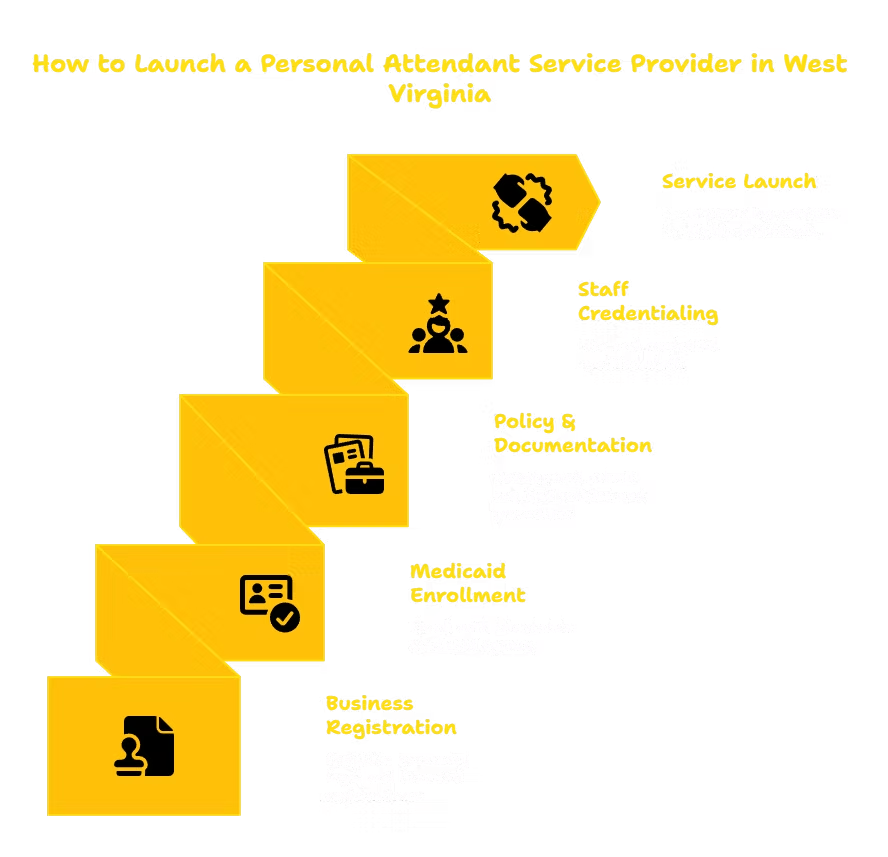
How Do Agencies Navigate the Enrollment and Documentation Process?
Securing status as an authorized Medicaid provider is a multi-step process that demands attention to detail. Agencies should expect a tiered timeline, starting with business registration and the submission of the initial agency application. Following this, the focus shifts to Medicaid provider enrollment through the Gainwell Technologies portal. This is a critical junction where agency documentation, such as the Policy & Procedure Manual and proof of staffing, must be validated against state requirements.
Once the paperwork is submitted, agencies may be subject to a readiness inspection or onboarding audit. These reviews are designed to ensure that the agency is capable of handling the administrative burden of Medicaid billing and the clinical requirements of patient care. Successful completion allows the agency to begin receiving participant referrals through case managers and the coordination services provided by Acentra Health.
- Step 1: Complete business registration, obtain EIN and NPI.
- Step 2: Submit ADW Personal Attendant agency application.
- Step 3: Complete Medicaid provider enrollment via Gainwell Technologies.
- Step 4: Submit P&P Manual and staff credentialing documents.
- Step 5: Pass readiness inspection and onboarding audit.
- Step 6: Begin accepting participant referrals through case managers and Acentra.
What Are the Staffing and Training Mandates?
The quality of service delivery rests on the competence of the personnel, and West Virginia mandates specific roles and requirements. The Personal Attendant (PA) must be at least 18 years old, successfully pass a WV CARES background check, and complete required training in CPR, universal precautions, and abuse prevention. These individuals are responsible for the direct execution of the PCSP and must be capable of assisting with Activities of Daily Living (ADLs) independently.
Clinical oversight is provided by a Registered Nurse (RN), who holds a current West Virginia license and is tasked with conducting participant assessments and supervising the PAs. Additionally, the Program Administrator ensures the agency maintains operational compliance by overseeing staff schedules, documentation accuracy, and personnel records. All staff, regardless of their role, must engage in mandatory orientation, annual competency evaluations, and ongoing training, including Electronic Visit Verification (EVV) compliance.
Frequently Asked Questions
What is the primary difference between the Agency model and Personal Options?
The Agency model involves the provider agency hiring and supervising staff to deliver care, while Personal Options is a self-directed model where the participant takes on the employer role, recruiting and managing their own attendants with the assistance of a fiscal agent.
Is Electronic Visit Verification (EVV) mandatory for PAS providers?
Yes, all providers must utilize an EVV system to document the time, location, and nature of the services rendered. Training on the specific EVV platform is a requirement for all staff to ensure accurate billing and compliance with federal and state mandates.
What happens if a participant’s needs change after their initial assessment?
If a participant's condition changes, the RN supervisor and the case manager must coordinate to re-evaluate the individual’s needs. Any modifications to the level or frequency of services must be documented, and where appropriate, re-authorized through Acentra Health to ensure the PCSP remains accurate and compliant.
Key Takeaway
Launching a Personal Attendant Services agency in West Virginia requires a rigorous commitment to documentation, clinical oversight, and regulatory compliance. By aligning business operations with the guidelines provided by WVDHHR, BMS, and Acentra Health, and by maintaining strict standards for staffing and EVV utilization, providers can effectively bridge the gap between policy and the delivery of essential care to vulnerable populations.
Last verified: October 2023. This content is for informational purposes only and does not constitute legal or medical advice. Providers are encouraged to consult official state agency websites and current Medicaid policy manuals for the most recent updates and regulatory changes.