PERSONAL ASSISTANCE SERVICES PROVIDER IN MARYLAND
By Fatumata Kaba · 2025-09-03 · 6 min read
Personal Assistance Services (PAS) in Maryland are vital home and community-based supports designed to empower individuals with disabilities and chronic conditions to maintain their independence within their own homes. By providing essential hands-on help with daily activities and instrumental tasks, these Medicaid-funded services serve as a cornerstone of the state’s long-term services and supports (LTSS) framework.
What Are the Governing Agencies and Oversight Requirements for PAS Providers?
The delivery of Personal Assistance Services in Maryland is governed by a multi-layered regulatory environment. The Maryland Department of Health (MDH) serves as the primary authority, overseeing the overarching Medicaid-funded HCBS programs. Within the MDH, the Office of Long-Term Services and Supports (LTSS Maryland) is responsible for the direct administration of the Community First Choice (CFC) program, the Community Options Waiver, and the Increased Community Services (ICS) initiative. These programs are subject to rigorous federal oversight by the Centers for Medicare & Medicaid Services (CMS) to ensure compliance with federal waiver requirements.
For providers serving the intellectual and developmental disability population, the Maryland Developmental Disabilities Administration (DDA) provides additional regulatory oversight. Understanding the specific jurisdiction of these agencies is critical for new providers, as different waivers may carry distinct requirements for enrollment, service delivery models, and reporting. Providers must ensure that their operations align with the specific policies set forth by these entities to maintain active and compliant Medicaid participation.
- Maryland Department of Health (MDH): Overall regulatory oversight of Medicaid-funded HCBS.
- Maryland Medicaid (LTSS Maryland): Administration of CFC, Community Options, and ICS programs.
- Maryland Developmental Disabilities Administration (DDA): Oversight of personal supports for DDA waiver participants.
- Centers for Medicare & Medicaid Services (CMS): Federal approval and compliance monitoring.
How Are Personal Assistance Services Defined and Authorized?
Personal Assistance Services focus on assisting participants with Activities of Daily Living (ADLs) and Instrumental Activities of Daily Living (IADLs). ADL support includes hands-on care such as bathing, dressing, grooming, toileting, and mobility assistance. IADL support encompasses the maintenance of the individual's living environment, including meal preparation, light housekeeping, laundry, shopping, and essential medication reminders. Additionally, providers may be authorized to offer accompaniment to medical appointments, community integration support, and, when medically necessary, safety monitoring and supervision.
Services must always be rendered in strict accordance with the individual's Person-Centered Plan (PCP). The PCP is a dynamic document that outlines the specific needs, preferences, and goals of the participant. Service delivery must be authorized through the participant's Medicaid service plan, and all actions taken by the Personal Care Aide (PCA) or support staff must remain within the scope of these authorized duties. Documentation of service delivery is a mandatory component of the program, requiring accurate electronic logging via the LTSS Maryland system.
What Are the Essential Steps for Provider Enrollment and Business Setup?
Establishing a PAS agency requires a structured approach to business formation and regulatory compliance. Before attempting to provide services, an entity must be properly registered with the Maryland Department of Assessments and Taxation (SDAT). Following business formation, the agency must secure a Federal Employer Identification Number (EIN) and a Type 2 National Provider Identifier (NPI). These identifiers are foundational to the Medicaid provider enrollment process.
Enrollment is facilitated through the ePREP portal, Maryland’s online system for Medicaid provider enrollment. During this process, the agency will identify its provider type as "Personal Assistance" and select the relevant programs, such as CFC, Community Options, ICS, or DDA personal supports. The process demands meticulous preparation of organizational documents, policy manuals, and staff qualification records. While an agency does not necessarily need a Residential Service Agency (RSA) license to provide basic PAS, specialized services involving skilled nursing or task delegation may necessitate additional scrutiny from the Maryland Board of Nursing.
- Form the business entity through the Maryland SDAT.
- Obtain a federal EIN and a Type 2 NPI.
- Register and submit an enrollment application via the ePREP portal.
- Prepare comprehensive policies covering intake, HIPAA compliance, and service documentation.
What Documentation and Staffing Standards Must Be Maintained?
Provider agencies are responsible for maintaining a robust library of internal documentation to satisfy state audits and ensure quality of care. This includes, but is not limited to, Articles of Incorporation, proof of Medicaid enrollment, and detailed policy and procedure manuals. These manuals should explicitly cover intake assessment protocols, ADL/IADL support logs, emergency preparedness, infection control, and formal grievance policies. Consistent record-keeping for staff training and incident reporting is non-negotiable for ongoing program eligibility.
Staffing requirements are contingent upon the specific needs of the waiver participant. A typical staffing model includes Personal Care Aides (PCAs) who have cleared rigorous background checks and completed waiver-mandated training. In scenarios where nursing tasks are delegated, staff must possess active Maryland CNA licenses. Supervisors and service coordinators are required to have experience in managing personal care services, ensuring that quality assurance, documentation review, and person-centered service delivery are prioritized at every level of the organization.
Frequently Asked Questions
Are PAS agencies required to obtain an RSA license in Maryland?
Agencies generally do not need to be licensed as a Residential Service Agency (RSA) unless they are providing skilled nursing services or delegating specific nursing tasks. However, providers should verify individual waiver requirements to ensure full compliance with their specific service delivery model.
What is the purpose of the ePREP portal?
The ePREP portal is Maryland’s central electronic system for Medicaid provider enrollment. It is the mandatory platform through which prospective providers apply to participate in programs like Community First Choice (CFC), Community Options, and ICS.
What are the primary responsibilities of a supervisor in a PAS agency?
Supervisors are responsible for maintaining quality assurance standards, reviewing service documentation for accuracy, ensuring staff are properly trained in person-centered care, and overseeing the effective delivery of supports as outlined in the participant's service plan.
How Does the Launch Timeline Look for New Providers?
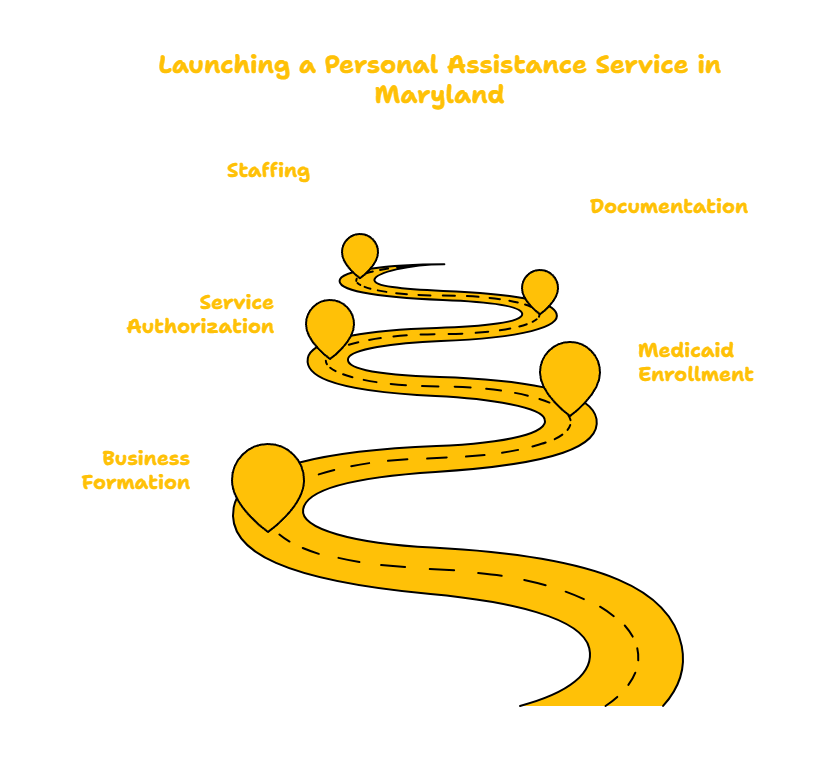
The timeline for launching a PAS agency is typically divided into several critical phases. Business formation through the SDAT and IRS usually requires one to two weeks. Following this, the development of organizational policies and the recruitment of qualified staff may take an additional two to four weeks. The Medicaid provider enrollment process via ePREP typically spans 30 to 60 days, though this can vary based on the completeness and accuracy of the application submitted. Once enrolled, the agency enters a phase of ongoing staff training, referral management, and continuous service delivery monitoring.
Waiver Consulting Group provides specialized support to help entrepreneurs navigate these phases. Services include business registration, ePREP enrollment assistance for CFC, Community Options, and ICS, as well as DDA vendor approval. Support also extends to the development of compliant policy manuals, staff credentialing tools, HIPAA-compliant documentation systems, and strategic referral networking with Service Coordinators and Resource Connections to ensure the agency is prepared for success in the Maryland HCBS market.
Key Takeaway: Establishing a successful Personal Assistance Services agency in Maryland requires strict adherence to MDH and LTSS Maryland regulations, a commitment to person-centered service delivery, and meticulous documentation practices. Providers who prioritize compliance, invest in comprehensive staff training, and maintain accurate electronic records via the ePREP and LTSS Maryland portals position themselves to provide high-quality care while successfully navigating the requirements of Maryland’s Medicaid waiver programs.
Last verified: October 2023. Disclaimer: This article is intended for informational purposes only and does not constitute legal or professional consulting advice. Requirements for Medicaid waiver programs are subject to change. Always refer to the official Maryland Department of Health, LTSS Maryland, and DDA websites for the most current regulations and program guidance.