PERSONAL ASSISTANCE SERVICES PROVIDER IN HAWAII
By Fatumata Kaba · 2025-07-16 · 5 min read
Personal Assistance Services (PAS) in Hawaii provide critical, direct support to individuals with disabilities, chronic illnesses, or age-related challenges, enabling them to maintain independence within their own homes and communities. Authorized under Hawaii’s Medicaid Home and Community-Based Services (HCBS) waiver programs, these services are essential for promoting participant dignity, safety, and meaningful inclusion by assisting with daily tasks and community integration.
Launching a PAS agency requires navigating a rigorous regulatory landscape overseen by the Hawaii Department of Human Services (DHS) Med-QUEST Division and the Department of Health (DOH) Developmental Disabilities Division (DDD). Providers must demonstrate operational readiness, administrative integrity, and a commitment to person-centered care to secure Medicaid certification and begin delivering services.
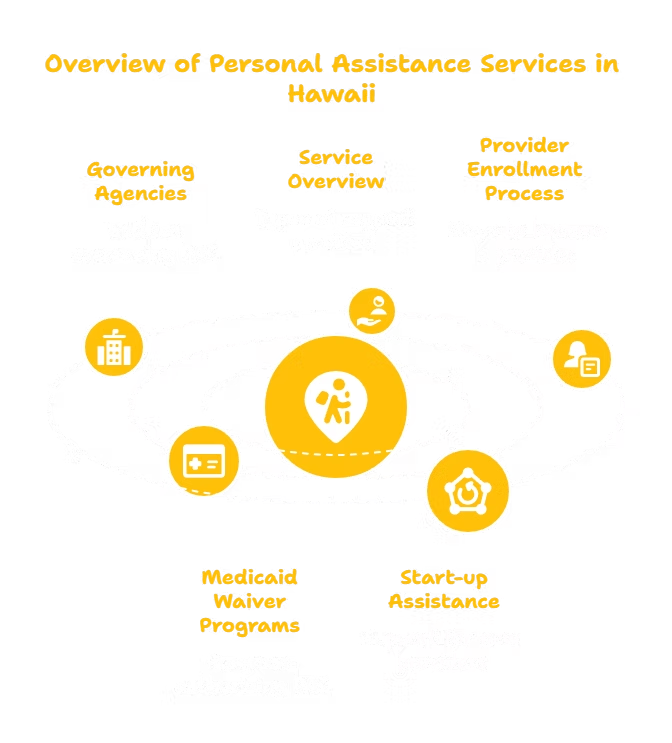
What Are the Governing Bodies and Regulatory Roles for PAS Providers in Hawaii?
Understanding the regulatory hierarchy is the first step toward successful provider enrollment. The Hawaii Department of Human Services (DHS) Med-QUEST Division acts as the primary authority for Medicaid provider enrollment, overseeing the authorization of services and the reimbursement mechanisms necessary for agency sustainability. They ensure that all services rendered comply with federal and state mandates regarding financial accountability and service delivery standards.
For providers serving the Intellectual and Developmental Disabilities (IDD) population, the Hawaii Department of Health (DOH) Developmental Disabilities Division (DDD) serves as the primary administrator. They are responsible for the oversight of HCBS waiver services, ensuring that providers adhere to specific quality-of-care requirements tailored to the needs of individuals with developmental disabilities. Furthermore, the federal Centers for Medicare & Medicaid Services (CMS) maintains ultimate oversight, mandating that all PAS operations align with federal HCBS regulations, particularly regarding the promotion of participant autonomy and person-centered service planning.
How Do PAS Providers Support Daily Living and Community Participation?
Personal Assistance Services are defined by their hands-on nature, focusing on helping participants complete essential daily tasks that would otherwise be impossible to manage independently. By centering services on the participant’s Individualized Service Plan (ISP), agencies provide highly customized support that reflects the specific needs and preferences of each individual. This ensures that the care provided is not merely clinical, but deeply supportive of the participant's personal lifestyle goals.
The scope of these services is broad, covering both internal home environments and external community settings. Approved providers are responsible for delivering the following supports:
- Activities of Daily Living (ADLs): Direct assistance with bathing, dressing, toileting, grooming, eating, and physical mobility.
- Instrumental Activities of Daily Living (IADLs): Essential household support, including meal preparation, laundry, light housekeeping, medication reminders, and grocery shopping.
- Community Access: Assistance with transportation or escorting participants to medical appointments and social or recreational activities.
- Health and Safety: Ongoing monitoring of a participant’s well-being, including communication assistance and emergency response coordination.
What Are the Essential Prerequisites for Licensing and Provider Approval?
Before an agency can begin the formal Medicaid enrollment process, it must establish a formal business entity and secure necessary credentials. This involves registration with the Hawaii Department of Commerce and Consumer Affairs (DCCA), which formalizes the business structure within the state. Following registration, the entity must secure a federal Employer Identification Number (EIN) and a Type 2 National Provider Identifier (NPI), which are required for all health-related billing and administrative interactions.
Beyond basic business registration, agencies must demonstrate financial and operational stability. This includes obtaining comprehensive general liability and professional liability insurance. Furthermore, prospective providers must develop a robust, HCBS-compliant Policy and Procedure Manual. This document must clearly articulate the agency's approach to participant intake, service delivery, and emergency response, as well as strict adherence to participant rights protections. These internal documents are not merely administrative formalities; they are critical components of the "readiness review" that state officials conduct to determine if an agency is qualified to participate in the waiver program.
How Does the Med-QUEST/DHS Provider Enrollment Process Function?
The transition from an interested applicant to an approved Medicaid provider is a multi-phased journey that typically spans several months. The process begins with the submission of the Provider Enrollment Application to the Med-QUEST Division. During this initial stage, agencies must explicitly define their intended service areas and demonstrate the qualifications of their proposed staff, ensuring that the agency has the capacity to meet the needs of the participants in those specific regions.
Once the application is submitted, the agency must provide extensive documentation, including Articles of Incorporation, proof of NPI/EIN, and operational policies. The Program Readiness Review serves as a final gatekeeper, where the DHS and DOH verify the agency’s infrastructure. This includes reviewing participant safety systems, service tracking logs, and overall Medicaid compliance. Only after a successful review can an agency move to the final stage: configuring billing codes for hourly or daily service units and activating their ability to receive Medicaid reimbursement.
What Are the Critical Staffing and Training Mandates?
The quality of a Personal Assistance Services agency is fundamentally dependent on its workforce. The organizational structure must include at least one qualified Personal Assistance Program Manager or Supervisor who possesses direct experience in community supports or disability services. This leadership role is responsible for overseeing the daily operations, ensuring that Direct Support Professionals (DSPs) adhere to state guidelines and the participant’s specific ISP.
Direct Support Professionals are required to hold a high school diploma or GED, and the agency is responsible for ensuring that each staff member completes a comprehensive onboarding program. Mandatory training requirements include, but are not limited to:
- HIPAA confidentiality and rigorous abuse prevention protocols.
- Standardized emergency preparedness, CPR, and First Aid certification.
- Person-centered care training that emphasizes cultural sensitivity and the upholding of participant rights.
- Annual continuing education focused on evolving Medicaid compliance standards and best practices in disability support.
Frequently Asked Questions
Which Medicaid waiver programs cover Personal Assistance Services in Hawaii?
Personal Assistance Services are currently authorized under the Developmental Disabilities/Intellectual Disabilities (DD/ID) Waiver and the Community Care Services (CCS) Program, the latter of which is specifically designed for adults living with serious mental illnesses and chronic health conditions.
How long should an agency expect the entire startup and enrollment process to take?
The timeline varies based on organizational readiness, but generally, the process takes approximately 150 to 200 days. This includes business formation (1–2 weeks), the Med-QUEST application and readiness review (60–90 days), staff hiring/intake systems (30–45 days), and final billing configuration (45–60 days).
What must be included in the provider’s policy and procedure manual?
The manual must be comprehensive and include protocols for participant intake and needs assessment, daily living assistance, incident tracking, HIPAA compliance, grievance handling, staff credentialing, background check procedures, and specific Medicaid billing and audit readiness workflows.
Key Takeaway
Establishing a successful Personal Assistance Services agency in Hawaii requires meticulous attention to both administrative detail and the regulatory requirements set forth by the DHS and DOH. By focusing on compliant infrastructure, high-quality staff training, and robust service delivery documentation from day one, providers can navigate the complex Medicaid enrollment landscape effectively and ensure the delivery of high-quality, person-centered care to Hawaii's most vulnerable populations.
Last verified: 2024. This content is provided for informational purposes only and does not constitute legal or professional advice. Always refer to the official Hawaii Med-QUEST and DOH guidelines for the most current regulatory requirements.