PERSONAL ASSISTANCE SERVICES PROVIDER IN GEORGIA
By Fatumata Kaba · 2025-07-14 · 5 min read
Becoming a Personal Assistance Services (PAS) provider in Georgia is a strategic way to support individuals with disabilities and aging-related needs while building a sustainable healthcare business. By delivering essential hands-on support through Georgia’s Medicaid Home and Community-Based Services (HCBS) waivers, providers play a vital role in promoting participant independence, dignity, and community integration.
This guide outlines the regulatory framework, administrative requirements, and operational steps necessary to launch a PAS agency. Navigating the requirements of the Department of Behavioral Health and Developmental Disabilities (DBHDD) and the Department of Community Health (DCH) is essential for maintaining compliance and securing reimbursement in Georgia’s complex Medicaid landscape.
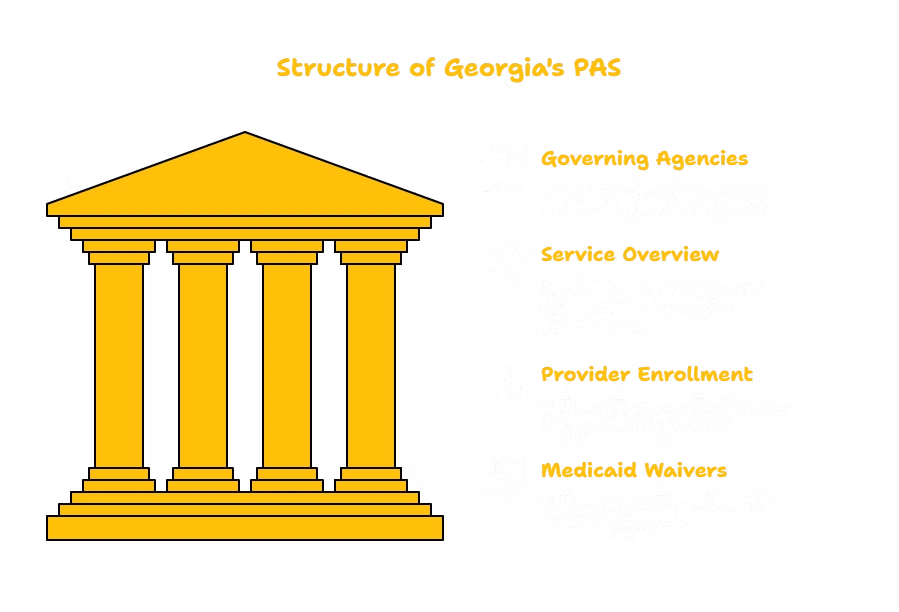
What Are the Governing Agencies and Regulatory Oversight?
The delivery of Personal Assistance Services in Georgia is governed by a multi-tiered regulatory structure that ensures federal and state standards are maintained. The Centers for Medicare & Medicaid Services (CMS) provides the overarching federal framework, ensuring that all HCBS waiver programs align with national quality and safety standards. Without this federal oversight, the state’s ability to offer waiver-funded community supports would not be possible.
At the state level, the Georgia Department of Behavioral Health and Developmental Disabilities (DBHDD) acts as the primary agency for the New Options Waiver (NOW) and Comprehensive Supports Waiver Program (COMP). DBHDD is responsible for the oversight of service delivery, provider enrollment criteria, and clinical quality assurance. Simultaneously, the Georgia Department of Community Health (DCH) manages the financial and enrollment aspects, overseeing Medicaid enrollment, service authorization, and the complex reimbursement processes required for provider compensation.
- DBHDD: Administers PAS for NOW and COMP waivers, defining service standards and provider requirements.
- DCH: Oversees Medicaid enrollment, claims processing, and reimbursement systems.
- CMS: Provides federal oversight to ensure compliance with Medicaid HCBS standards.
How Are Personal Assistance Services Delivered to Participants?
Personal Assistance Services are designed to be person-centered, meaning that care is tailored to the unique needs and goals of the individual participant as defined in their Individual Service Plan (ISP). Providers offer hands-on support that enables individuals to remain in their own homes rather than transitioning to institutional settings. This service delivery model focuses on both fundamental Activities of Daily Living (ADLs) and Instrumental Activities of Daily Living (IADLs).
Beyond basic care, providers are expected to act as a vital link in the participant's support network. This includes monitoring the participant's overall health, identifying changes in condition, and communicating effectively with care teams. Whether assisting with community outings, managing non-medical transportation, or providing basic safety monitoring, the provider's goal is to facilitate full community participation while ensuring the individual remains safe and secure.
- Activities of Daily Living (ADLs): Bathing, dressing, grooming, toileting, eating, and mobility assistance.
- Instrumental Activities of Daily Living (IADLs): Meal preparation, shopping, laundry, light housekeeping, and medication reminders.
- Community Support: Non-medical transportation coordination, social interaction support, and safety monitoring.
What Are the Licensing and Provider Approval Requirements?
Launching a provider agency requires a disciplined approach to administrative compliance. Before seeking authorization, a business must be properly formed under Georgia law, which begins with registering the entity with the Georgia Secretary of State. Following business formation, the agency must secure a Federal Employer Identification Number (EIN) and a Type 2 National Provider Identifier (NPI), which are prerequisites for all Medicaid billing activities.
Once the business is legally established, the provider must demonstrate operational readiness. This involves developing a robust set of internal policies that address every aspect of the service lifecycle, from the initial participant intake to emergency response and the protection of participant rights. Agencies must also maintain adequate general liability insurance, as proof of coverage is a mandatory component of the enrollment and credentialing review process.
What Is the Step-by-Step Provider Enrollment Process?
The path to becoming an approved provider is a multi-phase endeavor that requires coordination with both DBHDD and the Medicaid Management Information System (GAMMIS). The process begins with a formal expression of interest, where the prospective agency submits a Letter of Intent to DBHDD, accompanied by a comprehensive pre-qualification checklist that details the agency’s business structure and operational intent.
Following this, the agency must undergo a rigorous Program Readiness Review. DBHDD will evaluate the agency's internal protocols, including staffing plans, incident reporting procedures, and the quality of documentation systems. Once DBHDD provides official approval, the agency then navigates the DCH enrollment process through GAMMIS. This final step involves configuring specific billing codes and setting up the financial infrastructure necessary to receive Medicaid payments for authorized services.
- Initial Phase: Submit Letter of Intent to DBHDD and complete pre-qualification.
- Readiness Phase: Submit operational policies, staff training records, and sample documentation.
- Medicaid Phase: Complete enrollment in GAMMIS and configure service-specific billing codes.
The timeline for this transition is significant, typically spanning several months. Business formation and initial setup generally take 1–2 weeks, while the DBHDD provider application and readiness review process usually takes 60–90 days. Staffing, training, and final Medicaid enrollment can add an additional 75–105 days to the total launch timeline.
What Are the Essential Staffing and Training Mandates?
The quality of care provided is directly dependent on the competence and training of the staff. Every agency must appoint a Program Manager or Supervisor to oversee daily operations, ensure clinical compliance, and manage the direct support team. This role requires prior experience in disability services or personal care, along with a clean background check to ensure the safety of participants.
Direct Support Professionals (DSPs) are the core of the service delivery team. All DSPs must hold at least a high school diploma or GED, maintain current CPR/First Aid certification, and undergo thorough background screening. Beyond these entry requirements, the agency is responsible for implementing a comprehensive training curriculum. This must cover HIPAA confidentiality, abuse prevention, emergency preparedness, and the person-centered service delivery philosophy mandated by the state.
Frequently Asked Questions
What waivers are covered under these PAS regulations?
Personal Assistance Services are authorized under the Comprehensive Supports Waiver Program (COMP), the New Options Waiver Program (NOW), and the Elderly and Disabled Waiver Program (EDWP).
How does a provider ensure compliance during audits?
Compliance is maintained by keeping accurate, daily service logs that align perfectly with the participant’s Individual Service Plan (ISP). Maintaining organized staff credentialing records, incident reports, and billing documentation is essential for audit readiness.
What is the role of an NPI (Type 2) in this process?
A Type 2 NPI is a mandatory identifier for organizations. It is required for all Medicaid claims and electronic transactions, linking the business entity to the services billed within the GAMMIS system.
Key Takeaway
Establishing a Personal Assistance Services agency in Georgia requires a rigorous commitment to administrative accuracy and clinical compliance. By strictly adhering to the requirements set forth by DBHDD and DCH, and by investing in a robust infrastructure for staff training and documentation, providers can effectively support the independence of the individuals they serve while operating a compliant, successful Medicaid-funded enterprise.
Last verified: 2024. The information provided in this article is for educational purposes only and does not constitute legal or professional consulting advice. Requirements for Medicaid provider enrollment are subject to change by state and federal authorities; always consult the official Georgia DBHDD and DCH websites or a qualified professional for the most current regulatory updates.