PERSONAL ASSISTANCE SERVICES (PAS) PROVIDER IN ARIZONA
By Fatumata Kaba · 2025-07-02 · 5 min read
SUPPORTING INDEPENDENCE BY ASSISTING WITH DAILY ACTIVITIES IN HOME AND COMMUNITY SETTINGS
Personal Assistance Services (PAS) in Arizona provide essential support to individuals with disabilities, chronic illnesses, or age-related needs, allowing them to complete daily activities in their home and community settings. As a critical component of the Arizona Health Care Cost Containment System (AHCCCS) and the Division of Developmental Disabilities (DDD) framework, these services are designed to maximize participant independence and prevent unnecessary institutionalization.
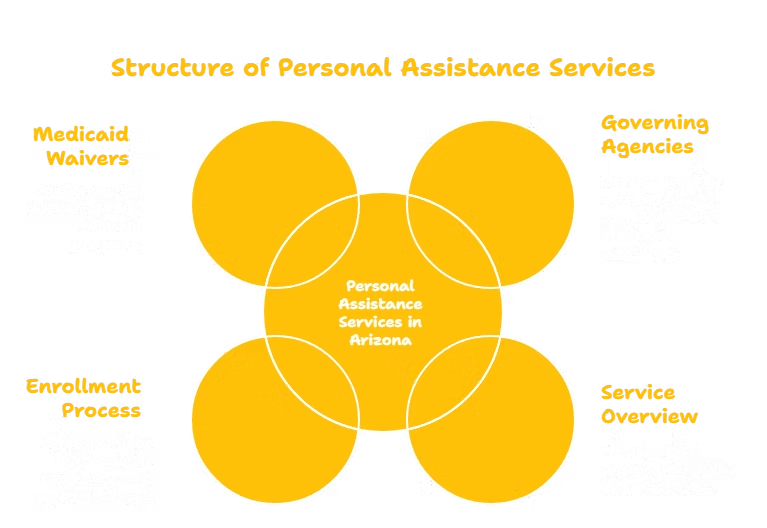
What Are the Roles of Governing Agencies in Arizona PAS?
The delivery of Personal Assistance Services is strictly regulated to ensure high standards of care and compliance with federal and state mandates. The Arizona Health Care Cost Containment System (AHCCCS) serves as the primary Medicaid agency, overseeing provider enrollment, service authorization, and the complex reimbursement processes required for HCBS programs. By establishing the financial and clinical guidelines, AHCCCS ensures that all services meet state-mandated requirements for quality and necessity.
Complementing this, the Arizona Department of Economic Security (DES) – Division of Developmental Disabilities (DDD) directly manages PAS delivery for members under its specific HCBS service models. Simultaneously, the Centers for Medicare & Medicaid Services (CMS) provides the overarching federal framework, ensuring that all Arizona programs strictly adhere to HCBS standards and the principles of person-centered care. Providers must align their operations with the directives issued by these three entities to maintain good standing.
How Do PAS Providers Deliver Care to Participants?
Personal Assistance Services encompass a broad range of direct supports designed to assist participants with activities they would typically perform independently if not for their health status. The primary objective is to maintain or improve the participant’s functional independence as outlined in their individualized, person-centered service plan. Care delivery must be consistent with these documented goals, prioritizing the participant’s safety and quality of life.
Approved providers are authorized to deliver a specific set of services, which generally includes the following:
- Assistance with Activities of Daily Living (ADLs), including bathing, dressing, grooming, toileting, and mobility.
- Support with Instrumental Activities of Daily Living (IADLs) such as meal preparation, housekeeping, laundry, and shopping.
- Medication reminders (non-nursing).
- Assistance with health-related tasks as permitted under Arizona regulations.
- Supervision and protective oversight to ensure participant safety.
- Accompaniment to medical appointments and community-based activities.
What Are the Prerequisites for Licensing and Provider Approval?
Establishing an agency to provide Personal Assistance Services requires a structured approach to administrative and clinical readiness. Before a provider can be authorized to bill for services, they must first register their business entity with the Arizona Corporation Commission and obtain a valid Employer Identification Number (EIN) from the IRS. Furthermore, a Type 2 National Provider Identifier (NPI) is essential for billing purposes within the Medicaid system.
Beyond basic business registration, agencies must meet stringent Qualified Vendor Application (QVA) requirements set forth by AHCCCS and the DDD. Providers are expected to maintain adequate liability insurance and develop robust internal policies and procedures. These manuals must cover personal care delivery, health-related task protocols, and a comprehensive framework for protecting participant rights. Additionally, agencies must establish systems to ensure that all staff members satisfy competency and training requirements defined by Arizona administrative codes.
What Does the AHCCCS and DDD Provider Enrollment Process Entail?
The enrollment process is a multi-phased endeavor that requires careful attention to detail. Initially, potential providers should request PAS application materials directly from the DDD or AHCCCS and are highly encouraged to attend official HCBS or DDD provider orientation sessions. These sessions provide clarity on program expectations and the technical requirements for operating within the state’s managed care landscape.
Following initial orientation, the provider must submit a comprehensive application, which includes documentation of the business license, staffing structure, and a clear service delivery model. Agencies must also provide intake forms, template care plans, and daily documentation logs that demonstrate how services will be tracked. Once submitted, the application undergoes a program readiness review, where AHCCCS and DDD officials evaluate the agency’s capacity to deliver safe, compliant care. Upon approval, the agency must complete formal registration as a Medicaid provider, contract with appropriate Managed Care Organizations (MCOs), and configure their internal billing systems to manage service authorizations effectively.
What Are the Standard Staffing and Training Requirements?
The quality of Personal Assistance Services is heavily dependent on the caliber and preparation of the workforce. Agencies typically employ a Personal Assistance Supervisor to manage documentation, staff performance, and regulatory compliance. Direct support workers—often referred to as Personal Care Assistants—carry out the hands-on care. These individuals are expected to hold a high school diploma or GED, possess valid CPR and First Aid certifications, and successfully clear state-mandated background checks.
All staff must complete a structured training program before providing care. This curriculum includes:
- Orientation on Medicaid HCBS services and rigorous documentation requirements.
- Instruction in ADL/IADL support techniques, participant rights, and data confidentiality.
- Abuse prevention protocols, emergency response procedures, and infection control standards.
- Ongoing annual continuing education and mandatory competency evaluations to ensure clinical standards remain high.
Frequently Asked Questions
Which Medicaid Waivers include Personal Assistance Services?
Personal Assistance Services are authorized under the Arizona Long Term Care System (ALTCS) for both the Elderly and Physically Disabled (EPD) program and the Developmental Disabilities (DD) program, as well as general Division of Developmental Disabilities (DDD) HCBS programs.
How long should a provider expect the startup process to take?
The typical timeline involves 1–2 weeks for business formation, 60–90 days for QVA or AHCCCS enrollment, 30–45 days for staff hiring and training, and 45–60 days for MCO contracting and billing setup.
What core documents must be included in a Policy & Procedure Manual?
Required documentation includes protocols for participant intake and person-centered planning, ADL/IADL assistance procedures, non-nursing health-related tasks, emergency response, client privacy, staff credentialing, incident reporting, and Medicaid billing/authorization tracking.
WAIVER CONSULTING GROUP’S START-UP ASSISTANCE SERVICE — ARIZONA PERSONAL ASSISTANCE SERVICES PROVIDER
WCG helps agencies and entrepreneurs launch Medicaid-compliant Personal Assistance Services under Arizona’s HCBS Waiver programs. Our scope of work includes business registration, EIN/NPI setup, AHCCCS/DDD application support, development of comprehensive Policy & Procedure Manuals, staff credentialing templates, Medicaid billing configuration, and staff training materials.
Key takeaway: Success as a PAS provider in Arizona depends on strict adherence to the regulatory requirements of AHCCCS and the DDD, a strong foundation of internal policy, and a commitment to maintaining meticulous, person-centered documentation for every participant served.
Last verified: October 2023. Disclaimer: This information is for educational purposes only and does not constitute legal or professional advice. Regulatory requirements are subject to change; always consult the official AHCCCS or DDD websites for the most current policies and application guidance.