Pennsylvania: How to Become an ODP Waiver Provider
By Fatumata Kaba · 2026-07-09 · 5 min read
Becoming an Office of Developmental Programs (ODP) waiver provider in Pennsylvania is a structured, sequenced regulatory process that requires strict adherence to state-defined milestones. Prospective agencies must transition through mandatory orientation, rigorous policy development, and systematic enrollment in the PROMISe billing portal before they are authorized to render services to individuals with intellectual disabilities or autism.
Understanding the Pennsylvania ODP Regulatory Landscape
The Pennsylvania Department of Human Services (DHS), through the Office of Developmental Programs, administers several critical Home and Community-Based Services (HCBS) waivers, including the Consolidated, Community Living, and P/FDS waivers. These programs are designed to provide person-centered support, but they carry significant regulatory weight. Agencies seeking to enter this market must understand that authorization is not a one-step process; it is a multi-tiered commitment to compliance.
The regulatory authority for these programs is rooted in federal HCBS requirements, which Pennsylvania translates into state-specific operational bulletins and provider agreements. Before an agency can accept a single referral, it must be fully vetted and qualified for every specific service it intends to provide. Attempting to bypass these requirements or operating without a valid provider agreement can result in immediate disqualification and a permanent bar from Medicaid billing.
Mandatory Orientation and Initial Training
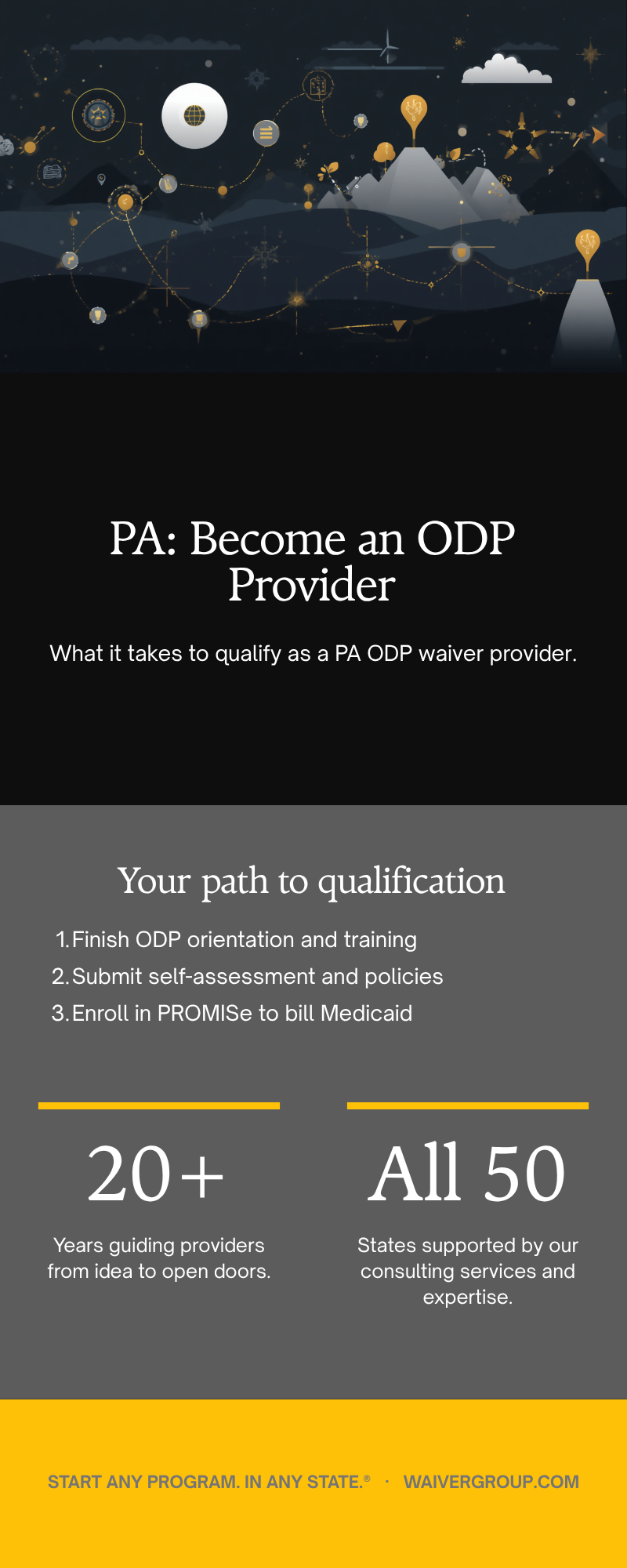
The first step in the ODP qualification journey is the completion of all required orientations and training modules. ODP mandates that provider agency administrators and key staff participate in these sessions to ensure a baseline understanding of waiver requirements, incident management, and person-centered planning. These training sessions are not merely administrative hurdles; they provide the foundational knowledge necessary to build an agency that aligns with Pennsylvania’s quality management expectations.
Once orientation is complete, agencies must begin the process of service-specific qualification. This involves identifying exactly which services from the waiver array the agency intends to offer. Each service, ranging from residential habilitation to employment supports, has unique regulatory expectations. Agencies should maintain thorough documentation of all completed trainings, as proof of these activities is a prerequisite for advancing to the self-assessment phase.
The Critical Role of Policy Manuals and Self-Assessment
The self-assessment and the accompanying written policies and procedures constitute the most significant barrier to entry for new providers. ODP does not merely check for the existence of policies; it validates that those policies are comprehensive, compliant with current state regulations, and operationalized. A generic policy template is rarely sufficient; agencies must ensure their internal documentation reflects how they will meet the specific standards outlined in the ODP manuals.
During the validation process, state reviewers will scrutinize how an agency handles areas such as:
- Participant rights and the promotion of self-determination.
- Incident management and reporting protocols per Pennsylvania standards.
- The delivery of person-centered service planning and implementation.
- Staff training requirements, including background clearances and competency testing.
- Emergency preparedness and business continuity plans.
If the policies do not explicitly address ODP requirements, or if the self-assessment is inconsistent with the provided documentation, the application will stall. Investing time in developing a robust, site-specific policy manual before submission is the single most effective way to avoid delays and ensure a smooth qualification path.
Meeting Appendix C Qualification Standards
Each ODP waiver—Consolidated, Community Living, and P/FDS—contains an Appendix C, which serves as the definitive reference for service definitions and provider qualification standards. These standards dictate the required staffing ratios, professional qualifications for staff, and the physical environment expectations for the services being provided. An agency must demonstrate that it meets every one of these standards to be considered qualified.
For example, if an agency aims to provide residential services, it must prove compliance with home and community-based settings requirements, which include participant access to the community, freedom of choice in daily activities, and physical accessibility. Reviewers will often require evidence of lease agreements, safety inspections, and staff certification logs to verify that the agency is truly capable of delivering the service at the standard required by the waiver.
Enrolling in PROMISe for Medicaid Billing
Qualification is a prerequisite for billing, not a guarantee of payment. Once an agency has received formal confirmation from ODP that it has met the qualification standards, it must then enroll in PROMISe (Provider Reimbursement and Operations Management Information System), Pennsylvania’s Medicaid Management Information System. PROMISe is the gateway through which all billing claims must be processed and verified.
Enrollment in PROMISe requires additional documentation to establish the agency as a legitimate Medicaid vendor in the state of Pennsylvania. This process includes verifying tax identification numbers, banking information for direct deposit, and specific service codes associated with the approved waiver services. It is essential to ensure that the services enrolled in PROMISe match exactly what was approved during the ODP qualification process, as mismatches often lead to rejected claims.
Frequently Asked Questions
What is the most common reason for a delay in the ODP qualification process?
The most frequent cause for delay is the submission of policies that do not adequately address the specific regulatory requirements set forth by ODP. Reviewers require clear, actionable procedures that demonstrate exactly how an agency will remain compliant on a day-to-day basis. Incomplete self-assessments or a lack of documentation supporting those assessments will also halt progress.
Can an agency provide services before being fully qualified?
No. Providing services before achieving full ODP qualification and enrollment in PROMISe is a violation of Medicaid rules. Agencies that render services without being officially authorized run the risk of non-payment for those services, potential audits, and exclusion from the Pennsylvania Medicaid program entirely.
How often should provider policies be updated?
ODP guidance is updated periodically to reflect changes in federal mandates and state-level policy. Agencies should conduct an internal review of their policy manuals at least annually, or immediately following the release of new ODP bulletins, to ensure their procedures remain compliant with the current waiver requirements.
Key takeaway: In Pennsylvania, qualification comes before billing. Complete orientation, pass the self-assessment with vetted policies, meet your waiver's Appendix C standards, and enroll in PROMISe.
Start Any Program. In Any State.®
20+ years clearing the path in all 50 states — we've done this before, and we'll do it for you. Book a video consultation at waivergroup.com/videoappointment · 302.888.9172 · [email protected].
Last verified August 2024. This content is for informational purposes only and does not constitute legal or professional advice. Always verify current requirements with the Pennsylvania Department of Human Services (DHS) and the Office of Developmental Programs (ODP) directly before making operational decisions.