Opening an Adult Day Services Program in Illinois: What the State Requires
By Fatumata Kaba · 2026-07-10 · 5 min read
Opening an adult day services (ADS) program in Illinois requires navigating the specific standards set forth by the Illinois Department on Aging (IDoA). Rather than obtaining a traditional healthcare facility license, prospective providers must secure formal certification under the state’s Community Care Program (CCP) to operate and receive reimbursement for services provided to eligible older adults.
Understanding the Illinois Certification Framework
In Illinois, the adult day services sector is governed by the Illinois Department on Aging rather than the Department of Public Health’s standard licensure process. The distinction is critical: certification serves as a formal recognition that your program meets the specific operational, safety, and clinical standards required to serve participants enrolled in the Community Care Program.
Because the CCP is a Medicaid-waiver-funded initiative, IDoA maintains rigorous oversight to ensure that the services provided—ranging from social engagement to health monitoring—align with state mandates. This process is site-specific; if you intend to operate multiple locations, each facility must undergo its own independent certification review process. Prospective providers should view this as a comprehensive audit of their operational readiness rather than a simple permit application.
Developing the Foundational Policy and Procedure Manual
The core of the Illinois certification process is the development of a comprehensive policy and procedure manual. State surveyors do not just look for a generic business plan; they require a detailed roadmap of how your program will function daily. This documentation serves as the primary evidence that your agency is prepared to manage participant health, safety, and rights in accordance with state regulations.
Your manual must explicitly demonstrate how your organization handles critical operational areas. If your documentation does not match your actual daily workflows, your application will likely face delays during the site inspection phase. Key areas that must be thoroughly documented include:
- Intake and eligibility assessment protocols
- Person-centered care planning and ongoing monitoring
- Staffing ratios, background checks, and professional development
- Emergency preparedness and disaster response
- Infection control and sanitation standards
- Food service safety and nutritional planning
- Transportation safety and logistics
Defining Leadership and Staffing Requirements
Beyond policy documentation, the state requires proof that your program is led by qualified individuals capable of maintaining institutional accountability. You must designate clear leadership roles, as IDoA requires specific personnel to be responsible for the oversight of clinical services and daily operations. These individuals must be able to demonstrate their understanding of the CCP requirements during the initial survey process.
Furthermore, frontline staff are subject to stringent readiness standards. It is not enough to simply hire employees; you must ensure that every staff member interacting with participants is prepared for medical emergencies. This includes maintaining current, verifiable certifications for CPR and first aid for all applicable staff. Documentation of these credentials must be kept in organized personnel files that are ready for immediate inspection by IDoA representatives.
Mastering Site-Specific Compliance
One of the most common pitfalls for new providers is assuming that certification for one location extends to a network of facilities. Illinois requires a separate certification application for each site you plan to operate. This ensures that every individual physical environment meets the necessary accessibility standards, fire safety codes, and spatial requirements essential for the aging population served under the Community Care Program.
During the site inspection, surveyors will evaluate the physical environment to ensure it provides a safe, dignified, and supportive atmosphere. They will examine the building's layout for accessibility, verify that safety equipment is functional, and confirm that the space is adequate for the number of participants proposed in your application. Achieving certification requires that your facility not only looks professional but also functions as a highly controlled, safe environment for vulnerable adults.
Navigating the Operational Approval Sequence
The path to certification is a sequential process that begins long before the doors open. Providers should follow a logical progression: first, develop the policies; second, formalize the administrative structure; third, secure the facility; and finally, submit the site-specific application to the Illinois Department on Aging. Each step must be completed with careful attention to how it interacts with the requirements of the Community Care Program.
Because the state has a vested interest in the quality of care provided under the waiver, they look for consistency across all application materials. Discrepancies between your proposed budget, your staffing plan, and your actual physical facility layout can trigger a request for more information, which extends the timeline for approval. Ensuring that all components of your application are synchronized is the most efficient way to navigate the certification process successfully.
Frequently Asked Questions
Does a provider need a medical facility license to open an adult day service?
No. In Illinois, adult day services are not licensed as medical facilities. Instead, providers are certified by the Illinois Department on Aging under the Community Care Program. This certification process focuses on social, supportive, and health-monitoring services specific to the waiver program requirements.
Is one certification application sufficient for multiple adult day center locations?
No. Each individual location must be certified separately by the Illinois Department on Aging. Each site must undergo its own review process, including an evaluation of the physical facility and the site-specific operational policies and staff qualifications.
What is the most critical component of the IDoA certification review?
The policy and procedure manual is arguably the most critical component. It must be exhaustive and include specific forms and protocols for intake, care planning, emergency response, and staffing. The documentation must accurately reflect the day-to-day operations of the facility to ensure the agency remains in compliance with Community Care Program standards.
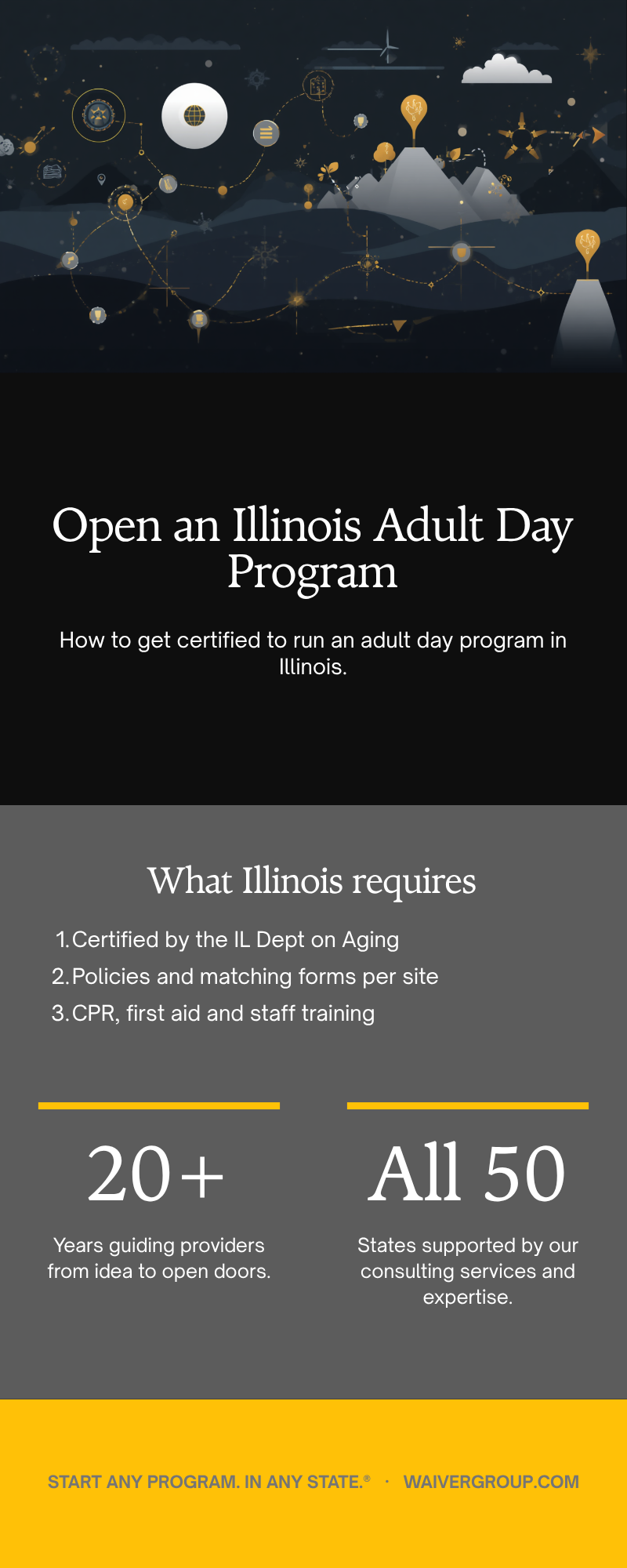
Key takeaway: Get certified by the Illinois Department on Aging, build a full policy manual with matching forms, name your leadership, and file a separate application for each site.
Last verified: October 2023. Disclaimer: This information is for educational purposes only and does not constitute legal or regulatory advice. State requirements, administrative rules, and department policies are subject to change. Always consult directly with the Illinois Department on Aging or qualified legal counsel regarding specific compliance obligations for your project. Start Any Program. In Any State.® 20+ years clearing the path in all 50 states — we've done this before, and we'll do it for you. Book a video consultation at waivergroup.com/videoappointment · 302.888.9172 · [email protected]