Ohio Behavioral Health: How to Bill Medicaid in the Right Order
By Fatumata Kaba · 2026-07-02 · 5 min read
For behavioral health providers in Ohio, the path to Medicaid reimbursement is defined by a rigid, non-negotiable sequence of regulatory milestones. To successfully transition from initial startup to a billing-eligible agency, providers must prioritize national accreditation, secure state certification, and finalize enrollment in that exact order to avoid application rejections.
Understanding the Ohio Behavioral Health Regulatory Sequence
The operational landscape for behavioral health in Ohio is governed by strict state requirements that ensure quality of care and financial accountability. When an agency attempts to bypass the established hierarchy of approvals, the result is almost always a returned application, causing significant delays in cash flow and service activation.
The state does not accept shortcuts. Whether an agency is providing community behavioral health services or residential support, the regulatory infrastructure is designed to confirm organizational readiness before authorizing Medicaid billing privileges. Failure to observe the sequential nature of this process is the most common reason for startup friction in the Ohio market.
Why National Accreditation is the Foundation
Since October 2023, the Ohio Department of Mental Health and Addiction Services (OhioMHAS) has mandated that new community behavioral health providers must hold national accreditation for any service that carries established accreditation standards. This requirement is not optional and serves as the prerequisite for all subsequent state-level actions.
Securing accreditation validates that an agency meets nationally recognized benchmarks for clinical practice, safety, and administrative governance. Providers must engage one of the following recognized accrediting bodies to fulfill this mandate:
- Commission on Accreditation of Rehabilitation Facilities (CARF)
- The Joint Commission (TJC)
- Council on Accreditation (COA)
Securing OhioMHAS Certification
Once national accreditation is secured, the next logical step is obtaining certification through the Ohio Department of Mental Health and Addiction Services. This certification is the state’s formal recognition that the provider is authorized to deliver specific behavioral health services within the Ohio system.
The certification process involves a rigorous review of policies, clinical documentation standards, and service delivery protocols. Because this step relies heavily on the credentials obtained during the accreditation phase, attempting to file for OhioMHAS certification without a finalized accreditation status will result in administrative denial. The information provided to the accrediting body must align perfectly with the application submitted to the state to ensure a smooth review process.
Navigating Medicaid Provider Enrollment
Only after receiving OhioMHAS certification may an agency proceed to enroll as a provider with the Ohio Department of Medicaid (ODM). This step transitions the agency from a state-certified entity to a recognized billing provider authorized to receive payment for clinical services rendered to Medicaid-eligible populations.
In addition to ODM enrollment, many providers must also secure contracts with Managed Care Entities (MCEs). Because the majority of Ohio’s Medicaid behavioral health services are administered through these managed care plans, obtaining the state enrollment is only half the battle. Providers must be prepared to submit their accreditation and OhioMHAS certification documentation as part of the contracting phase with each individual MCE.
Transitioning from County Funding to Medicaid Revenue
Many behavioral health startups begin their operations by utilizing county-level funding or per-diem arrangements. While these local funding streams are essential for initial stability, the long-term sustainability of most clinical models depends on moving toward Medicaid clinical revenue.
This transition requires moving beyond general agency operations into a highly structured billing environment. Agencies must ensure that their clinical documentation and billing workflows are audit-ready, as Medicaid requires strict adherence to service definitions and medical necessity criteria. Establishing these systems concurrently with the accreditation process ensures that when the billing ID is finally activated, the agency is prepared for immediate claim submission.
Common Pitfalls in the Application Process
The primary reason for failure in this industry is the assumption that these steps can occur in parallel. Many administrators attempt to initiate Medicaid enrollment while still waiting for accreditation, or they apply for state certification without the necessary foundational documents. This usually results in a cycle of "return-to-sender" notifications from state reviewers.
Furthermore, providers often fail to account for the time required to onboard administrative staff into the various state portals. Because each department—OhioMHAS and the Department of Medicaid—operates on its own timeline, proactive planning is required. Administrative teams should ensure that all staff signatures, provider identifiers, and facility addresses are consistent across every application and accreditation document to avoid disqualification due to clerical errors.
Frequently Asked Questions
Can I apply for OhioMHAS certification while my accreditation is still pending?
No. Current requirements mandate that providers demonstrate proof of national accreditation through recognized bodies like CARF, TJC, or COA before the state will finalize the certification process for services subject to accreditation standards.
Is it possible to bill Medicaid while waiting for my managed care contracts to finalize?
Generally, billing is restricted until you are officially enrolled with the Ohio Department of Medicaid and have confirmed your network status with the relevant Managed Care Entities. You should clarify your billing effective dates with each plan to ensure claims are not denied.
What is the most effective way to manage the timeline of these three phases?
The most effective approach is to build a project management schedule that treats accreditation, state certification, and enrollment as a waterfall process. By waiting to submit each application until the previous approval is firmly in hand, you reduce the risk of administrative denials and ensure a more predictable path to revenue.
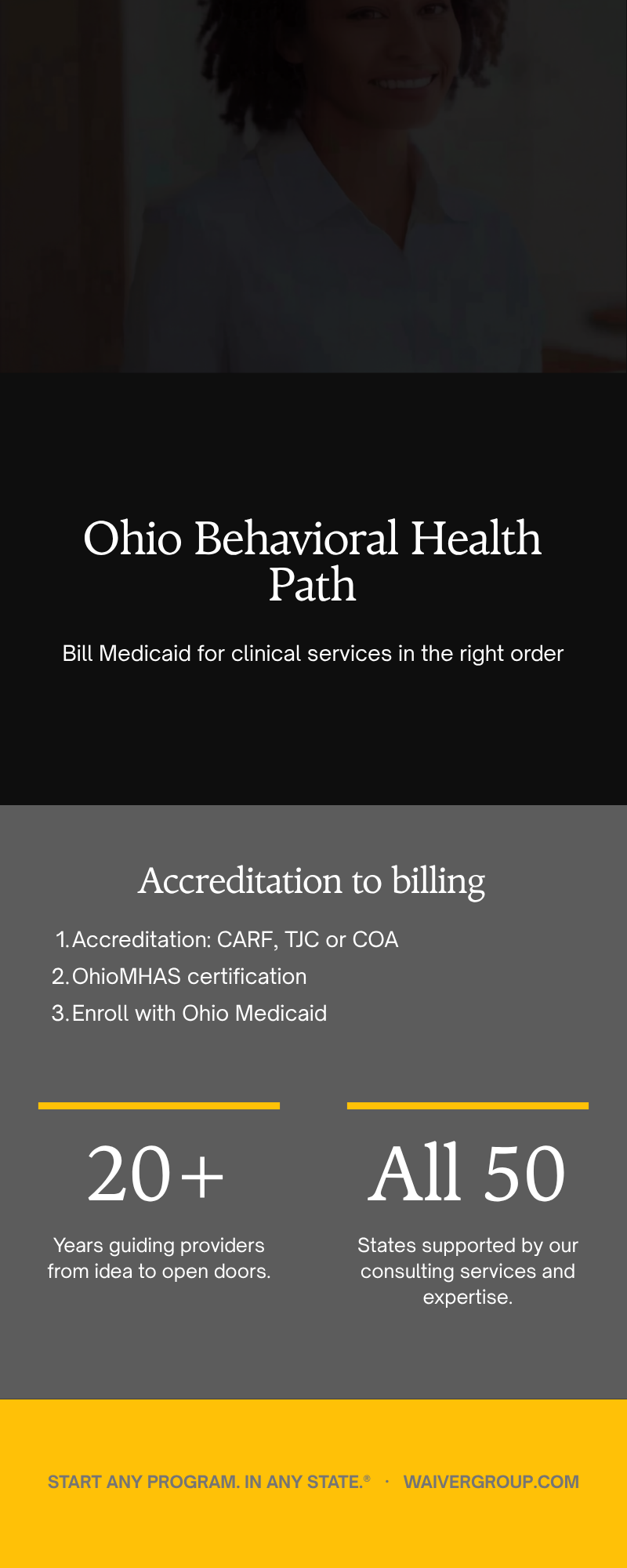
Key takeaway: In Ohio, the order is fixed: national accreditation from CARF, TJC, or COA, then OhioMHAS certification, then Ohio Medicaid enrollment.
Last verified: 2024. Disclaimer: This information is for educational purposes only and does not constitute legal or professional consulting advice. Requirements are subject to change by the Ohio Department of Mental Health and Addiction Services and the Ohio Department of Medicaid. Always verify current administrative rules through official state portals before initiating applications. Start Any Program. In Any State.® 20+ years clearing the path in all 50 states — we've done this before, and we'll do it for you. Book a video consultation at waivergroup.com/videoappointment · 302.888.9172 · [email protected]