NURSING SERVICES PROVIDER IN INDIANA
By Watchen Roberts · 2025-08-13 · 5 min read
Nursing Services in Indiana are essential clinical interventions delivered to individuals with complex medical needs to promote health, safety, and community-based independence. By providing skilled care in home and community settings, these services effectively prevent unnecessary institutionalization and support long-term stability for Medicaid waiver participants.
What Are the Roles of Governing Agencies in Indiana Nursing Services?
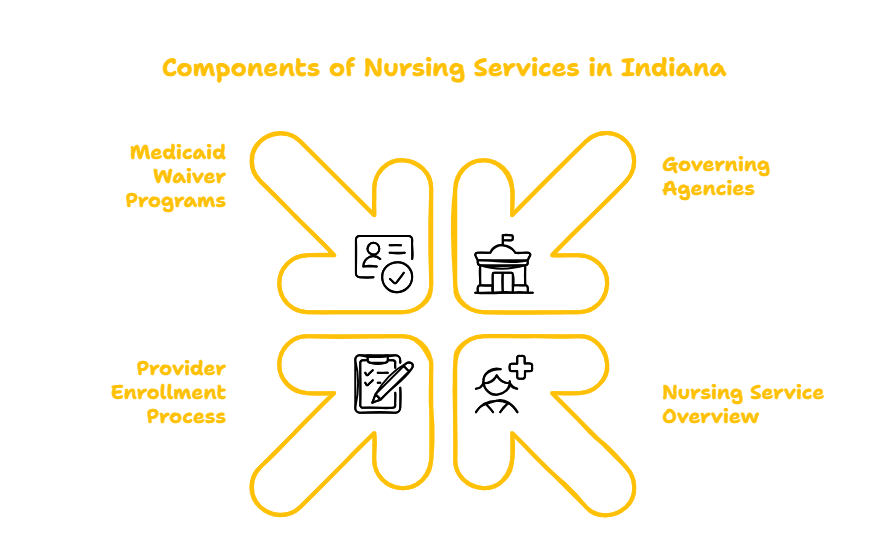
The administration of Nursing Services in Indiana involves a coordinated effort between state and federal oversight bodies to ensure patient safety and fiscal accountability. The Indiana Family and Social Services Administration (FSSA) and its Office of Medicaid Policy and Planning (OMPP) serve as the primary entities managing Medicaid funding, provider enrollment, and reimbursement protocols. Their oversight ensures that services align with state-specific Medicaid mandates.
Complementing this, the Indiana State Department of Health (ISDH) is responsible for the licensing of Home Health Agencies (HHAs) and the enforcement of clinical regulations. Providers must maintain strict compliance with ISDH standards to remain in good standing. At the federal level, the Centers for Medicare & Medicaid Services (CMS) provides oversight to ensure that Medicaid-funded nursing care adheres to federal Home and Community-Based Services (HCBS) requirements and Conditions of Participation (CoPs).
What Scope of Care Does a Nursing Services Provider Deliver?
Nursing Services encompass a wide range of skilled interventions provided under a physician’s order to support individuals requiring ongoing clinical oversight. Providers must ensure that all care is tailored to the participant's specific medical needs as outlined in their comprehensive Plan of Care (POC). Authorized services focus on maintaining stability and managing chronic conditions to reduce the risk of emergency hospitalization.
Approved clinical interventions generally include the following:
- Intermittent or continuous skilled nursing care provided by a Registered Nurse (RN) or Licensed Practical Nurse (LPN).
- Medication administration, including complex injections and IV therapy.
- Specialized clinical tasks such as wound care, tracheostomy management, and ventilator support.
- Management of enteral feeding tubes, catheter care, and bowel programs.
- Monitoring of chronic diseases such as diabetes, hypertension, and epilepsy.
- Health education, clinical documentation, and active coordination with the participant’s broader medical team.
How Do Providers Navigate Licensing and Enrollment Requirements?
Establishing a Nursing Services provider agency in Indiana requires a rigorous commitment to legal and operational compliance. Prospective providers must first formalize their business entity with the Indiana Secretary of State and obtain an IRS EIN along with a Type 2 NPI. The most critical regulatory step is obtaining a Home Health Agency License through the ISDH, which validates that the organization is prepared to meet state quality standards.
Once licensed, agencies must navigate the Medicaid enrollment process through the Indiana Medicaid Provider Enrollment Portal. If the agency intends to serve Medicare beneficiaries, additional certification through CMS via the PECOS system is necessary. Furthermore, providers must secure robust general liability, professional liability, and malpractice insurance to mitigate operational risks and maintain compliance with state and federal standards.
What Documentation Is Necessary for Audit Readiness?
Maintaining a comprehensive, audit-ready clinical record system is a fundamental requirement for any Nursing Services provider. Agencies must keep detailed documentation for every participant, encompassing initial intake assessments, physician-signed Plans of Care, and ongoing clinical progress notes. These records serve as the primary evidence for Medicaid reimbursement and must be readily available for state reviews.
A robust Nursing Services Policy & Procedure Manual is required to ensure consistency across the organization. This manual should cover critical operational areas, including:
- Participant assessment protocols and intake procedures.
- Detailed clinical documentation standards and skilled care recording.
- Emergency preparedness, infection control, and incident reporting policies.
- HIPAA compliance, participant rights, and grievance procedures.
- Staff credentialing, annual competency verification, and ongoing training records.
What Are the Staffing and Competency Requirements?
The quality of Nursing Services is entirely dependent on the qualifications and dedication of the clinical staff. The Director of Nursing (DON) must be a licensed Indiana RN with demonstrated supervisory and home health experience. Similarly, all RNs and LPNs must maintain active, unencumbered Indiana licenses, possess current CPR certification, and undergo thorough background screenings prior to providing direct care.
Staff must be trained to operate within their defined scope of practice, with LPNs working under the direct supervision of an RN. All clinical personnel are required to complete mandatory annual training covering HIPAA, participant abuse prevention, infection control, and emergency safety protocols. Documenting these competencies is essential for maintaining licensure and meeting Indiana Medicaid provider expectations.
Which Indiana Programs Cover Nursing Services?
Nursing Services in Indiana are supported by both the Medicaid State Plan and several HCBS waiver programs, designed to allow participants to remain in their homes rather than in institutions. Providers should be familiar with these programs to ensure accurate billing and service delivery alignment. The primary programs include the Indiana Medicaid State Plan Home Health Services, the Aged and Disabled (A&D) Waiver, and the Traumatic Brain Injury (TBI) Waiver.
Additionally, nursing care is a covered service under the Community Integration and Habilitation (CIH) Waiver and is available to a limited extent under the Family Supports Waiver (FSW). Regardless of the specific program, providers are expected to focus on hourly skilled nursing interventions, complex medical monitoring, caregiver training, and seamless coordination with interdisciplinary care teams to achieve the best possible health outcomes for the participant.
Frequently Asked Questions
How long does it typically take to launch a nursing services agency in Indiana?
The launch process generally takes between 7 to 11 months depending on the phase. Business formation and licensing take roughly 2–4 months; staff hiring and compliance setup take 2–3 months; ISDH surveys and Medicaid enrollment take 60–90 days; and billing configuration takes 30–45 days.
What is the difference between State Plan and Waiver Nursing Services?
State Plan Home Health services are typically short-term or intermittent, focusing on acute recovery or specific medical episodes. Waiver-based nursing services, such as those under the A&D or CIH waivers, are often designed to support participants with chronic needs who require ongoing, long-term skilled intervention to maintain community residency.
Is CMS certification mandatory for all Indiana Nursing Services providers?
CMS certification is required if the provider intends to serve Medicare beneficiaries. While Medicaid enrollment is the primary requirement for waiver and state plan nursing services, many providers opt for CMS certification to expand their scope of service and billing capabilities within the healthcare continuum.
Key Takeaway
Successfully launching and operating a Nursing Services provider in Indiana requires strict adherence to ISDH licensing, Medicaid enrollment protocols, and federal HCBS standards. By maintaining rigorous documentation, employing highly qualified nursing staff, and ensuring continuous clinical oversight, providers can deliver vital, high-quality care that supports the independence of individuals across the state's diverse Medicaid programs.
Last verified: October 2023. Disclaimer: This article is for informational purposes only and does not constitute legal or professional consulting advice. Requirements for Indiana Medicaid and ISDH licensing are subject to change. Always consult directly with the Indiana Family and Social Services Administration (FSSA) and the Indiana State Department of Health (ISDH) for the most current regulations and policy updates.