NURSING SERVICES PROVIDER IN ILLINOIS
By Fatumata Kaba · 2025-07-19 · 5 min read
Nursing Services in Illinois encompass skilled medical care delivered to individuals with complex health needs, allowing them to remain in their homes rather than institutional settings. By providing essential, physician-ordered clinical interventions, these services support health stability, recovery, and independence for participants across Medicaid State Plan and Home and Community-Based Services (HCBS) waiver programs.
What Are the Governing Agencies for Nursing Services in Illinois?
The regulatory environment for Nursing Services in Illinois is multifaceted, involving federal oversight and state-level administration. Providers must navigate requirements set forth by these agencies to ensure that care delivery meets both clinical and legal standards, protecting both the participant and the agency's standing as an approved provider.
Three primary entities oversee the administration and regulation of these services:
- Illinois Department of Healthcare and Family Services (HFS): Administers Medicaid State Plan and Waiver-funded Nursing Services. This agency is responsible for overseeing provider enrollment, service authorization, and the mechanics of reimbursement.
- Illinois Department of Public Health (IDPH): Licenses Home Health Agencies and provides the regulatory framework for nursing standards, public health compliance, and the quality of care provided in community settings.
- Centers for Medicare & Medicaid Services (CMS): Provides federal oversight to ensure that programs funded by Medicaid and Medicare adhere to national standards for participant-centered care and the verification of medical necessity.
How Do Providers Deliver Skilled Nursing Care?
Nursing Services provide hands-on medical care under the strict direction of a physician or other authorized practitioner. The primary goal is to support individuals in managing medical conditions safely within their homes or community settings, effectively serving as an alternative to unnecessary hospitalization or long-term institutionalization.
Approved providers are responsible for delivering a wide range of specialized services, including:
- Comprehensive health assessments and chronic disease management (e.g., diabetes or cardiac care).
- Administration of medications, injections, and IV therapy.
- Wound care, dressing changes, and tracheostomy or ventilator management.
- Enteral feeding management, catheter care, and bowel program support.
- Health education for participants and their caregivers, alongside coordination with healthcare providers to ensure integrated care.
It is vital to note that all interventions must be prescribed in a physician’s order and align with the participant’s Individualized Service Plan (ISP) or Plan of Care (POC). Every action must strictly adhere to the Medicaid definition of skilled nursing care.
What Are the Licensing and Enrollment Requirements?
Becoming an approved Illinois nursing provider requires a methodical approach to business and clinical compliance. Entrepreneurs must first establish a formal business entity with the Illinois Secretary of State before pursuing the necessary identifiers and licenses required for the healthcare sector.
The prerequisites for provider approval include the following steps:
- Obtain a federal Employer Identification Number (EIN) and a Type 2 National Provider Identifier (NPI).
- Secure a Home Health Agency license through the Illinois Department of Public Health if the business intends to provide in-home nursing.
- Register through the Illinois Medicaid Provider Enrollment Portal (IMPACT system) and, where applicable, the CMS PECOS system.
- Maintain comprehensive professional and general liability insurance policies.
- Develop robust internal policies covering skilled nursing delivery, infection control, emergency response, and participant rights.
What Is the Process for Illinois Provider Enrollment?
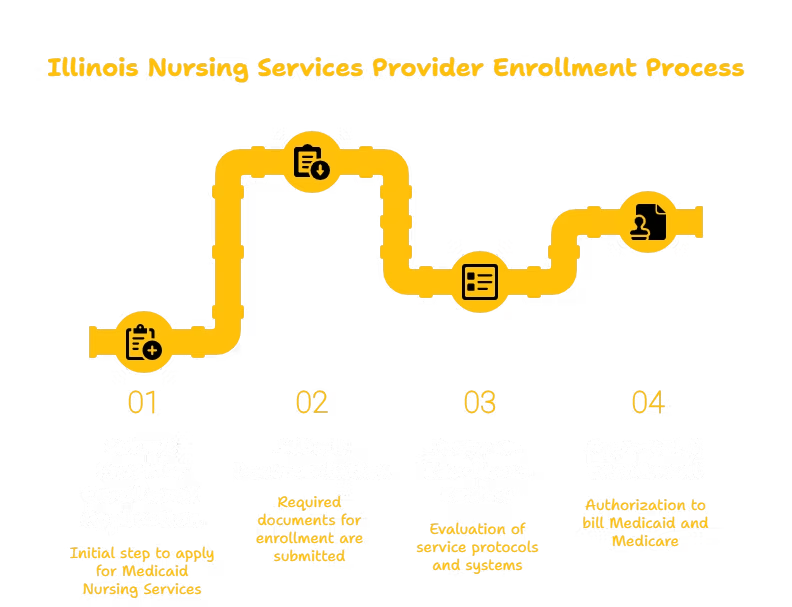
The enrollment process is a sequential journey that moves from initial application to rigorous program readiness review. Providers must be prepared for comprehensive documentation audits and site surveys conducted by the IDPH and HFS, which are designed to verify that the agency has the infrastructure to support safe, compliant care.
The standard progression for new providers includes:
- Application Submission: Submitting the necessary documentation via the IMPACT system for Medicaid-funded services and the PECOS system for Medicare billing.
- Documentation Review: Supplying the agency with proof of incorporation, licensure, insurance, and detailed clinical staffing credentials.
- Readiness Surveys: Participating in evaluations where state surveyors review clinical records systems, nursing protocols, and emergency procedures.
- Authorization: Upon final approval, the provider is granted a Medicaid/Medicare billing number, allowing the agency to bill for authorized services using specific billing codes.
What Are the Staffing and Documentation Standards?
A successful nursing provider agency relies on the quality and oversight of its clinical staff. All personnel, including Registered Nurses (RNs) and Licensed Practical Nurses (LPNs), must maintain active state licensure, participate in ongoing competency training, and undergo rigorous background checks to ensure participant safety.
Key requirements for staff and internal documentation include:
- Clinical Oversight: The appointment of a Nursing Services Administrator or Clinical Supervisor who holds an active Illinois RN license and possesses relevant clinical supervision experience.
- Continuous Training: Mandating that all staff complete training in HIPAA compliance, infection control, abuse prevention, and emergency preparedness.
- Record Keeping: Maintaining a detailed Nursing Services Policy & Procedure Manual that covers intake, physician order management, medication administration, and audit-readiness documentation.
Frequently Asked Questions
What is the timeline to launch a nursing service provider in Illinois?
The process generally takes between 10 and 17 months. This includes 2–4 months for business formation, 3–5 months for staff hiring and policy development, 3–6 months for licensure and enrollment, and 30–60 days for system setup.
Are nursing services covered under both State Plan and Waiver programs?
Yes, services are reimbursed through the Illinois Medicaid State Plan as well as several specific waivers, including the Adults with Developmental Disabilities Waiver, the Persons with Brain Injury (BI) Waiver, and the Persons with Disabilities (PD) Waiver.
What specific roles are required to operate as an agency?
Agencies must employ an RN as the Clinical Supervisor. Depending on the needs of the participants, the agency will staff RNs for complex care and LPNs to perform tasks under the supervision of the RN.
Key Takeaway
Launching a Nursing Services agency in Illinois requires strict adherence to IDPH and HFS regulatory standards, a commitment to clinical excellence, and the development of robust, audit-ready operational systems. By focusing on physician-ordered care and comprehensive staffing compliance, providers can successfully secure their place within the Illinois Medicaid and Medicare network to support vulnerable populations in the community.
Last verified: October 2023. Disclaimer: This information is for educational purposes and does not constitute legal or professional advice. Always consult with the Illinois Department of Healthcare and Family Services (HFS) and the Illinois Department of Public Health (IDPH) for the most current regulatory updates and individual program requirements.