NURSING SERVICES PROVIDER IN COLORADO
By Fatumata Kaba · 2025-07-06 · 5 min read
DELIVERING SKILLED, INDIVIDUALIZED HEALTHCARE TO MEDICAID MEMBERS IN HOME AND COMMUNITY SETTINGS
Providing nursing services in Colorado involves delivering essential medical care, health assessments, and treatment oversight to Medicaid members living with chronic illnesses or disabilities. By becoming an authorized provider, agencies enable vulnerable populations to receive high-quality clinical support within their own homes, supported by Colorado Medicaid and various Home and Community-Based Services (HCBS) waivers.
What are the regulatory requirements for Colorado nursing service providers?
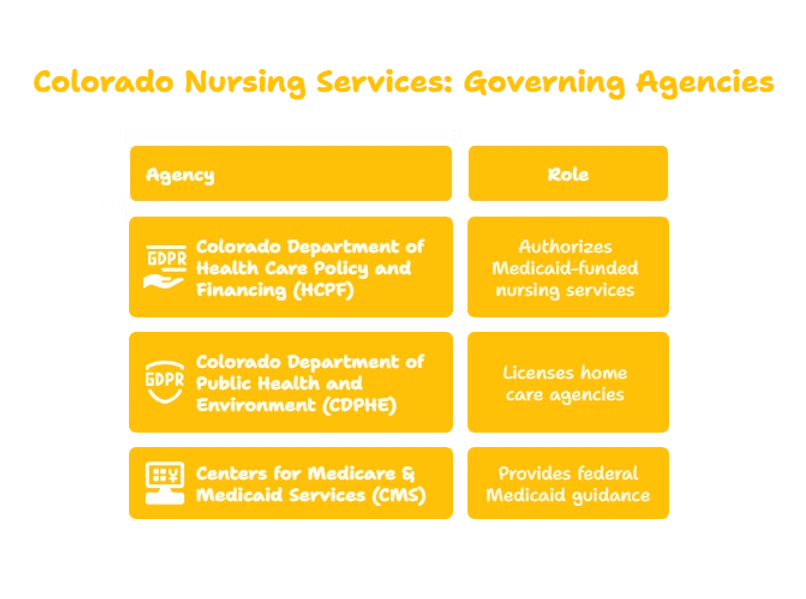
To operate as a nursing services provider in Colorado, an organization must navigate a dual-layer regulatory framework involving state licensure and federal Medicaid compliance. The Colorado Department of Public Health and Environment (CDPHE) serves as the primary regulatory body for licensing health facilities, specifically requiring a Class A Home Care Agency license for any entity providing skilled medical services, including nursing. This license ensures that the agency maintains the necessary infrastructure to deliver safe, clinical care.
Simultaneously, the Colorado Department of Health Care Policy and Financing (HCPF) manages the authorization and reimbursement process for Medicaid-funded services. Providers must demonstrate alignment with federal guidance issued by the Centers for Medicare & Medicaid Services (CMS). Compliance necessitates that all services are ordered by a physician and integrated into the participant’s individualized care plan, ensuring that the care delivered meets both the medical needs of the client and the financial requirements of the waiver program.
- CDPHE: Enforces Class A and Class B home care agency licensure and clinical standards.
- HCPF: Authorizes Medicaid reimbursement and manages waiver program eligibility.
- CMS: Provides the overarching federal compliance framework for all Medicaid HCBS operations.
How do you achieve clinical licensure and Medicaid enrollment?
The path to becoming an approved provider begins with establishing the legal business structure, including registration with the Colorado Secretary of State and obtaining an EIN from the IRS and a Type 2 NPI. Once the legal foundation is set, the agency must apply for a Class A Home Care Agency license through the CDPHE. This phase is rigorous, requiring the submission of comprehensive clinical supervision plans, internal safety protocols, and successfully passing a facility inspection to ensure that the agency is prepared to manage skilled medical tasks.
After securing licensure, the agency must proceed to Medicaid enrollment via the Gainwell Technologies Medicaid Provider Portal. This stage requires uploading valid licensure documentation, confirming NPI details, and providing proof of adequate staffing. Following enrollment, success depends on networking with Case Management Agencies (CMAs) and local hospitals, which are the primary sources of referrals for HCBS members requiring skilled nursing care.
What constitutes the essential service delivery model?
Nursing services are designed to support waiver participants through continuous health monitoring and clinical intervention. A qualified provider is responsible for delivering direct skilled nursing, which may include wound care, complex medication administration, catheter care, and the management of chronic conditions such as diabetes or respiratory issues. These interventions must be documented meticulously to reflect the clinical outcomes and the necessity of care as defined by the participant's physician.
Beyond direct care, the nursing service model emphasizes education and supervision. Providers are tasked with educating participants and their families on disease management and health safety. Additionally, if the agency utilizes non-licensed support staff, the nursing staff must provide appropriate delegation and clinical oversight to ensure that non-medical care remains safe and effective for the participant. Consistent documentation of these nursing interventions is not only a clinical necessity but a prerequisite for successful reimbursement.
- Skilled nursing visits for acute and chronic health needs.
- Medication setup, administration, and ongoing safety monitoring.
- Health assessments and recurring clinical reassessments.
- Delegation and oversight of support staff performing health-related tasks.
- Comprehensive documentation of nursing interventions and patient outcomes.
What are the specific staffing and competency requirements?
The quality of nursing services is dictated by the qualifications and training of the staff. A Class A agency must employ licensed Registered Nurses (RNs) and Licensed Practical Nurses (LPNs). The RNs typically handle the assessment and care planning, while LPNs operate under RN supervision to carry out specific treatments as outlined in the individualized care plan. Every nurse must hold an active Colorado license and undergo mandatory background checks, CPR certification, and health screenings like TB clearance.
Clinical supervision is a non-negotiable requirement for Class A agencies. A designated clinical supervisor, who must be a Colorado-licensed RN with documented supervisory experience, is responsible for the oversight of clinical documentation, staff training, and the overall quality of care delivered by the nursing team. All staff members must participate in ongoing training programs covering HIPAA compliance, abuse reporting, infection control, and emergency response to ensure the agency remains in good standing.
Frequently Asked Questions
What is the difference between Class A and Class B licensure in Colorado?
A Class A license is strictly for home care agencies that provide skilled medical services, including nursing. A Class B license is reserved for agencies that provide non-medical services only and does not authorize the delivery of skilled nursing care.
Which Medicaid waivers cover nursing services?
Nursing services are covered under several programs, including the HCBS-EBD (Elderly, Blind, and Disabled) waiver, the HCBS-BI (Brain Injury) waiver, and various Children’s HCBS waivers like the CHCBS and CLLI programs. Skilled nursing may also be accessed through State Plan Home Health if prescribed independently of a waiver.
How long does the provider setup process take?
The timeline varies based on the agency's readiness. Business formation usually takes 1–2 weeks, while CDPHE Class A licensure typically spans 60–90 days. Medicaid enrollment via the portal generally requires an additional 30–60 days, with staff onboarding occurring concurrently.
Summary of Required Documentation and Compliance
Operating a nursing services provider requires a centralized, secure system for managing administrative and clinical records. Agencies must maintain a robust policy and procedure manual that covers intake processes, physician order verification, and care planning. Additionally, the agency must have established protocols for incident reporting, infection control, and emergency procedures. Because these services involve sensitive health data, the agency must also implement strict HIPAA compliance measures, ensuring that all client consents, treatment logs, and staff credentials are current and audit-ready.
Key Takeaway: Successful operation as a Colorado Medicaid nursing provider relies on maintaining a high standard of clinical documentation, strictly adhering to Class A licensure requirements through the CDPHE, and ensuring seamless coordination with CMAs and HCPF-managed systems to provide consistent care for waiver participants.
Last verified: May 2024. This article is provided for informational purposes only and does not constitute legal or professional consulting advice. Requirements for Medicaid provider enrollment and home care licensure in Colorado are subject to change; please verify all information directly with the Colorado Department of Health Care Policy and Financing (HCPF) and the Colorado Department of Public Health and Environment (CDPHE).