NURSING FACILITY TRANSITION SERVICES PROVIDER IN SOUTH CAROLINA
By Fatumata Kaba · 2025-10-13 · 5 min read
Nursing Facility Transition Services (NFTS) in South Carolina empower Medicaid recipients to successfully move from institutional settings back into their own homes or community-based living arrangements. By leveraging South Carolina’s Home and Community-Based Services (HCBS) waivers and the Money Follows the Person (MFP) initiative, provider agencies play a critical role in reducing institutional reliance while fostering independence, dignity, and self-directed care for some of the state’s most vulnerable populations.
Understanding the Role of Nursing Facility Transition Services
Transition services are designed to bridge the significant gap between institutionalized care and independent living. The process is not merely about finding a physical space; it is a comprehensive, person-centered approach that involves clinical coordination, housing search assistance, and social service navigation. Providers act as the primary bridge, ensuring that the transition is safe, sustainable, and aligned with the participant's long-term health goals.
When an individual expresses a desire to return to the community, the provider works directly with case managers from the South Carolina Department of Health and Human Services (SCDHHS) or the Department of Disabilities and Special Needs (DDSN). The primary objective is to evaluate the participant's readiness, identify potential environmental barriers, and secure the necessary support systems—such as personal care aides or durable medical equipment—before the official discharge date occurs.
Navigating the Governance and Funding Landscape
Success in this sector requires a thorough understanding of the interagency relationships that govern Medicaid funding in South Carolina. The South Carolina Department of Health and Human Services (SCDHHS) acts as the state’s primary authority, overseeing waiver administration, funding allocations, and provider enrollment standards. For participants with Intellectual and Developmental Disabilities (IDD), the South Carolina Department of Disabilities and Special Needs (DDSN) provides additional layers of coordination to ensure specialized care needs are met.
On the federal level, the Centers for Medicare & Medicaid Services (CMS) maintains oversight of the Money Follows the Person (MFP) initiative. This program is instrumental in providing the financial flexibility needed to cover transition-specific costs that may not be standard under regular Medicaid state plan services. Providers must ensure their internal documentation and billing practices remain compliant with both state and federal mandates to avoid audit risks or funding delays.
Core Service Deliverables for Approved Providers
Approved NFTS providers are expected to offer a holistic range of services that extend from the initial planning phase through the first 90 days of community residency. This continuity of care is vital for preventing recidivism, where a participant might otherwise feel forced to return to a nursing facility due to a lack of community support. The provider's scope of work includes the following essential activities:
- Transition Planning & Coordination: Developing a comprehensive discharge strategy.
- Housing Search & Lease Assistance: Helping participants locate accessible, affordable housing.
- Home Setup & Environmental Modification: Ensuring the physical residence meets the participant’s safety and accessibility needs.
- Purchase of Basic Household Goods: Procuring essential items such as beds, cookware, and hygiene products.
- Utility Deposits & Start-Up Fees: Facilitating the logistical costs of establishing a new residence.
- Coordination of In-Home Services: Scheduling transportation, personal care, and other vital support services.
- Follow-Up Support: Providing a 90-day post-discharge safety net to ensure the transition remains stable.
Requirements for Provider Enrollment and Business Compliance
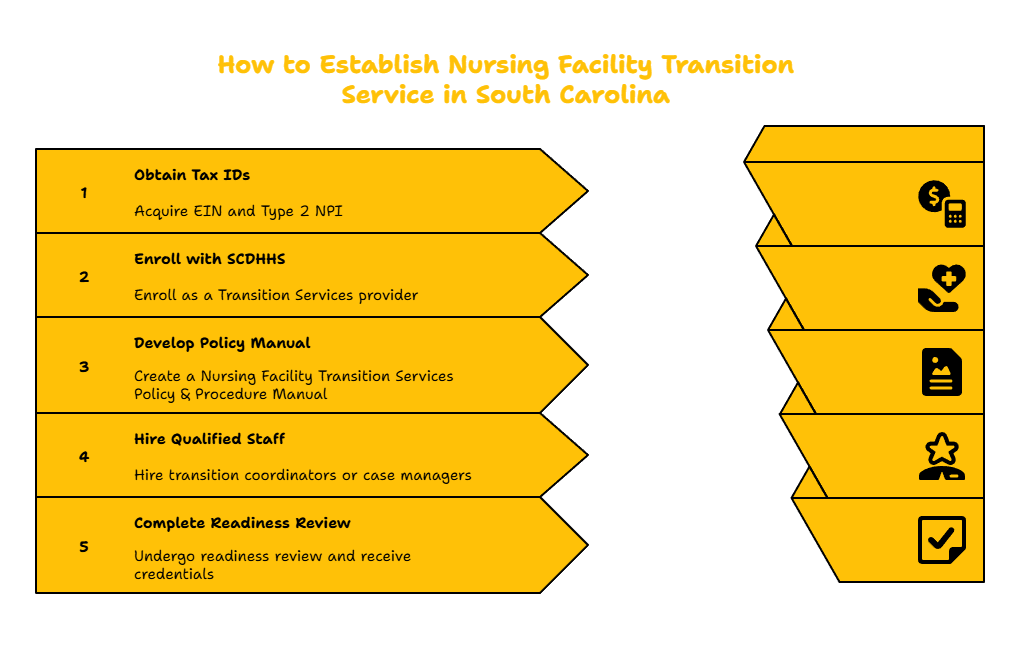
Becoming an authorized provider in South Carolina is a rigorous process that demands high standards of administrative and operational readiness. Before engaging with state agencies, a business must be properly registered with the South Carolina Secretary of State and possess a valid EIN and Type 2 NPI. The enrollment process involves a detailed review of the agency's organizational capacity, including a review of the Nursing Facility Transition Services Policy & Procedure Manual.
Agencies are evaluated not only on their ability to perform the work but on their capacity to document and justify the services provided for Medicaid reimbursement. Maintaining liability insurance, managing vendor relationships for household goods, and ensuring secure record-keeping are foundational responsibilities. The following documentation is typically required for a successful enrollment package:
- Articles of Incorporation and business tax documentation.
- Evidence of provider enrollment confirmation from SCDHHS.
- Verification of appropriate liability insurance coverage.
- A robust Policy & Procedure Manual detailing HIPAA compliance, critical incident reporting, and billing workflows.
Developing Competent Staffing and Internal Procedures
The quality of a transition program is inherently tied to the competence and training of its staff. The primary role within this service is the Transition Coordinator, a professional who must possess a solid foundation in case management, waiver navigation, or housing support. Because these individuals work with high-risk populations, they must clear comprehensive background checks and undergo specialized training in HIPAA, participant rights, and crisis intervention protocols.
Agencies should also consider the role of a Program Supervisor to maintain quality control over documentation and billing accuracy. All staff members, regardless of their role, must participate in ongoing training sessions that cover the nuances of housing barriers and the coordination of Medicaid benefits. Providing staff with clear, standardized templates for transition plans and purchase logs is essential for maintaining compliance across the entire organization.
Frequently Asked Questions
How long does the provider enrollment process take?
The timeline varies based on the agency's readiness. Business setup and manual development typically take 1–2 months, while the Medicaid enrollment and provider training phases generally require an additional 2–3 months. Thorough preparation of all required documentation before submission is the best way to avoid delays.
What happens during the 90-day follow-up period?
The 90-day follow-up is a critical period for stabilizing the participant in their new environment. During this time, the transition coordinator monitors the effectiveness of the home setup, ensures that all scheduled in-home services are being delivered, and addresses any emerging issues before they escalate into crises that could jeopardize the individual's community placement.
Which Medicaid waiver programs cover these transition services?
Transition services are primarily authorized through the Community Long Term Care (CLTC) program and the Money Follows the Person (MFP) initiative. Additionally, participants within the ID/RD Waiver, HASCI Waiver, and Community Supports Waiver may be eligible for transition coordination depending on their specific assessed needs and the requirements of their respective waiver programs.
Key Takeaways for Prospective Providers
Establishing a Nursing Facility Transition Service provider agency in South Carolina requires a strategic blend of logistical precision, regulatory compliance, and a genuine commitment to person-centered care. By strictly adhering to the standards set forth by SCDHHS and CMS, providers can ensure they remain eligible for state funding while successfully guiding Medicaid recipients toward meaningful, independent living. Investing in comprehensive policy manuals, rigorous staff training, and efficient administrative systems is the most effective way to ensure long-term sustainability as a provider.
Last verified: November 2024. This information is provided for educational purposes only and does not constitute legal or professional advice. Always consult with the South Carolina Department of Health and Human Services or appropriate legal counsel to confirm current program requirements and state-specific regulations.