NURSING FACILITY TRANSITION SERVICES PROVIDER IN OREGON
By Fatumata Kaba · 2025-10-06 · 6 min read
Nursing Facility Transition (NFT) Services in Oregon are specialized Medicaid-funded supports designed to empower individuals currently residing in nursing homes or institutional settings to return to community-based living. By providing comprehensive care planning, housing navigation, and essential transition supplies, these services enable beneficiaries to exercise dignity and choice in their living arrangements while receiving the necessary support to maintain long-term stability.
What Are the Core Functions of a Nursing Facility Transition Provider?
An approved Nursing Facility Transition provider serves as a vital bridge between institutional care and independent community living. Providers work in close collaboration with facility discharge planners, state case managers, and the individual’s support network to ensure a seamless transition that prioritizes the health and safety of the participant. The primary goal is to mitigate the risks associated with moving from a controlled institutional environment to an autonomous setting.
Providers are responsible for managing the logistical and administrative complexities of the move. This includes identifying safe, accessible, and affordable housing, navigating complex application processes, and coordinating the setup of utilities and community-based services. By offering consistent follow-up monitoring, providers ensure that the individual remains successfully integrated into their new environment, preventing re-institutionalization and fostering long-term success.
- Transition Planning & Coordination: Collaborating with facilities and case managers to develop a step-by-step discharge and support plan.
- Housing Search & Setup: Identifying appropriate housing options, assisting with applications, and arranging utilities.
- One-Time Transition Supports: Purchasing basic furnishings, appliances, and supplies to establish a new home.
- Caregiver Training & Family Support: Educating caregivers on service needs, medication management, and safety.
- Linkage to HCBS Services: Referring to providers for personal care, homemaker services, nursing, or behavioral supports.
- Follow-Up Monitoring: Checking in post-transition to ensure stability and service access.
- Documentation: Service plans, purchase logs, visit notes, and Medicaid billing records.
Which Agencies Govern Nursing Facility Transition in Oregon?
The delivery of NFT services in Oregon is governed by a multi-tiered regulatory framework. The Oregon Department of Human Services (ODHS), specifically the Aging and People with Disabilities (APD) division, acts as the primary authority. They are responsible for overseeing the transition planning process, approving funding for specific support needs, and coordinating with local offices to ensure that service delivery aligns with the needs of the beneficiary.
At the state and federal level, the Oregon Health Authority (OHA) manages the administration of the Oregon Health Plan (OHP), overseeing provider enrollment, quality assurance, and compliance with Medicaid standards. Meanwhile, the Centers for Medicare & Medicaid Services (CMS) provides the overarching federal framework, ensuring that Oregon’s programs, including the Money Follows the Person (MFP) initiative, adhere to national HCBS rules and quality benchmarks. Additionally, all businesses must maintain compliance with state regulations as overseen by the Oregon Secretary of State.
What Are the Essential Requirements for Provider Enrollment?
Prospective providers must meet a series of administrative and operational requirements before they can begin billing for transition services. Initial steps include the formal registration of the business entity with the Oregon Secretary of State, obtaining an Employer Identification Number (EIN) from the IRS, and securing a Type 2 National Provider Identifier (NPI). These foundational documents are necessary for all subsequent state and federal applications.
Once the business is legally established, the provider must enroll as a Medicaid provider through the OHA Provider Portal and apply for specific approval as a transition service provider through ODHS/APD. Operational requirements also include securing appropriate general liability and workers’ compensation insurance. Furthermore, every provider must develop and maintain a robust Nursing Facility Transition Policy & Procedure Manual that codifies how the agency will handle the various complexities of the transition process according to state-defined standards.
- Register your business with the Oregon Secretary of State.
- Obtain an EIN from the IRS and a Type 2 NPI.
- Enroll as a Medicaid provider through the OHA Provider Portal.
- Apply for approval as a transition service provider through ODHS/APD.
- Carry general liability and workers’ compensation insurance.
- Develop a Nursing Facility Transition Policy & Procedure Manual based on state transition standards.
How Do Agencies Structure Staffing and Documentation?
The success of a transition program relies on qualified personnel who understand both the clinical and social aspects of community integration. Key roles include the Transition Coordinator or Case Manager, who is responsible for the actual facilitation of the move, and the Program Supervisor, who oversees service quality and manages agency-level compliance. Support aides may also be utilized for manual tasks such as home setup, shopping for essential household goods, and preparing living spaces for the individual's arrival.
Documentation is a critical component of program integrity. Providers are expected to maintain comprehensive records, including service plans, incident reports, purchase logs for one-time transition supports, and follow-up visit logs. All staff members must undergo rigorous training, including HIPAA compliance, abuse prevention, incident reporting protocols, and Medicaid-specific documentation training. Regular performance reviews and continuing education ensure that staff remain equipped to provide high-quality, person-centered support in a dynamic environment.
Which Medicaid Waiver Programs Support Transition Services?
Nursing Facility Transition services are facilitated through several key funding streams designed to provide flexibility for the individual. The K Plan (1915(k)) is a primary vehicle, covering transition planning and the costs associated with establishing a new home. Similarly, APD Waivers serve seniors and adults with physical disabilities, while IDD Waivers, including both Comprehensive and Support Services, specifically address the needs of individuals with intellectual or developmental disabilities moving out of institutional or foster care settings.
The Money Follows the Person (MFP) program serves as a critical initiative for individuals who have resided in a facility for at least 60 days, providing additional support to help them successfully re-enter the community. Beyond these specific waivers, general State Plan Medicaid may provide limited coverage for essential transition coordination services. Understanding which waiver is applicable to a specific participant is essential for accurate billing and service provision.
Frequently Asked Questions
What is the typical timeline to launch a transition services agency?
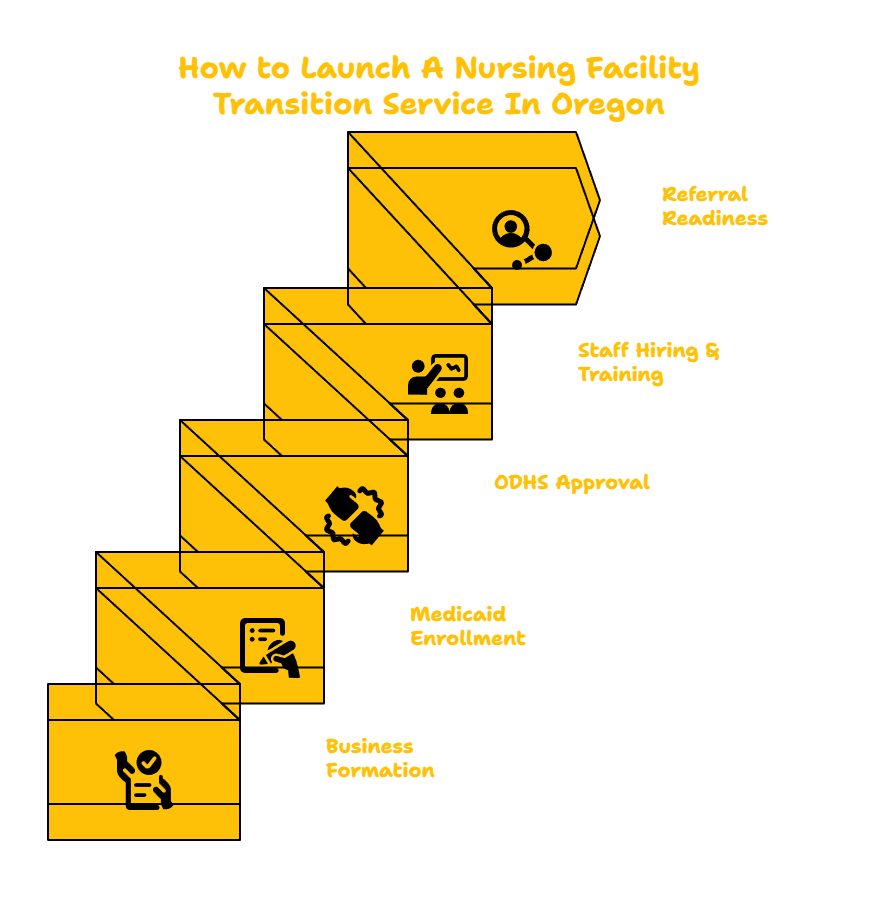
Launching a transition agency involves several phases: business formation and manual preparation typically take 1–2 months, followed by Medicaid enrollment and ODHS approval, which can take 2–3 months. Staff hiring and training usually require 30–60 days, with actual service delivery beginning once referral relationships and housing contacts are firmly established.
What must be included in the Policy & Procedure Manual?
The manual must comprehensively cover discharge and housing planning workflows, emergency preparedness protocols, service delivery documentation guidelines, staff training policies, and participant rights. It must also include specific templates for item purchase logs, transition tracking forms, and billing procedures to ensure consistent quality and compliance.
What types of supports are considered one-time transition expenses?
These are the costs associated with establishing a new home in the community, which may include the purchase of basic household furniture, essential appliances, cleaning supplies, and other goods necessary for health and safety upon move-in. These costs are defined under the specific rules of the applicable Medicaid waiver or program.
Key Takeaway
Successfully operating as a Nursing Facility Transition provider in Oregon requires a rigorous commitment to documentation, regulatory compliance, and person-centered coordination. By aligning business operations with the guidelines established by ODHS, OHA, and CMS, providers can ensure the sustainability of their programs while providing essential services that enable individuals to transition safely from institutional settings to community living.
Last verified: October 2023. Disclaimer: This information is for educational purposes only and does not constitute legal or professional consulting advice. Requirements for Medicaid providers are subject to change. Please consult official Oregon Department of Human Services (ODHS) and Oregon Health Authority (OHA) guidelines for the most current regulations and program specifications.