NURSING FACILITY TRANSITION SERVICES PROVIDER IN LOUISIANA
By Fatumata Kaba · 2025-08-12 · 5 min read
Nursing Facility Transition Services in Louisiana are specialized supports designed to facilitate the successful relocation of eligible Medicaid participants from institutional settings, such as nursing homes, into integrated community-based residences. These services, which align with federal Money Follows the Person (MFP) initiatives and various Home and Community-Based Services (HCBS) waivers, provide the critical coordination and logistical assistance necessary to ensure a safe, sustainable, and person-centered transition to the least restrictive environment possible.
What Are the Governing Agencies and Regulatory Frameworks?
The provision of Nursing Facility Transition Services is subject to rigorous oversight by state and federal entities to ensure participant safety and the appropriate use of Medicaid funding. In Louisiana, the Department for Medicaid Services (DMS) serves as the primary governing body responsible for defining eligibility, managing waiver enrollment, and authorizing the financial frameworks that support transition initiatives. Their role is to ensure that transition providers comply with the stringent requirements set forth for Medicaid-funded home and community-based services.
Parallel to the DMS, the Louisiana Department for Aging and Independent Living (DAIL) provides essential oversight by monitoring daily transition activities and protecting participant rights throughout the relocation process. Meanwhile, Managed Care Organizations (MCOs) act as the operational point of contact for providers, managing service authorizations, processing reimbursements, and tracking long-term outcomes. At the federal level, the Centers for Medicare & Medicaid Services (CMS) maintains the broader administrative infrastructure for the Money Follows the Person program and ensures state-level compliance with federal standards.
How Do Providers Facilitate the Transition Process?
Nursing Facility Transition Services are inherently person-centered, focusing on the unique needs, preferences, and clinical requirements of the individual. The process begins with comprehensive transition planning and readiness assessments to identify the individual's specific goals and potential barriers to community living. Providers must work closely with facility discharge teams, family members, and assigned case managers to ensure that no critical aspect of the participant's care is overlooked during the move.
Key responsibilities for the transition provider include the development of a Person-Centered Service Plan (PCSP) that outlines post-transition care needs. Providers are also tasked with identifying accessible housing options, arranging necessary home modifications, and coordinating the logistics of the move. Once the individual has relocated, the provider’s role shifts toward short-term follow-up to ensure that the individual remains stable, safe, and integrated into their new community environment.
- Transition planning and rigorous readiness assessments.
- Collaborative coordination with case managers and facility staff.
- Housing identification and logistical move support.
- Development and oversight of the Person-Centered Service Plan (PCSP).
- Ongoing stabilization and safety monitoring post-move.
What Are the Licensing and Enrollment Requirements for New Providers?
Becoming an approved provider for Nursing Facility Transition Services requires a structured approach to business registration and regulatory compliance. Initially, the business must be properly registered with the Louisiana Secretary of State and secure all necessary legal identifiers, including an IRS EIN and a Type 2 NPI. Prospective providers must then engage with the Medicaid Partner Portal Application (MPPA) to initiate the formal enrollment process, which includes verifying the capability to provide services within specific geographic areas and targeted populations.
Beyond the initial enrollment, providers must establish a robust internal administrative infrastructure. This includes obtaining comprehensive liability and workers’ compensation insurance, as well as the development of a formal Nursing Facility Transition Policy & Procedure Manual. This manual must explicitly outline how the organization will manage participant intake, conduct housing readiness assessments, maintain HIPAA-compliant documentation, and respond to critical incidents. Only after successfully navigating the MCO credentialing process and demonstrating adherence to these operational standards can a provider begin accepting participant referrals.
Which Staffing Roles and Qualifications Are Mandatory?
The quality of transition services relies heavily on the expertise and professional background of the staff. Transition Coordinators or Community Integration Specialists serve as the primary point of contact for participants and must demonstrate significant experience in case management, housing navigation, or disability support services. It is highly recommended that these staff members have reliable transportation to facilitate the movement of individuals and the management of their transition tasks.
All personnel must undergo standardized training to ensure high-quality care and legal compliance. This includes mandatory education on HIPAA and participant confidentiality, person-centered planning principles, and protocols for preventing abuse, neglect, and exploitation. Furthermore, staff should be trained in emergency response and the specific nuances of community-based long-term services and supports (LTSS). As the field evolves, ongoing professional development is essential to keep staff updated on best practices for supporting individuals with complex needs in the community.
Frequently Asked Questions
What is the role of the Managed Care Organization (MCO) in this process?
The MCO is responsible for authorizing specific transition services for individual participants, coordinating provider reimbursement, and monitoring the quality and success of the transition through outcome tracking.
How long does the provider enrollment process typically take?
While timelines vary based on completeness of submissions, the overall process from business registration through MCO credentialing generally takes between three to six months to reach full operational status.
What specific documentation is required for the Nursing Facility Transition Policy & Procedure Manual?
The manual must contain detailed participant intake procedures, housing readiness assessment tools, transition timelines, service tracking logs, coordination forms for external partners, and established protocols for billing, HIPAA compliance, and critical incident reporting.
How Can Providers Effectively Launch Their Operations?
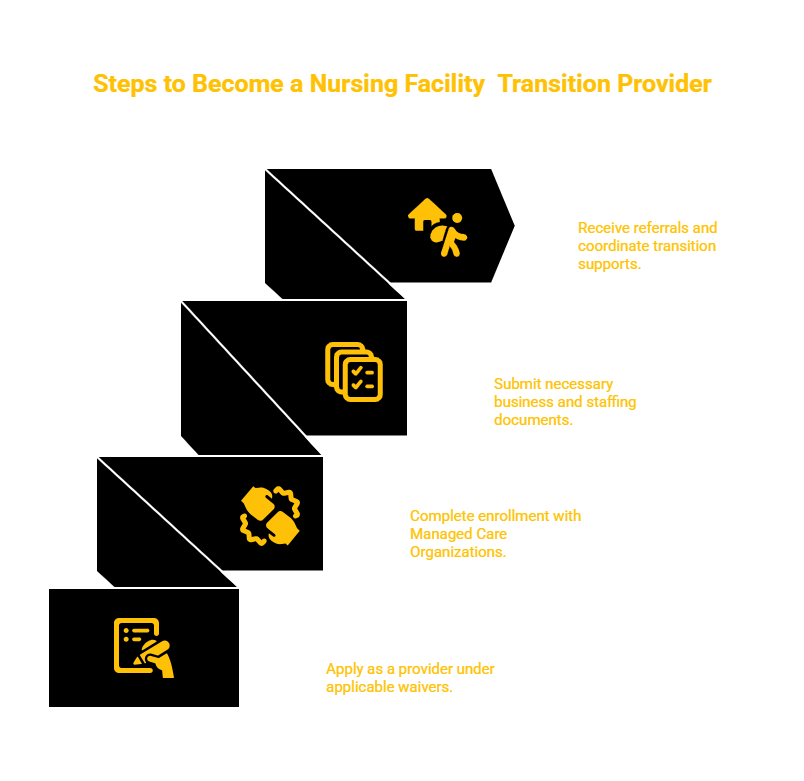
The path to becoming an active provider involves a sequential commitment to administrative rigor and regulatory alignment. The initial phase focuses on core business foundations, including legal registration and the drafting of comprehensive operational manuals. Following this, the focus shifts to the MPPA enrollment and MCO credentialing, which serves as the gateway to receiving authorized referrals from Medicaid waivers such as the Supports for Community Living (SCL), Michelle P. Waiver (MPW), and the Acquired Brain Injury (ABI) waivers.
Successful providers integrate their services into the existing continuum of care by establishing strong relationships with local nursing facilities and waiver case management teams. By maintaining accurate service logs, adhering to person-centered planning, and consistently providing documentation of successful community integration, providers fulfill the essential mission of ensuring that long-term care participants have the dignity and independence afforded by community living.
Key takeaway: Establishing a Nursing Facility Transition agency in Louisiana requires strict adherence to MPPA enrollment, the development of a comprehensive Policy & Procedure manual, and the cultivation of strong relationships with MCOs and facility discharge teams to successfully facilitate participant movement into the community.
Last verified: October 2023. Disclaimer: This guide is for informational purposes and does not constitute legal or professional medical advice. Always refer to the official Louisiana Department for Medicaid Services and Department for Aging and Independent Living websites for the most current regulations and program requirements.