NURSING FACILITY TRANSITION SERVICES PROVIDER IN ARKANSAS
By Fatumata Kaba · 2025-07-04 · 5 min read
Nursing Facility Transition Services in Arkansas provide a vital pathway for individuals currently residing in institutional settings to successfully reintegrate into home and community-based environments. Through a combination of person-centered planning, housing navigation, and essential logistical support, these services uphold the principles of the Money Follows the Person initiative and federal Olmstead compliance, ensuring that participants receive the necessary supports to live as independently as possible.
What Are the Governing Bodies Behind Arkansas Nursing Facility Transitions?
The successful delivery of transition services requires strict adherence to both state and federal oversight. In Arkansas, the primary agency responsible for the oversight and administration of these services is the Department of Human Services (DHS), specifically the Division of Developmental Disabilities Services (DDS). The DDS authorizes transition services under the Community and Employment Supports (CES) Waiver and is responsible for assigning case coordination to ensure that each participant’s move is well-managed.
Complementing this, the Division of Medical Services (DMS) manages the fiscal aspect, overseeing Medicaid reimbursement processes for all transition-related expenses. On a national level, the Centers for Medicare & Medicaid Services (CMS) provides essential federal oversight. CMS ensures that all institutional transitions adhere to the federal Home and Community-Based Services (HCBS) Final Rule, which mandates that individuals are integrated into the community and have full access to the benefits of community living.
How Do Nursing Facility Transition Services Support Community Reintegration?
Transition services are designed to bridge the gap between institutional care and independent living. The process begins with a comprehensive readiness assessment to determine the individual’s needs, preferences, and ability to thrive in a community setting. Transition coordinators work closely with the participant to build a care team, align necessary supports, and develop a personalized plan that accounts for housing, healthcare, and daily living requirements.
Providers are responsible for a wide range of logistical tasks that make a move sustainable. This includes identifying appropriate housing, securing essential household items, managing utility deposits, and providing direct assistance during the actual move-in process. Following the relocation, providers continue to offer follow-up monitoring to ensure that the individual is successfully adapting to their new environment and that all services are being delivered as outlined in the individual’s approved ISP.
- Transition planning and individualized readiness assessments
- Home setup coordination and procurement of essential furniture and household goods
- Payment facilitation for utility deposits and initial household expenses
- Care team coordination to ensure medical and social services are active upon move-in
- Transportation and on-site move-in assistance
- Ongoing post-transition monitoring and meticulous documentation of outcomes
What Are the Essential Requirements for Provider Enrollment?
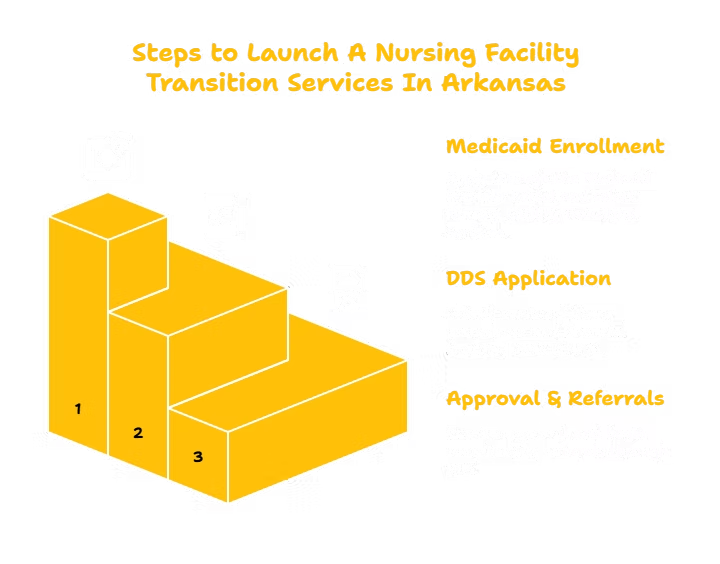
To become a recognized provider of Nursing Facility Transition Services in Arkansas, organizations must navigate a rigorous multi-step enrollment process. Initially, businesses must be legally formed and registered with the Arkansas Secretary of State, maintaining a valid Employer Identification Number (EIN) from the IRS and a Type 2 National Provider Identifier (NPI). These foundational requirements verify the legal legitimacy of the entity.
Following business registration, potential providers must apply for enrollment as a Medicaid provider through the official Arkansas Medicaid Provider Portal. This stage requires the submission of banking information for electronic fund transfers (EFT) and W-9 documentation. Simultaneously, providers must submit a CES Waiver Provider Application to the DDS, which includes detailed service delivery procedures, financial tracking mechanisms, and evidence of organizational capacity to manage public funds and participant consent.
- Submission of legal business documentation (Articles of Incorporation, licenses)
- Obtainment of IRS EIN and NPI (Type 2)
- Medicaid provider enrollment through the state portal
- Submission of comprehensive service delivery policies to the DDS
- Proof of adequate liability insurance coverage
How Should Providers Structure Staffing and Documentation Protocols?
Success in this field relies on a robust administrative structure. Transition Coordinators or Program Supervisors must possess documented experience in case management, housing coordination, or similar HCBS waiver services to effectively lead the transition process. Direct support staff or logistics coordinators must hold a high school diploma or GED, pass mandatory background checks, and maintain registry clearance to work with vulnerable populations.
Documentation is a critical component of regulatory compliance. Providers must maintain a comprehensive policy and procedure manual that covers everything from housing navigation protocols and financial tracking logs to emergency planning and incident reporting. All staff members are required to undergo specific training, including person-centered planning, HIPAA compliance, ethics, and the safe execution of relocation procedures, with annual refreshers to remain updated on state and federal mandates.
Frequently Asked Questions
What is the timeline for launching a transition service program?
The total duration for launching can vary, but generally involves 1–2 weeks for business formation, 45–90 days for Medicaid and waiver enrollment, 30–45 days for hiring and planning, and an additional 2–4 weeks to activate referrals and initiate transition support.
Which specific waivers cover these services?
Nursing Facility Transition Services are primarily authorized under the Community and Employment Supports (CES) Waiver, the ARChoices in Homecare Waiver for non-developmentally disabled populations, and the Money Follows the Person (MFP) program.
What documentation is required during the provider application?
Applicants must provide their business license, EIN, NPI, Medicaid provider approval, and a detailed policy manual including transition templates, housing protocols, financial logs, emergency procedures, and staff training/supervision logs.
Key Takeaways for Provider Success
Launching a Nursing Facility Transition Service requires a focus on rigorous compliance and person-centered service delivery. By maintaining organized financial logs, fostering strong relationships with DDS case coordinators, and ensuring all staff are trained in the complexities of community reintegration, providers can establish a sustainable and impactful presence in the Arkansas HCBS market. Success is measured not only by the number of transitions completed but by the long-term stability and independence of the individuals served.
Waiver Consulting Group provides specialized start-up assistance for organizations aiming to enter the Arkansas market. Our support includes business registration, Medicaid enrollment guidance, the development of comprehensive policy and procedure manuals, staff training documentation, and the creation of essential templates for intake, financial tracking, and transition planning.
Last verified: October 2023. This information is provided for educational purposes and is not legal or professional advice. Requirements for Medicaid and HCBS waiver programs are subject to change. Always consult with the Arkansas Department of Human Services or the appropriate state governing body before making business decisions.